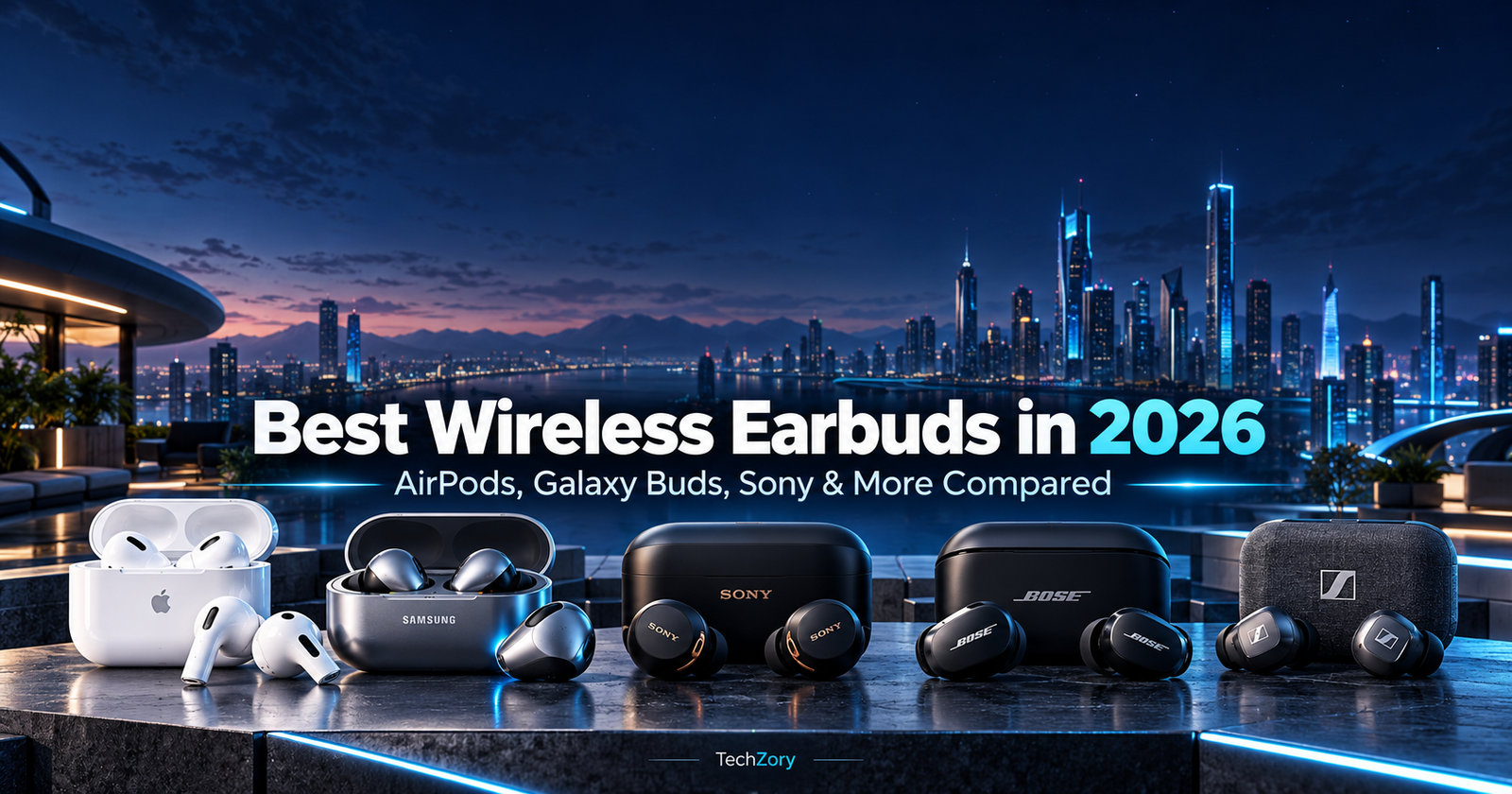
Wireless earbuds have become one of the most competitive categories in consumer technology.
In 2026, premium earbuds are no longer judged only by sound quality. Buyers now expect effective active noise cancellation, clear microphones, long battery life, comfortable fit, spatial audio, multipoint connectivity, high-resolution Bluetooth codecs, smart assistants, and increasingly advanced health and AI features.
The challenge is that no single pair is ideal for everyone.
An iPhone owner may benefit most from deep Apple ecosystem integration.
A Galaxy user may prefer Samsung’s seamless device switching and high-quality proprietary codecs.
Frequent travelers may prioritize noise cancellation.
Athletes may care more about secure fit and sweat resistance.
Audio enthusiasts may focus on driver design, codec support, and tuning.
This guide compares 10 of the best wireless earbuds in 2026 across different use cases rather than ranking every model from best to worst.
Table of Contents
Best Wireless Earbuds in 2026: Quick Overview
| Earbuds | Main Strength | Best Fit |
|---|---|---|
| Apple AirPods Pro 3 | Apple integration, ANC and smart features | iPhone users |
| Sony WF-1000XM6 | Balanced premium performance | Music, travel and everyday use |
| Samsung Galaxy Buds4 Pro | Galaxy ecosystem and adaptive audio | Samsung Galaxy users |
| Bose QuietComfort Ultra Earbuds (2nd Gen) | Noise cancellation and comfort | Travelers and commuters |
| Technics EAH-AZ100 | Sound quality and multipoint | Audio enthusiasts |
| Google Pixel Buds Pro 2 | Android and Pixel integration | Pixel and Android users |
| Sennheiser MOMENTUM True Wireless 4 | Codec support and detailed sound | Audiophile-oriented users |
| Nothing Ear (3) | Design, LDAC and call features | Style-conscious Android users |
| Powerbeats Pro 2 | Secure sports fit and heart-rate monitoring | Fitness and workouts |
| Apple AirPods 5 | Open-ear comfort and ANC | Users who dislike silicone tips |
1. Apple AirPods Pro 3 — Premium Earbuds for the Apple Ecosystem
AirPods Pro 3 remain Apple’s premium in-ear wireless earbuds in 2026.
Apple redesigned the fit, improved active noise cancellation, added heart-rate sensing for workouts, and extended battery life.
Apple states that AirPods Pro 3 can deliver up to eight hours of listening with Active Noise Cancellation enabled.
The earbuds also support Adaptive Audio, Transparency mode, Personalized Spatial Audio, Voice Isolation, and Live Translation where supported.
Heart-rate sensing is particularly interesting because it allows the earbuds to contribute workout information without requiring a separate chest strap.
AirPods Pro 3 also integrate closely with Apple’s Find My network and other Apple devices.
The biggest reason to choose them is not any individual specification.
It is the way the hardware and software work together across iPhone, iPad, Mac, Apple Watch, and Apple TV.
Their limitations are equally clear.
Android users lose much of that ecosystem advantage, and several hearing and intelligence features vary by region and device support.
Best fit: iPhone users who want premium ANC, strong ecosystem integration, spatial audio, and workout features.
2. Sony WF-1000XM6 — Balanced Premium Wireless Earbuds
Sony’s WF-1000XM6 continues the company’s premium 1000X true-wireless line.
The earbuds support active noise cancellation, Ambient Sound mode, multipoint connectivity, and Sony’s LDAC codec for higher-bitrate Bluetooth audio on compatible devices.
Sony lists battery life of up to eight hours with noise cancellation enabled and up to 12 hours with noise cancellation disabled.
Wireless charging is supported through the charging case.
The WF-1000XM6 also supports SBC, AAC, LDAC, and LC3 codecs.
That broad codec support makes the Sony earbuds particularly flexible across different smartphones and devices.
Sony’s approach is attractive for buyers who do not want to be tied too closely to one phone ecosystem.
They can pair well with Android devices, Windows laptops, and other Bluetooth equipment while still providing advanced audio features.
Best fit: Travelers, music listeners, Android users, and buyers seeking a balanced premium earbud rather than a platform-specific option.
3. Samsung Galaxy Buds4 Pro — Built Around Galaxy Devices
Samsung introduced the Galaxy Buds4 series in February 2026, with the Galaxy Buds4 Pro positioned as the premium model.
The Buds4 Pro use an enhanced two-way speaker design and include adaptive noise cancellation, Adaptive EQ, Ambient Sound, Voice Detect, 360 Audio, and Samsung’s Seamless Codec.
Samsung lists Bluetooth 6.1 and IP57 durability.
Battery life reaches up to six hours of music playback with ANC enabled, or up to 26 hours when including the charging case.
The Buds4 Pro are especially compelling for people already using Galaxy smartphones, tablets, and other Samsung devices.
Features such as Auto Switch, Samsung Find, Samsung codecs, and Galaxy AI integration create a more connected experience within that ecosystem.
Owners of non-Samsung devices can still use the earbuds, but they may not receive the full set of platform-specific features.
Best fit: Samsung Galaxy phone owners who want advanced ANC, adaptive audio, and tight ecosystem integration.
4. Bose QuietComfort Ultra Earbuds (2nd Gen) — Strong Noise Cancellation
Bose has built much of its headphone reputation around noise cancellation, and the QuietComfort Ultra Earbuds (2nd Gen) continue that focus.
The second generation introduced improved adaptive noise cancellation, better voice pickup, and wireless charging.
Bose also provides adjustable noise control through its app.
The earbuds use Bose CustomTune technology to personalize audio and noise cancellation based on the listener’s ears.
Battery life is rated at up to six hours with Immersive Audio disabled and four hours with it enabled.
The case adds additional listening time.
The earbuds are IPX4 rated for water and sweat resistance.
For frequent flights, commuting, or noisy offices, reducing background sound may be more important than having the longest list of ecosystem features.
That is where the Bose approach becomes attractive.
Best fit: Frequent travelers, commuters, office users, and buyers who place noise cancellation near the top of their priorities.
5. Technics EAH-AZ100 — Hi-Fi Focus With Three-Device Multipoint
Technics approaches wireless earbuds from a traditional hi-fi perspective.
The EAH-AZ100 uses 10mm magnetic-fluid drivers designed to reduce distortion while producing detailed highs, mids, and bass.
The earbuds support LDAC high-resolution Bluetooth audio, Dolby Atmos spatial audio with head tracking, adaptive noise cancellation, and Voice Focus AI for clearer calls.
One particularly useful feature is three-device multipoint connectivity.
That means a user can keep the earbuds connected across combinations such as a smartphone, laptop, and tablet without constantly repairing devices.
Technics rates battery life at approximately 10 hours with noise cancellation enabled under standard playback conditions, with approximately 28 hours available when the charging case is included.
Battery life changes when LDAC and other features are active.
Best fit: Listeners who prioritize audio quality, professionals using multiple devices, and buyers who want extensive Bluetooth flexibility.
6. Google Pixel Buds Pro 2 — Smart Android Integration
Pixel Buds Pro 2 are designed around Google’s Android and Pixel ecosystem.
Each earbud uses Google’s Tensor A1 processor and an 11mm dynamic driver.
Features include Active Noise Cancellation with Silent Seal 2.0, Transparency mode, Conversation Detection, Clear Calling, and Bluetooth Super Wideband.
The earbuds support Bluetooth 5.4 and can connect to Bluetooth devices beyond Google’s ecosystem, although some advanced functions require Android and a Google account.
Google rates them for up to eight hours of listening with ANC enabled and up to 30 hours with the charging case.
With ANC disabled, those figures increase to up to 12 hours and 48 hours respectively.
The case supports USB-C and Qi wireless charging.
Best fit: Pixel phone owners and Android users who value Google services, compact design, strong battery life, and smart calling features.
7. Sennheiser MOMENTUM True Wireless 4 — Codec Flexibility for Audio Enthusiasts
Sennheiser’s MOMENTUM True Wireless 4 continues to appeal to listeners who care about codec support and detailed audio reproduction.
The earbuds use 7mm TrueResponse dynamic drivers and support SBC, AAC, aptX, aptX Adaptive/Lossless, and LC3.
Bluetooth 5.4 is supported.
They also feature hybrid active noise cancellation and sound personalization.
Sennheiser advertises up to 30 hours of total playback with the charging case under supported conditions.
The broad codec selection is particularly useful for Android users with devices capable of taking advantage of aptX Adaptive or aptX Lossless.
As always, codec support on both the earbuds and the source device must match before those benefits can be used.
Best fit: Audio-focused Android users, listeners who value codec choice, and people who prefer Sennheiser’s tuning approach.
8. Nothing Ear (3) — Distinctive Design With High-Resolution Audio
Nothing continues to distinguish its products through transparent-inspired industrial design.
Ear (3) combines that visual identity with 45dB noise cancellation and 24-bit high-resolution LDAC audio.
Nothing also promotes its Super Mic system as a major feature of this generation.
The result is an earbud aimed at users who want something visually different from the familiar white or black designs dominating the market.
LDAC support also makes Ear (3) particularly relevant to Android listeners using compatible high-resolution audio sources.
The biggest consideration is ecosystem depth.
Nothing does not have the same broad hardware ecosystem as Apple, Samsung, or Google, so the decision is more about the earbuds themselves rather than seamless integration across many devices.
Best fit: Android users who want distinctive design, LDAC audio, ANC, and modern call features.
9. Powerbeats Pro 2 — Wireless Earbuds Designed for Training
Powerbeats Pro 2 take a different approach from most premium earbuds.
Instead of optimizing primarily for minimal size, they use ear hooks to remain secure during exercise.
They also include active noise cancellation, Transparency mode, and heart-rate monitoring.
The heart-rate sensors can send real-time workout data to compatible fitness applications and Apple Fitness.
Apple expanded support in 2026 so heart-rate information can integrate with Fitness across supported Apple devices.
This makes Powerbeats Pro 2 useful for runners, gym users, and anyone who regularly finds conventional earbuds moving or falling out during exercise.
The ear-hook design is more visible and less compact than traditional earbuds, so it will not appeal to everyone.
Best fit: Running, gym sessions, sports, and buyers who prioritize secure fit over minimal size.
10. Apple AirPods 5 — Open-Ear Alternative With ANC
Apple introduced AirPods 5 in September 2026.
Unlike AirPods Pro 3, they use an open-ear design without silicone ear tips.
That distinction matters.
Some users dislike the sealed feeling created by traditional in-ear earbuds, making an open design considerably more comfortable.
Apple added active noise cancellation to the AirPods 5 line and claims the new generation removes up to 50 percent more external noise than AirPods 4 with ANC.
AirPods 5 also include Adaptive Audio, Transparency mode, Conversation Awareness, Live Translation, and deeper Siri integration.
The version with the Wireless Charging Case provides up to five hours of listening with ANC enabled and up to 22 hours when the case is included.
An open-ear design cannot create the same physical seal as silicone-tip earbuds, so buyers who want maximum isolation may still prefer AirPods Pro 3, Sony, Bose, or Galaxy Buds4 Pro.
Best fit: Apple users who prioritize open-ear comfort and dislike silicone ear tips.
Which Wireless Earbuds Should You Choose?
The correct choice depends strongly on the phone and devices you already use.
For iPhone owners, AirPods Pro 3 provide the deepest Apple integration.
Galaxy phone owners should consider Galaxy Buds4 Pro because Samsung-specific codecs and switching features become more useful inside the Galaxy ecosystem.
Pixel users gain similar advantages from Pixel Buds Pro 2.
Sony WF-1000XM6 and Technics EAH-AZ100 are more platform-neutral and make sense for people using multiple brands of devices.
Bose is particularly appealing when noise cancellation is a priority.
Sennheiser targets listeners who care strongly about codec options and audio tuning.
Powerbeats Pro 2 provide a more secure solution for exercise.
AirPods 5 solve a different problem by offering advanced wireless features without sealing the ear canal.
Active Noise Cancellation vs. Passive Isolation
Active Noise Cancellation uses microphones and digital signal processing to reduce external noise.
It works particularly well against continuous low-frequency sounds such as aircraft engines, air conditioning, and transportation noise.
Passive isolation comes primarily from how well the ear tips seal the ear canal.
The two systems work together in most premium in-ear earbuds.
An earbud with excellent ANC but a poor physical fit may perform worse than expected.
This is why trying multiple ear-tip sizes can make a surprisingly large difference.
Open-ear earbuds such as AirPods 5 do not create the same physical seal, so their noise-cancelling behavior should not be compared directly with sealed in-ear designs.
If you prefer full-size over-ear models for stronger isolation and longer listening sessions, see our guide to the best noise-canceling headphones in 2026.
How Much Battery Life Do You Need?
For most people, six to eight hours of continuous playback is enough for normal daily use.
The charging case extends total usage substantially.
Long-haul travelers may benefit from models with longer individual earbud battery life because putting the earbuds back into the case interrupts listening.
Battery claims should also be treated as maximum figures measured under specific conditions.
ANC, high-resolution codecs, spatial audio, call usage, volume level, and wireless features can all reduce real-world battery life.
Bluetooth Codecs Explained
A Bluetooth codec determines how audio data is compressed and transmitted between a source device and earbuds.
Common codecs include:
SBC — Basic Bluetooth audio compatibility.
AAC — Widely used, especially with Apple devices.
LDAC — Sony-developed codec capable of higher-bitrate audio on compatible equipment.
aptX Adaptive and aptX Lossless — Qualcomm technologies available on selected Android hardware.
LC3 — A newer codec associated with Bluetooth LE Audio.
A premium codec does not automatically guarantee better sound.
Driver quality, tuning, fit, recording quality, and implementation remain equally important.
Most buyers should therefore treat codec support as one part of the overall package rather than the only purchase criterion.
Multipoint Connectivity Matters More Than It Sounds
Multipoint allows earbuds to maintain connections with more than one device.
This becomes especially useful for professionals.
For example, earbuds can remain connected to both a laptop and smartphone, allowing a user to work on a computer while still receiving calls.
Technics goes further with support for three simultaneous devices on the EAH-AZ100.
Users who frequently move between phones, tablets, and laptops should pay close attention to this feature.
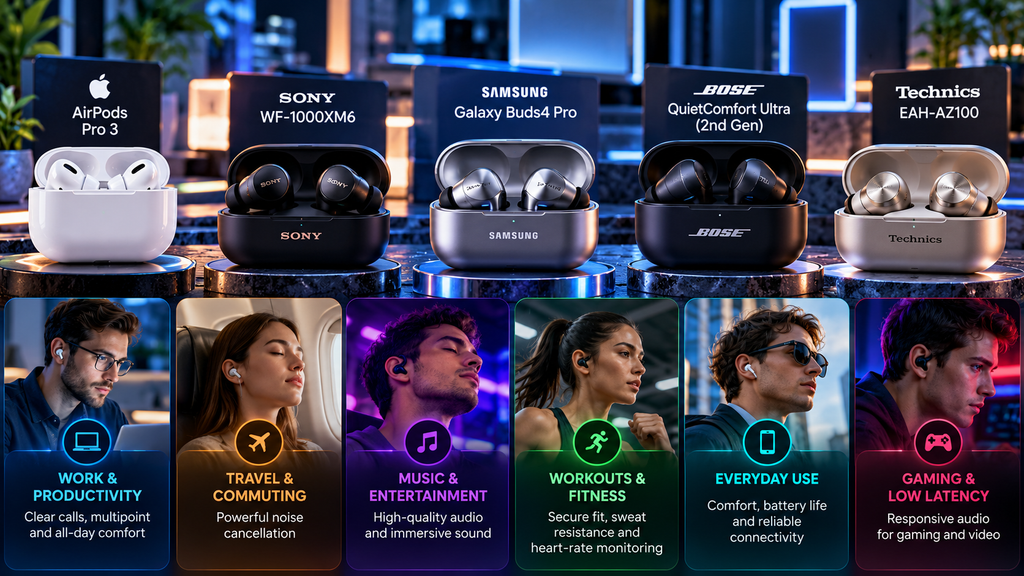
Earbud Fit and Comfort
Sound specifications are irrelevant if the earbuds are uncomfortable.
Ear shapes differ substantially, so a model that fits one person perfectly may cause discomfort for another.
Most sealed earbuds include several silicone tip sizes.
Choosing the correct size improves:
Comfort.
Bass response.
Passive isolation.
Noise cancellation.
Stability.
People who dislike silicone tips entirely may prefer an open-ear design such as AirPods 5.
Athletes who need maximum stability may prefer ear hooks such as those used by Powerbeats Pro 2.
Water and Sweat Resistance
Water-resistance ratings matter for workouts and outdoor use.
However, ratings differ between models and usually apply to the earbuds rather than the charging case.
Water resistance should not automatically be interpreted as waterproofing.
Always check the manufacturer’s exact rating before using earbuds around heavy rain, pools, or water sports.
Are Expensive Wireless Earbuds Worth It?
Premium earbuds generally justify their higher prices through combinations of:
Better ANC.
More sophisticated microphones.
More consistent connectivity.
Higher-quality materials.
Wireless charging.
Advanced codecs.
Spatial audio.
Ecosystem features.
Software support.
However, not every buyer needs all of those features.
If your main use is podcasts at home or occasional music during a commute, a less expensive model may provide nearly everything you need.
Premium models make the most sense when features such as strong ANC, multipoint, ecosystem integration, fitness monitoring, or advanced audio support are used frequently.
If you are planning a broader device upgrade, you can also explore our guide to tech products worth upgrading in 2026.
Frequently Asked Questions
What are the best wireless earbuds in 2026?
Strong current options include AirPods Pro 3, Sony WF-1000XM6, Galaxy Buds4 Pro, Bose QuietComfort Ultra Earbuds (2nd Gen), Technics EAH-AZ100, Pixel Buds Pro 2, Sennheiser MOMENTUM True Wireless 4, Nothing Ear (3), Powerbeats Pro 2, and AirPods 5.
The best choice depends on device ecosystem, fit, sound preference, ANC requirements, and intended use.
Which wireless earbuds are suitable for iPhone?
AirPods Pro 3 offer the deepest integration with Apple’s ecosystem.
AirPods 5 are a strong alternative for users who prefer an open-ear design.
Which earbuds are suitable for Samsung Galaxy phones?
Galaxy Buds4 Pro are designed specifically to take advantage of Samsung’s ecosystem, codecs, Auto Switch, and Galaxy-specific features.
Which earbuds are suitable for Android?
Sony WF-1000XM6, Pixel Buds Pro 2, Technics EAH-AZ100, Sennheiser MOMENTUM True Wireless 4, Nothing Ear (3), and Galaxy Buds4 Pro can all be strong Android options depending on the phone.
Which earbuds are suitable for workouts?
Powerbeats Pro 2 are particularly well suited to workouts because of their ear-hook design and heart-rate monitoring.
AirPods Pro 3 also include heart-rate sensing and improved fit.
Do I need Active Noise Cancellation?
ANC is particularly useful for flights, commuting, offices, and other consistently noisy environments.
Users who mostly listen in quiet places may not need to prioritize it.
Are open-ear earbuds better?
Not necessarily.
Open-ear designs can feel more comfortable because they do not seal the ear canal, but sealed earbuds generally provide stronger passive isolation and potentially more effective overall noise reduction.
How long should wireless earbuds last on one charge?
Around six to eight hours is sufficient for many users, although some models exceed this.
Actual battery life depends on ANC, codecs, volume, calls, and other enabled features.
Final Thoughts
The best wireless earbuds in 2026 are increasingly defined by how well they fit into a user’s lifestyle and device ecosystem.
AirPods Pro 3 deliver a deeply integrated experience for Apple users.
Sony WF-1000XM6 offer a flexible premium package across platforms.
Galaxy Buds4 Pro are optimized for Samsung’s ecosystem.
Bose QuietComfort Ultra Earbuds (2nd Gen) focus heavily on noise cancellation and comfort.
Technics EAH-AZ100 combine high-resolution audio with unusually flexible multipoint connectivity.
Pixel Buds Pro 2 provide smart integration for Google’s Android ecosystem.
Sennheiser MOMENTUM True Wireless 4 emphasize codec flexibility and sound.
Nothing Ear (3) combines distinctive styling with modern audio technology.
Powerbeats Pro 2 target athletes who need secure fit and workout data.
AirPods 5 provide an alternative for listeners who want modern features without silicone ear tips.
Rather than choosing earbuds because one model is labeled the universal winner, identify which features you will actually use every day.
Fit, ecosystem compatibility, battery life, ANC, call quality, and comfort usually matter more over time than any single specification.