

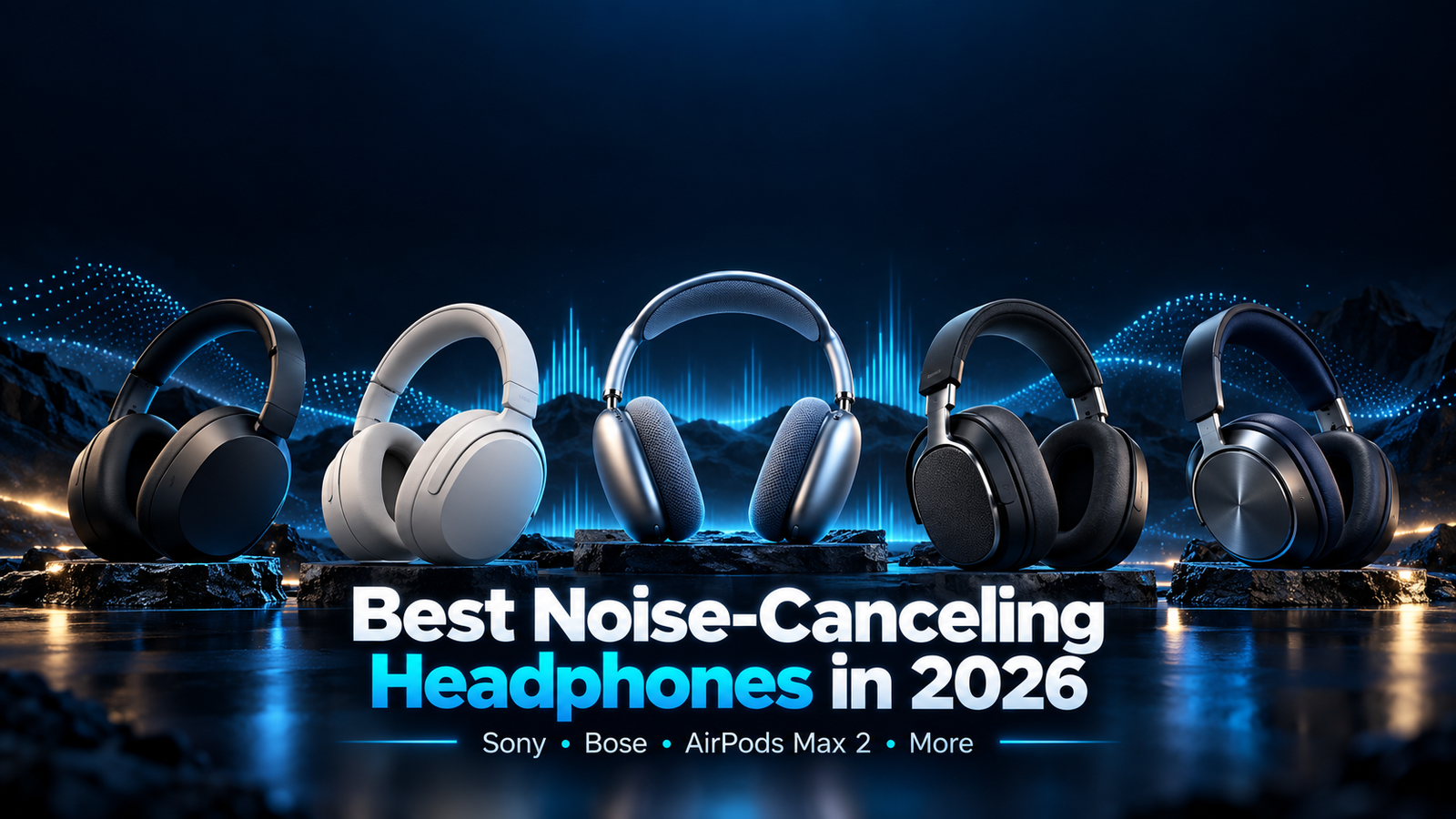
Noise-canceling headphones have become essential tools for travel, work, study, entertainment, and everyday listening.
In 2026, premium headphones do far more than simply block background noise. Modern models combine adaptive active noise cancellation, high-resolution audio, spatial sound, advanced microphones, multipoint Bluetooth, intelligent listening modes, and increasingly sophisticated mobile apps.
Sony, Bose, Apple, Sennheiser, and Bowers & Wilkins all approach the category differently.
Some headphones prioritize powerful noise cancellation. Others focus on battery life, sound quality, ecosystem integration, comfort, or premium materials.
That means the right choice depends on how and where you plan to use your headphones.
This guide compares several of the most important noise-canceling headphones available in 2026 and explains their strengths, limitations, and ideal use cases.
Table of Contents
Best Noise-Canceling Headphones in 2026: Quick Overview
| Headphones | Key Strength | Battery Life | Best Suited For |
|---|---|---|---|
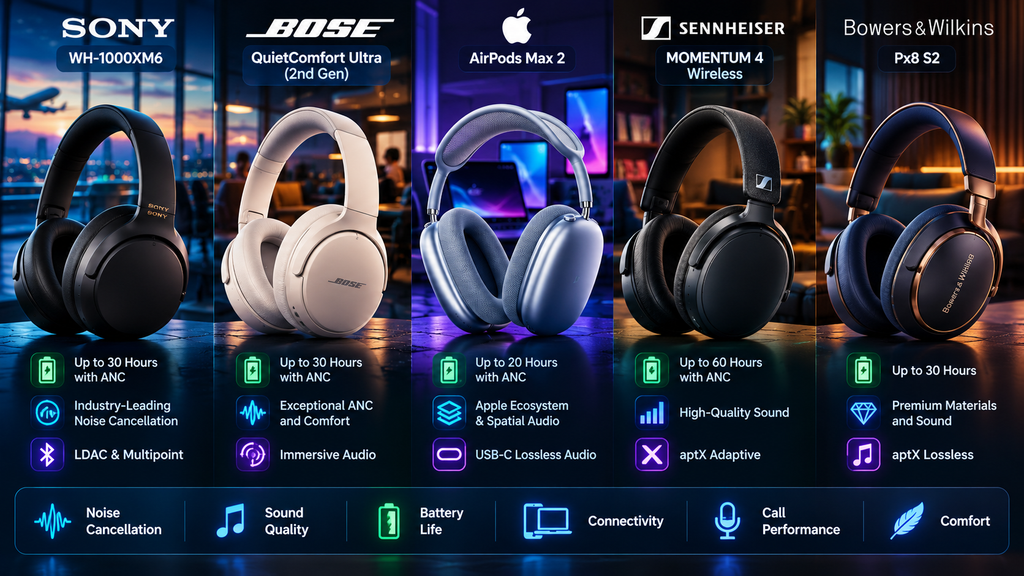
| Sony WH-1000XM6 | Balanced ANC, sound, features | Up to 30 hours with ANC | Travel and everyday use |
| Bose QuietComfort Ultra Headphones (2nd Gen) | Strong ANC and comfort | Up to 30 hours with ANC | Frequent travelers |
| Apple AirPods Max 2 | Apple ecosystem and spatial audio | Up to 20 hours with ANC | Apple users |
| Sennheiser MOMENTUM 4 Wireless | Long battery life | Up to 60 hours with ANC | Long listening sessions |
| Bowers & Wilkins Px8 S2 | Premium materials and sound | Up to 30 hours | Premium audio listeners |
| Bose QuietComfort Headphones (2nd Gen) | Comfort and simpler Bose experience | Up to 24 hours | Everyday Bose users |
No single pair is ideal for everyone.
The best choice depends on the combination of noise cancellation, sound quality, comfort, battery life, phone ecosystem, and price that matters most to you.
1. What Makes Good Noise-Canceling Headphones in 2026?
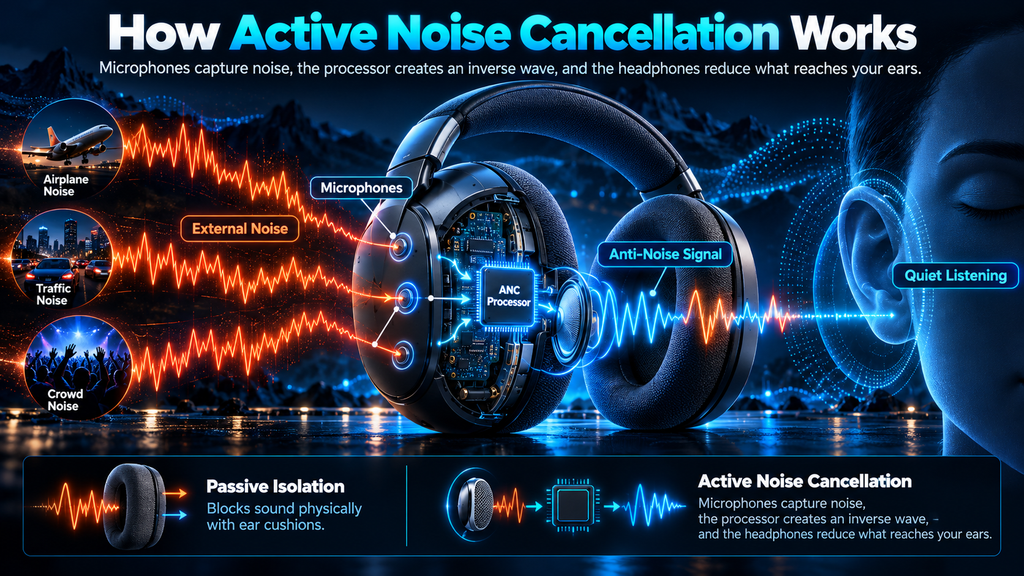
Active Noise Cancellation, or ANC, uses microphones to detect surrounding sound and then produces an opposing audio signal designed to reduce unwanted noise.
Modern ANC systems can adjust continuously as the environment changes.
However, noise cancellation is only one part of the experience.
A good pair of headphones should also provide:
- Comfortable ear cups and headband
- Balanced sound quality
- Reliable Bluetooth connectivity
- Clear microphones for calls
- Useful transparency or ambient modes
- Good battery life
- Fast charging
- Stable mobile-app support
- Multipoint connectivity where supported
Premium models increasingly add spatial audio, intelligent listening modes, high-resolution codecs, and USB-C audio.
2. Noise Cancellation Is Not the Same as Sound Isolation
Passive isolation physically blocks sound using ear cushions and headphone construction.
Active noise cancellation electronically reduces external noise.
The strongest results usually come from combining both approaches.
Low-frequency sounds such as aircraft engines, air-conditioning systems, buses, and continuous road noise are typically easier for ANC systems to reduce.
Sudden voices and rapidly changing sounds can be more challenging.
This is why real-world noise cancellation performance can vary between environments.
3. Sony WH-1000XM6
The Sony WH-1000XM6 remains one of Sony’s flagship wireless noise-canceling headphones in 2026.
Sony combines adaptive noise cancellation with a sophisticated microphone system and its HD Noise Canceling Processor QN3.
The headphones use multiple microphones to analyze surrounding noise and adjust cancellation dynamically.
They are designed as an all-purpose premium option for commuting, flying, office work, calls, and entertainment.
4. Sony WH-1000XM6 Noise Cancellation
Noise cancellation is one of the central features of the WH-1000XM6.
Sony uses an adaptive microphone system together with its noise-processing hardware to continuously optimize ANC.
The headphones also include an Ambient Sound mode when users need to remain aware of their surroundings.
This makes them flexible for environments ranging from aircraft cabins to offices and city streets.
5. Sony WH-1000XM6 Sound Quality
Sony supports several audio technologies designed to improve wireless listening.
The WH-1000XM6 supports:
- SBC
- AAC
- LDAC
- LC3
LDAC can transmit higher-resolution audio over compatible Bluetooth devices.
Sony also includes DSEE Extreme processing, which is designed to improve compressed digital audio.
Users can further customize the listening experience through Sony’s companion software.
6. Sony WH-1000XM6 Battery Life
Sony rates the WH-1000XM6 for up to approximately:
- 30 hours of music playback with noise cancellation enabled
- 40 hours with noise cancellation disabled
Actual battery life depends on volume, Bluetooth settings, codecs, ANC usage, and other features.
For most travelers, a 30-hour ANC rating should comfortably cover long flights and multiple commuting sessions between charges.
7. Sony WH-1000XM6 Connectivity
The WH-1000XM6 supports Bluetooth 5.3 and multipoint connectivity.
Multipoint is particularly useful for people who regularly switch between two devices.
For example, you could connect the headphones to a laptop for work while remaining connected to a smartphone for calls.
A detachable wired connection is also supported.
8. Who Should Consider the Sony WH-1000XM6?
The WH-1000XM6 is well suited to users looking for a balanced combination of:
- Strong ANC
- Good sound quality
- Long battery life
- Advanced Bluetooth features
- Customization
- Call performance
- Travel-friendly functionality
Its broad feature set makes it particularly attractive to people who use the same headphones across several different environments.
9. Bose QuietComfort Ultra Headphones (2nd Gen)
Bose has built much of its reputation around noise-canceling technology.
The QuietComfort Ultra Headphones (2nd Gen) continue that approach while adding refinements to audio, battery life, connectivity, and intelligent listening behavior.
They sit at the premium end of Bose’s headphone range.
10. Bose QuietComfort Ultra 2nd Gen Noise Cancellation
Bose uses adaptive noise cancellation combined with multiple listening modes.
The updated generation includes refinements designed to make transitions in noise cancellation smoother, particularly when outside sounds suddenly change.
This can be useful during travel, public transportation, or walking through environments where noise levels vary continuously.
Users can also switch to awareness modes when hearing the surrounding environment is important.
11. Bose Immersive Audio
Bose also emphasizes immersive audio processing.
Immersive Audio attempts to create a wider sound presentation rather than making audio appear to come directly from inside the headphones.
This can make movies, music, and other media feel more spacious.
However, immersive processing consumes additional battery power.
12. Bose QuietComfort Ultra 2nd Gen Battery Life
Bose rates the QuietComfort Ultra Headphones (2nd Gen) for approximately:
- Up to 30 hours with noise cancellation enabled and Immersive Audio disabled
- Up to 23 hours with Immersive Audio enabled
- Up to 45 hours with noise cancellation disabled
Battery performance will vary according to listening volume and enabled features.
13. Bose Comfort and Everyday Use
Comfort remains one of the defining characteristics of the QuietComfort family.
For users who wear headphones for several hours at a time, weight distribution, ear-cushion softness, and headband pressure can matter as much as sound quality.
This becomes particularly important during long flights, extended work sessions, or long periods of study.
14. Who Should Consider Bose QuietComfort Ultra Headphones?
They make sense for users who prioritize:
- Noise reduction
- Long-session comfort
- Travel
- Simple controls
- Immersive audio
- Adaptive listening modes
Frequent travelers are likely to find this combination particularly useful.
15. Apple AirPods Max 2
AirPods Max 2 are Apple’s current premium over-ear headphones.
Introduced in 2026, the second generation moves to the H2 platform and adds newer intelligent audio features while retaining the distinctive over-ear design of the original AirPods Max.
The largest advantage is integration with Apple’s wider ecosystem.
16. AirPods Max 2 and the Apple Ecosystem
For people using an iPhone, iPad, Mac, and other Apple devices, AirPods Max 2 can provide a tightly integrated experience.
Features include automatic device interaction, Siri functionality, Personalized Spatial Audio, and other Apple-specific audio capabilities.
The value of this integration is significantly higher for users already invested in Apple devices.
Android users can still use Bluetooth audio, but they do not receive the same complete ecosystem experience.
17. AirPods Max 2 Noise Cancellation
Apple says AirPods Max 2 provide stronger Active Noise Cancellation than the original AirPods Max.
The headphones also add Adaptive Audio, allowing the listening system to respond more intelligently to environmental conditions.
Transparency mode remains available for situations where surrounding sound needs to remain audible.
18. AirPods Max 2 Intelligent Audio Features
AirPods Max 2 introduce features including:
- Adaptive Audio
- Conversation Awareness
- Voice Isolation
- Personalized Volume
- Loud Sound Reduction
- Live Translation
- Personalized Spatial Audio
These features demonstrate how premium headphones are increasingly becoming intelligent wearable audio devices rather than simple Bluetooth accessories.
19. AirPods Max 2 USB-C Audio
USB-C is used for charging and can also support lossless audio.
This gives users another option when wireless Bluetooth compression is not desirable.
It can be particularly useful for compatible computers and other devices used for media creation or high-quality listening.
20. AirPods Max 2 Battery Life
Apple rates AirPods Max 2 for up to approximately 20 hours of listening with Active Noise Cancellation enabled.
A five-minute charge can provide around 1.5 hours of additional listening time.
Twenty hours is sufficient for most daily use and long flights, although several competitors provide substantially longer rated battery life.
21. Who Should Consider AirPods Max 2?
AirPods Max 2 make the most sense for users heavily invested in the Apple ecosystem.
They are especially relevant for people who value:
- Apple device integration
- Spatial Audio
- Adaptive Audio
- ANC
- USB-C audio
- Siri features
- Premium construction
Users primarily concerned with maximum battery endurance may prefer alternatives.
22. Sennheiser MOMENTUM 4 Wireless
The MOMENTUM 4 Wireless continues to stand out because of its unusually long battery life.
Sennheiser combines adaptive ANC with a sound-focused design and broad Bluetooth codec support.
Although it is not the newest design in this comparison, it remains relevant because its core specifications continue to compete strongly.
23. Sennheiser MOMENTUM 4 Battery Life
Sennheiser rates the MOMENTUM 4 Wireless for up to approximately 60 hours of music playback over Bluetooth with ANC enabled under its test conditions.
That is considerably longer than many premium competitors.
For travelers or users who dislike frequent charging, battery endurance can be one of the strongest reasons to consider it.
24. Sennheiser Sound and Bluetooth Codecs
The MOMENTUM 4 uses 42mm dynamic drivers.
Supported Bluetooth codecs include:
- SBC
- AAC
- aptX
- aptX Adaptive
Codec availability depends on the source device.
Android devices with compatible Qualcomm audio support may benefit from aptX technologies, while Apple devices typically use AAC over Bluetooth.
25. Who Should Consider Sennheiser MOMENTUM 4?
The MOMENTUM 4 is particularly relevant for listeners who prioritize:
- Long battery life
- Music playback
- Sound customization
- aptX support
- Long listening sessions
- Reduced charging frequency
It may be especially attractive for users who travel regularly but do not want to recharge headphones every few days.
26. Bowers & Wilkins Px8 S2
The Bowers & Wilkins Px8 S2 takes a more luxury-oriented approach.
Instead of focusing only on ANC, the Px8 S2 combines premium construction, high-resolution audio capabilities, sophisticated wireless codecs, and active noise cancellation.
Materials include leather and aluminum components, giving the headphones a noticeably different positioning from many plastic-focused competitors.
27. Px8 S2 Sound Technology
The Px8 S2 uses custom 40mm Carbon Cone drivers.
It also supports several Qualcomm codecs, including:
- aptX Lossless
- aptX Adaptive
- aptX HD
- AAC
- SBC
For compatible sources, aptX Lossless provides another option for users seeking higher-quality wireless audio.
The headphones also support USB-C audio.
28. Px8 S2 Noise Cancellation and Calls
Bowers & Wilkins uses a total of eight microphones across the headphones.
These microphones support both noise cancellation and voice-call processing.
The company’s design goal is to reduce unwanted external sound without excessively interfering with music dynamics.
29. Px8 S2 Battery Life
The Px8 S2 is rated for up to approximately 30 hours of playback.
A 15-minute quick charge can provide several additional hours of listening.
That places battery endurance broadly in line with several other premium ANC headphones.
30. Who Should Consider Bowers & Wilkins Px8 S2?
The Px8 S2 is aimed more toward users who place significant value on:
- Premium materials
- Detailed music reproduction
- High-resolution codec support
- Luxury design
- ANC
- Wired USB-C audio
It is less about maximizing value and more about combining premium construction with high-end personal audio.
31. Bose QuietComfort Headphones (2nd Gen)
Bose also introduced the second generation of its standard QuietComfort Headphones in 2026.
This model sits below the QuietComfort Ultra line while retaining Bose’s focus on comfort and noise cancellation.
The new generation includes refreshed styling, TrueSpatial Technology, USB-C audio, and updated call performance.
32. Bose QuietComfort 2nd Gen Battery Life
Bose rates the QuietComfort Headphones (2nd Gen) for up to:
- 24 hours of listening
- Around 18 hours when Immersive Audio is enabled
A short quick-charge session can provide additional listening time.
This model may appeal to users who want the core Bose experience without moving to the Ultra series.
33. Sony vs. Bose
Sony and Bose remain two of the most direct competitors in premium ANC headphones.
Sony emphasizes a broad combination of:
- Noise cancellation
- Codec support
- Customization
- Multipoint
- Long battery life
Bose places particularly strong emphasis on:
- ANC
- Comfort
- Simple listening modes
- Immersive Audio
- Travel-friendly usability
The better match depends on the user’s priorities rather than one model universally outperforming the other in every area.
34. Sony vs. AirPods Max 2
Sony provides broader cross-platform flexibility.
AirPods Max 2 provide deeper Apple integration.
An iPhone and Mac user may value automatic Apple features and Spatial Audio more heavily.
Someone switching frequently between Android, Windows, and other devices may prefer Sony’s more platform-neutral approach.
Battery life also differs, with Sony offering a longer official ANC playback rating.
35. Bose vs. AirPods Max 2
These headphones approach premium audio from different directions.
Bose focuses heavily on comfort and noise-control technology.
Apple focuses on combining premium headphones with its wider device ecosystem and intelligent audio features.
For long flights, physical comfort may play a major role.
For users moving between Apple devices, ecosystem integration can be equally important.
36. Which Headphones Have the Longest Battery Life?
Among the models compared here, Sennheiser MOMENTUM 4 Wireless has the highest manufacturer-rated battery endurance.
Its rating of up to 60 hours with ANC is substantially above many competitors.
Sony follows with up to 30 hours with ANC.
Bose QuietComfort Ultra 2nd Gen also reaches up to approximately 30 hours under its standard ANC configuration.
Bowers & Wilkins Px8 S2 offers approximately 30 hours of playback.
Bose QuietComfort 2nd Gen offers up to 24 hours.
AirPods Max 2 are rated for up to 20 hours with ANC.
Battery claims should always be treated as estimates because actual results vary with volume, codecs, features, temperature, and listening behavior.
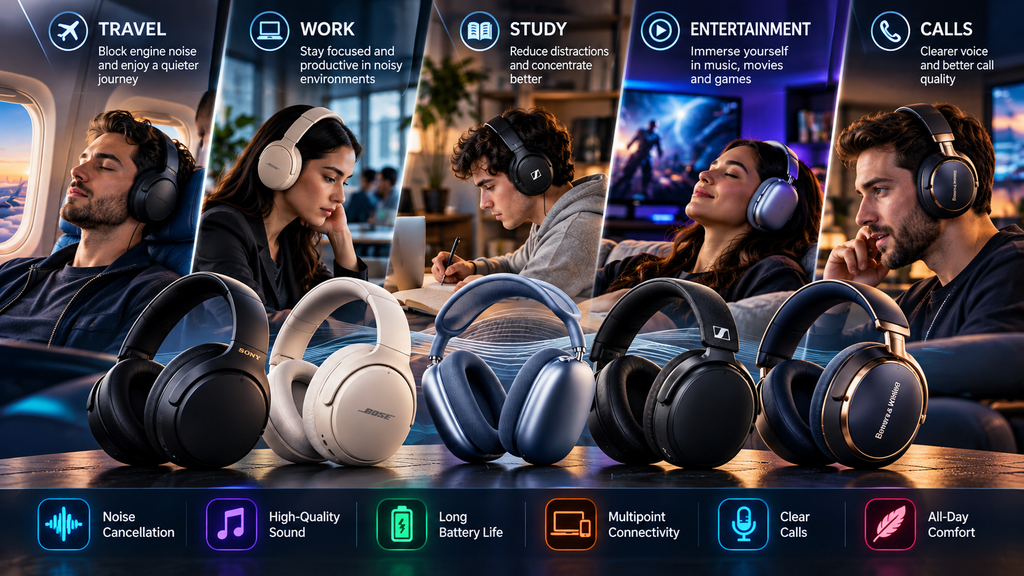
37. Which Headphones Are Better for Flying?
Air travel places several demands on headphones simultaneously.
Useful features include:
- Strong low-frequency ANC
- Comfortable ear cushions
- Long battery life
- Compact storage
- Reliable transparency mode
- Wired playback options
Sony and Bose are especially travel-focused options because ANC, comfort, and battery performance are central to both product lines.
Sennheiser’s extremely long battery life is also attractive for extended travel.
38. Which Headphones Are Better for Office Work?
Office users should consider more than noise cancellation.
Microphone quality, multipoint connectivity, comfort, transparency modes, and device switching can be just as important.
If you move constantly between a computer and phone, multipoint connectivity becomes particularly useful.
A good transparency mode is also valuable when colleagues need to speak to you without requiring the headphones to be removed.
For users who rely on AI-powered workflows, the right headphones can also complement modern productivity tools during meetings, focused work, and content creation.
39. Which Headphones Are Better for Calls?
Modern premium headphones increasingly use multiple microphones and signal-processing algorithms to isolate speech.
However, microphone performance can change dramatically depending on background noise, wind, room acoustics, and device software.
Users who spend several hours each day in online meetings should therefore treat call performance as a major buying criterion rather than an extra feature.
40. Which Headphones Are Better for Music?
Music-focused users should consider:
- Driver tuning
- Codec support
- EQ controls
- USB audio
- Frequency balance
- Dynamics
- Source device compatibility
Sennheiser and Bowers & Wilkins emphasize sound reproduction heavily.
Sony provides extensive digital processing and codec options.
AirPods Max 2 add lossless USB-C audio alongside Apple’s computational audio features.
Different tuning preferences mean that sound quality is partly subjective.
41. Bluetooth Codecs Matter — But Only With Compatible Devices
A headphone may support an advanced codec, but the source device must support it as well.
For example, LDAC and aptX technologies are more commonly useful with compatible Android devices.
Apple devices generally rely on AAC for Bluetooth audio.
USB-C audio can bypass some Bluetooth limitations on supported headphones.
That means codec specifications should always be considered together with the phone, tablet, or computer being used.
42. Multipoint Bluetooth Can Be Extremely Useful
Multipoint allows headphones to remain connected to more than one source device.
A common example is connecting to:
- A laptop for meetings
- A smartphone for calls
Without multipoint, users may need to disconnect and reconnect manually throughout the day.
For office and productivity users, this can materially affect the overall experience.
43. Comfort Matters More Than Specifications Suggest
Headphones may look excellent on a specification sheet but become uncomfortable after several hours.
Important factors include:
- Headband pressure
- Ear-cup depth
- Cushion material
- Weight
- Heat buildup
- Glasses compatibility
Head shape varies significantly between users, so comfort is one of the most personal parts of choosing headphones.
44. Do You Need Spatial or Immersive Audio?
Spatial audio attempts to create a more three-dimensional presentation.
It can be particularly enjoyable with movies, supported music, and some games.
However, it should not automatically be treated as superior for every type of audio.
Some listeners prefer traditional stereo reproduction for music.
Spatial processing can also reduce battery life on certain headphones.
45. Transparency and Ambient Modes
ANC is useful when you want to block the outside world.
Transparency modes are useful when you need to hear it.
Examples include:
- Walking near traffic
- Airport announcements
- Speaking with coworkers
- Ordering food or coffee
- Waiting for transportation
The ability to switch quickly between isolation and awareness is now an important part of premium headphone design.
46. Should You Upgrade Older Noise-Canceling Headphones?
An upgrade may make sense if your current headphones have:
- Weak battery capacity
- Poor microphone quality
- Outdated Bluetooth support
- Uncomfortable ear cushions
- Limited transparency modes
- No multipoint support
- Noticeably weaker ANC
- Charging ports that no longer fit your devices
However, a functioning older premium model may still provide excellent audio.
Upgrading purely because a newer generation exists is not always necessary.
If you are comparing several device upgrades, our guide to tech products worth upgrading in 2026 can help you decide which upgrades deserve priority.
47. What to Check Before Buying Noise-Canceling Headphones
Before purchasing, check the following:
Phone compatibility:
Confirm which codecs and ecosystem features work with your phone.
Battery requirements:
Think realistically about how frequently you are willing to recharge.
Comfort:
Consider how many hours you normally wear headphones.
ANC:
Determine whether you need maximum isolation or only moderate noise reduction.
Microphones:
Important for frequent calls and remote meetings.
Multipoint:
Useful for switching between computers and phones.
USB audio:
Useful if you want a wired digital connection.
Travel size:
Check whether the headphones fold and how large the case is.
Price:
Premium headphones can vary substantially in cost, and newer models do not automatically provide better value for every user.
48. A Practical Headphone Buying Guide for 2026
Start with how you actually use headphones.
If you spend significant time flying or commuting, prioritize ANC, comfort, and battery life.
If you work across several devices, prioritize multipoint connectivity and microphone quality.
If you use mostly Apple devices, ecosystem integration may significantly influence your choice.
If music quality is the main priority, pay closer attention to codecs, driver design, tuning, EQ options, and wired audio support.
If you regularly forget to charge devices, long battery life may matter more than advanced spatial-audio features.
The most expensive headphones are not automatically the right headphones for every listener.
Frequently Asked Questions
What are the main premium noise-canceling headphones to consider in 2026?
Important models include Sony WH-1000XM6, Bose QuietComfort Ultra Headphones (2nd Gen), Apple AirPods Max 2, Sennheiser MOMENTUM 4 Wireless, and Bowers & Wilkins Px8 S2.
Which headphones have the longest battery life?
Sennheiser rates MOMENTUM 4 Wireless for up to 60 hours of Bluetooth playback with ANC under its test conditions, giving it a substantial advantage in rated endurance over many premium competitors.
Are AirPods Max 2 good for Android?
They can function as Bluetooth headphones with Android, but many of their strongest ecosystem features are designed around Apple devices.
Are Sony WH-1000XM6 good for travel?
Their combination of ANC, approximately 30-hour rated battery life with noise cancellation, ambient mode, and portable design makes them well suited to travel.
How long does the Bose QuietComfort Ultra 2nd Gen battery last?
Bose rates the headphones for up to approximately 30 hours with ANC enabled and Immersive Audio disabled.
Is active noise cancellation safe?
ANC works by using microphones and audio processing to reduce environmental sound. Users should still keep listening volumes at reasonable levels and remain aware of surroundings when situational awareness is important.
Should I choose headphones based only on ANC?
No. Comfort, sound quality, microphone performance, battery life, Bluetooth connectivity, transparency mode, and device compatibility can be just as important.
Is USB-C audio better than Bluetooth?
USB-C can provide a direct digital connection and may support lossless audio on compatible products. Whether the difference is meaningful depends on the headphones, source material, playback device, and listener.
Do expensive headphones always sound better?
Not necessarily. Sound preferences vary, and higher prices may also reflect materials, industrial design, brand positioning, or additional features rather than sound quality alone.
Final Thoughts
Noise-canceling headphones in 2026 have evolved into sophisticated personal audio systems.
Sony WH-1000XM6 combines ANC, connectivity, battery life, and extensive features in a highly versatile package.
Bose QuietComfort Ultra Headphones (2nd Gen) emphasize noise cancellation, comfort, and travel-friendly usability.
AirPods Max 2 bring stronger integration with Apple’s ecosystem together with adaptive and spatial audio features.
Sennheiser MOMENTUM 4 Wireless stands out for unusually long battery life and a sound-focused approach.
Bowers & Wilkins Px8 S2 combines premium materials with high-resolution audio technologies and luxury-oriented design.
Bose QuietComfort Headphones (2nd Gen) provide another modern option for listeners who want Bose comfort and ANC without necessarily moving to the Ultra tier.
The right choice therefore depends less on finding one universal winner and more on matching the headphones to your phone, listening habits, travel needs, comfort preferences, and battery requirements.
Sources
- Sony — WH-1000XM6 Official Product Page
- Sony — WH-1000XM6 Specifications
- Bose — QuietComfort Ultra Headphones (2nd Gen) Official Announcement
- Apple — Introducing AirPods Max 2
- Apple — AirPods Max 2 Technical Specifications
- Sennheiser — MOMENTUM 4 Wireless Official Specifications
- Bowers & Wilkins — Px8 S2 Official Product Page
- Bose — QuietComfort Headphones (2nd Gen) Official Product Page







Comments 1