

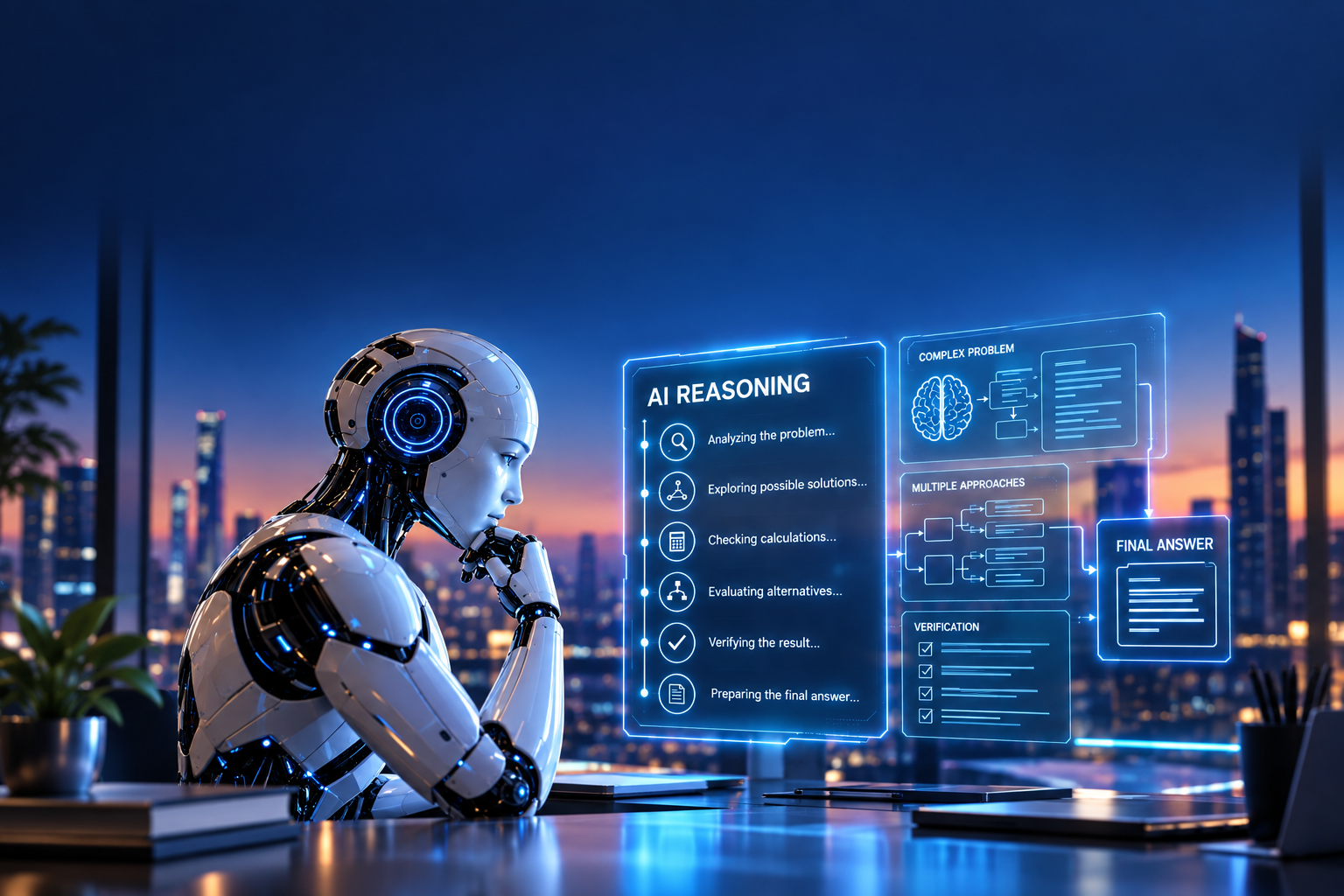
Artificial intelligence is entering a new phase in which answering quickly is no longer the only goal. AI reasoning models in 2026 are increasingly designed to spend more computational effort analyzing difficult problems, exploring possible solutions, checking their work, and deciding how to respond before producing a final answer.
This approach is often described as reasoning, extended thinking, deliberation, or test-time compute. Instead of immediately generating a response, a reasoning model can devote additional processing to complex tasks such as mathematics, software development, scientific analysis, planning, research, and multi-step problem solving.
That does not mean an AI system “thinks” exactly like a human. The word thinking is a convenient way to describe additional computational work performed before or during generation. The internal mechanisms are fundamentally different from human cognition.
And importantly, more thinking is not always better. Additional reasoning can improve performance on difficult problems, but it can also increase latency, token usage, computational cost, and energy consumption. For simpler questions, a fast answer may be just as useful.
The important change is therefore not that every AI system will simply take longer to answer. It is that modern AI systems are becoming better at deciding how much computational effort a problem deserves.
This guide explains what AI reasoning models are, how longer thinking works, where it provides real benefits, what its limitations are, and why inference-time reasoning could become one of the most important directions in artificial intelligence.
Table of Contents
AI Reasoning Models in 2026: Quick Overview
| Question | General Answer |
|---|---|
| What is an AI reasoning model? | A model designed to perform additional internal computation before producing a final answer. |
| Does it literally think like a human? | No. “Thinking” describes computational reasoning, not human consciousness or cognition. |
| Why spend more time reasoning? | Complex problems may benefit from planning, checking alternatives, correcting mistakes, and performing multiple reasoning steps. |
| Is longer thinking always better? | No. Extra computation helps some difficult tasks but may add unnecessary latency and cost to simpler ones. |
| What is test-time compute? | Computational resources used while the model is solving a request rather than during its original training. |
| Where is reasoning especially useful? | Mathematics, coding, science, planning, research, complex analysis, and multi-step workflows. |
| What is the major tradeoff? | Better reasoning can require more processing time, tokens, infrastructure, and energy. |
| What comes next? | More adaptive AI systems that dynamically allocate reasoning effort based on task difficulty. |
1. What Is an AI Reasoning Model?
A traditional large language model generates text by predicting an appropriate continuation based on its training and the context supplied by the user.
A reasoning model adds another important dimension: it can devote more computational effort to working through a difficult task before settling on a final response.
This may involve breaking a problem into smaller components, considering alternative approaches, checking intermediate results, identifying contradictions, revising a plan, or using external tools before completing the task.
Modern reasoning systems can therefore behave differently depending on the problem.
A straightforward question may require very little additional processing. A difficult mathematical proof, complicated software bug, large research problem, or multi-stage planning task may justify substantially more reasoning.
This shift matters because it changes one of the traditional assumptions about AI performance.
For years, much of the industry’s progress came from making models larger, training them on more data, and spending more computing power during training. Reasoning models add another scaling dimension:
How much computation should the model use when solving this particular problem?
That is the central idea behind inference-time or test-time compute.
2. What Is Test-Time Compute?
AI development involves at least two very different stages: training and inference.
Training is the enormous process through which a model learns patterns from data before it is made available to users.
Inference happens later, when a trained model receives a question or task and generates a response.
Test-time compute, also called inference-time compute, means allocating additional computational resources during that second stage.
Instead of assuming that every request deserves roughly the same amount of processing, an AI system can spend more effort on problems that appear difficult.
Research on modern reasoning systems has shown that increasing inference-time computation can improve performance on many reasoning-heavy tasks, although the relationship is not unlimited or universal.
This creates a new way to improve AI systems.
Rather than only asking:
“How large can we make the model?”
developers can also ask:
“How effectively can the model use more computation when a problem actually needs it?”
3. How Does Longer AI Reasoning Work?
The exact implementation differs between AI systems, but the general idea is straightforward.
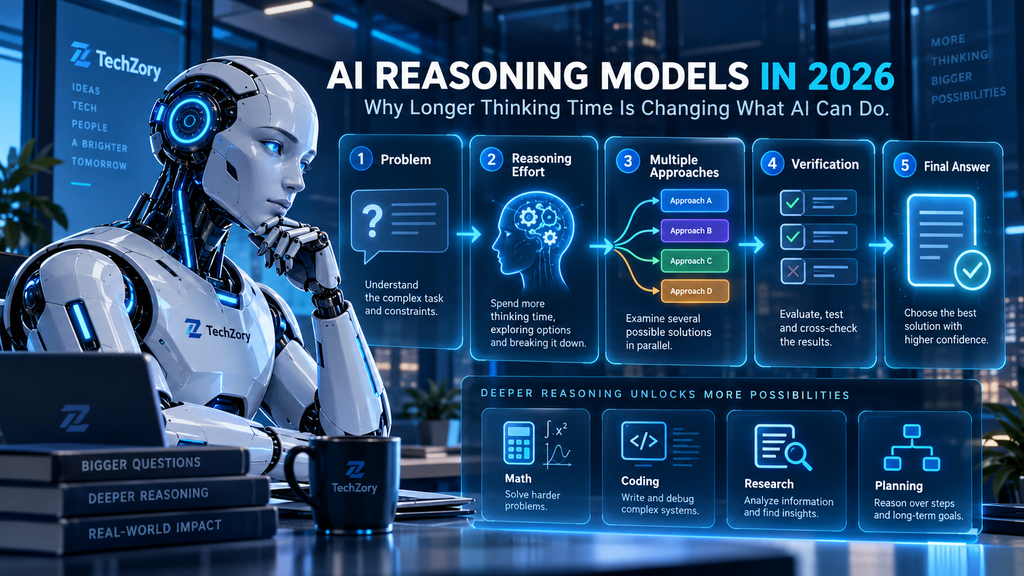
A reasoning model receives a task and performs internal computational work before producing its final answer. Depending on the model and configuration, it may devote relatively little effort to an easy request or substantially more effort to a difficult one.
Some modern systems expose controls such as reasoning effort, thinking level, or thinking budget. These controls allow developers or the AI system itself to balance quality against speed and computational cost.
OpenAI’s reasoning documentation, for example, describes different reasoning-effort settings and explains that higher effort can improve performance on complex tasks while increasing latency and token usage. Google’s Gemini models similarly support configurable thinking levels and can dynamically adjust reasoning according to task complexity. Anthropic has also developed extended-thinking capabilities that allow Claude models to spend more computational effort on difficult problems.
The important point is that there is no universal amount of “thinking time.”
A model does not need to spend 30 minutes on every difficult question, nor is a fixed number of seconds or minutes a reliable measure of intelligence.
The useful variable is effective computational effort.
4. Why Can More Reasoning Improve AI Answers?
Complex problems often cannot be solved reliably through a single obvious step.
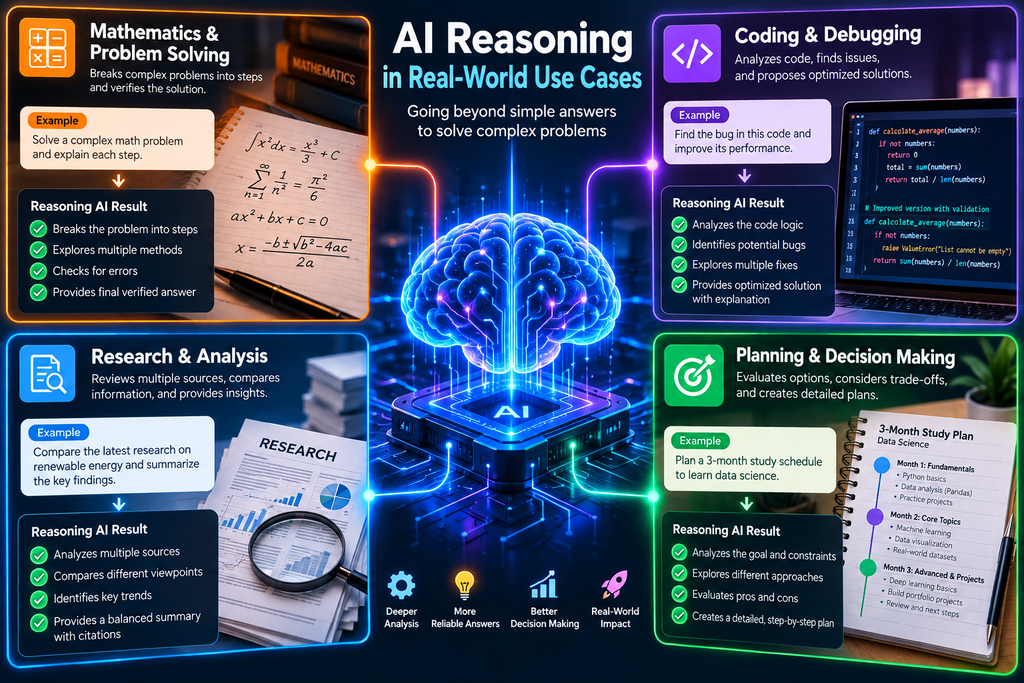
Consider a difficult programming problem. The AI may need to understand the requirements, examine several pieces of code, identify the source of an error, evaluate possible fixes, consider side effects, and verify that its proposed solution is consistent with the rest of the system.
A difficult mathematics problem may require several intermediate deductions before the final answer becomes clear.
A research task may require identifying relevant evidence, comparing sources, resolving conflicting information, and synthesizing a conclusion.
More inference-time computation gives a reasoning model additional opportunities to perform this kind of structured work.
OpenAI’s early research on reasoning models demonstrated that performance on difficult reasoning tasks could improve when models were allowed to use more test-time computation. More recent work across the industry continues to investigate how inference-time scaling can improve reasoning efficiency and reliability.
The goal is not simply to produce a longer answer.
A model can generate thousands of words without performing useful reasoning.
The real objective is to use additional computation to improve the quality of the final result.
5. Where Does Extra Reasoning Help the Most?
The benefit of longer reasoning varies dramatically depending on the task.
| Task | Potential Benefit of Extra Reasoning |
|---|---|
| Advanced mathematics | High |
| Complex software debugging | High |
| Scientific reasoning | High |
| Multi-step planning | High |
| Large-document analysis | High |
| Research synthesis | High |
| Tool-based workflows | High |
| Simple factual questions | Usually limited |
| Basic rewriting | Usually limited |
| Short summaries | Often limited |
| Routine conversation | Usually limited |
Mathematics and Science
Reasoning-intensive mathematics and science problems often require several connected steps. These tasks are natural candidates for additional inference-time compute because an incorrect intermediate step can affect the entire solution.
Google DeepMind has reported continued improvements in advanced mathematical problem solving as inference-time compute increases in its Deep Think research systems.
Software Development
Complex software work can involve large repositories, interacting components, ambiguous requirements, and multiple possible solutions.
Additional reasoning can help an AI system inspect dependencies, understand how code fits together, evaluate alternatives, and catch problems that might be missed by a faster response.
Research and Analysis
Research questions may require examining large amounts of information rather than generating an answer from a single piece of context.
Reasoning models can be particularly useful when evidence needs to be compared, prioritized, reconciled, or connected across multiple documents.
Planning
Travel planning, engineering design, business analysis, scheduling, and other planning tasks often involve constraints that interact with one another.
A system that can evaluate several possible plans before committing to one may produce more useful results than a model optimized primarily for immediate response speed.
Tool-Based AI Workflows
Reasoning becomes especially important when AI systems can use tools.
A capable system may need to decide which tool to use, interpret the result, determine whether more information is needed, correct an unsuccessful step, and continue until the task is finished.
This is closely related to AI agents, but the concepts are not identical.
A reasoning model describes how an AI system processes a difficult problem.
An AI agent describes a system that can work toward a goal and take actions using tools or environments.
Strong reasoning can therefore improve an agent, but a reasoning model does not automatically become an autonomous agent.
6. Do AI Models Really “Think”?
The word think is useful in everyday discussion, but it should not be interpreted too literally.
Current AI reasoning systems do not provide evidence that their internal computation is equivalent to human thought, awareness, understanding, or consciousness.
When AI developers refer to reasoning or thinking, they are generally describing computational processes that help the model solve a task.
These processes may include evaluating intermediate representations, allocating reasoning tokens, exploring solution paths, calling tools, checking results, or refining a response.
This distinction matters because phrases such as “the AI thought for ten minutes” can easily create the wrong impression.
A more technically accurate statement would be:
The system used additional inference-time computation before producing its final response.
That language may sound less dramatic, but it better represents what is happening.
7. How Major AI Systems Handle Reasoning in 2026
Reasoning is no longer limited to one research project or one AI company.
Different providers have developed their own approaches to controlling how much effort AI models devote to difficult tasks.
| Provider Approach | General Idea |
|---|---|
| OpenAI reasoning effort | Controls how much internal reasoning effort the model applies to a task. |
| Google Gemini thinking levels | Allows different levels of thinking and dynamic reasoning based on task complexity. |
| Anthropic extended thinking | Gives Claude additional computational space for difficult reasoning tasks. |
| Research systems | Explore techniques such as repeated sampling, verification, search, refinement, and other inference-time scaling methods. |
The terminology differs, but the broader trend is clear.
AI inference is becoming adaptive.
Instead of processing every task in exactly the same way, models can increasingly adjust their computational effort according to the difficulty and importance of the problem.
8. Reasoning Models vs. Standard Language Models
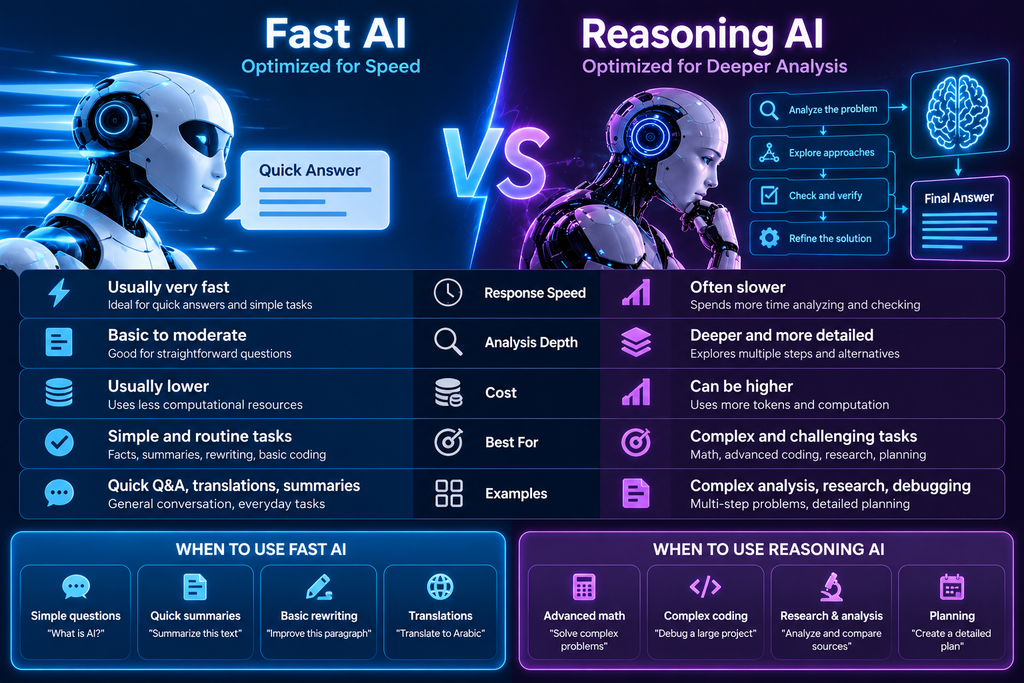
Reasoning models should not be viewed as universally superior to faster general-purpose models.
They serve different needs.
| Feature | Faster General-Purpose Model | Reasoning Model |
|---|---|---|
| Response speed | Usually faster | Often slower |
| Cost | Usually lower | Can be higher |
| Simple questions | Excellent | Often unnecessary |
| Complex reasoning | Good to strong | Usually better suited |
| Multi-step planning | Moderate to strong | Strong |
| Difficult mathematics | Variable | Often stronger |
| Complex coding | Strong | Particularly useful for difficult problems |
| Large ambiguous tasks | Can struggle | Often better suited |
| Computational requirements | Lower | Potentially higher |
For many applications, the most efficient strategy may be to combine the two.
Simple tasks can be routed to fast, inexpensive models.
Difficult tasks can be routed to models configured for deeper reasoning.
This creates an intelligent tradeoff between quality, cost, and latency.
9. Is More Thinking Always Better?
No.
This may be the most important limitation to understand.
Increasing inference-time compute can improve results on difficult tasks, but there is no guarantee that every additional token or second of processing will produce a better answer.
Recent research into test-time scaling has found that different strategies behave differently depending on the model and problem difficulty. No single inference-time scaling technique dominates every scenario.
A model can also spend unnecessary effort on an easy problem.
This is sometimes informally described as overthinking.
Imagine asking an AI to calculate a simple percentage. A long exploration of multiple solution methods would add latency and cost without meaningfully improving the answer.
The ideal reasoning system therefore needs more than the ability to think longer.
It needs the ability to decide when longer reasoning is worth the cost.
10. The Cost of Longer Reasoning
Reasoning is not free.
Additional inference-time computation can increase several costs simultaneously.
Higher Latency
More computation usually means the user waits longer for the final answer.
For research, coding, or scientific work, waiting may be acceptable.
For voice assistants, search suggestions, customer-service chat, or real-time applications, long delays can significantly reduce usability.
Higher Computational Cost
Reasoning consumes processing resources.
When models generate or internally use more tokens and perform more inference work, the cost of operating the system can increase.
Energy Use
More computation also means more hardware activity.
Research into the energy cost of test-time compute suggests that reasoning strategies must be evaluated not only for accuracy but also for efficiency.
This will become increasingly important as reasoning models are deployed at massive scale.
Opportunity Cost
An AI system using a large amount of compute on one problem may consume resources that could otherwise serve many simpler requests.
Efficient routing and adaptive reasoning will therefore be essential for large AI platforms.
11. Why Adaptive Reasoning May Matter More Than Maximum Reasoning
The future is unlikely to be a world where every AI response takes several minutes.
A more practical future is one where AI systems automatically determine how much effort each task requires.
For example:
A simple definition may receive an almost immediate answer.
A difficult coding problem may receive a deeper analysis.
A scientific research question may trigger extensive reasoning, tool use, verification, and multiple stages of evaluation.
A high-stakes business workflow may combine AI reasoning with human approval before any important action is taken.
This ability to allocate compute intelligently could be more valuable than simply maximizing reasoning time.
The best AI system may therefore not be the one that always thinks the longest.
It may be the system that knows when to answer quickly and when to slow down.
12. Reasoning Models and the Rise of AI Agents
Reasoning models and AI agents are closely connected, but they solve different parts of the problem.
An AI agent may need to perform a sequence such as:
Goal → Plan → Choose Tool → Take Action → Observe Result → Adjust → Continue
Reasoning helps the system decide what should happen at each stage.
Without sufficient reasoning, an agent may choose the wrong tool, misunderstand a result, repeat a failed action, or continue in the wrong direction.
Longer reasoning can therefore support more capable multi-step agents.
However, deeper reasoning does not automatically make an AI agent safe or reliable.
Agentic systems still require appropriate permissions, monitoring, security controls, human approval for sensitive actions, and mechanisms for recovering from errors.
Reasoning improves decision-making potential; it does not eliminate the need for responsible system design.
13. What AI Reasoning Means for Everyday Users
For most users, the technical details of inference-time compute may remain invisible.
For everyday work, AI productivity tools are also becoming more capable as reasoning improves how they handle writing, research, analysis, and complex tasks.
What they will notice is a growing difference between quick AI and deep AI.
Some requests will be answered almost instantly.
Others may display a message indicating that the AI is analyzing, researching, reasoning, or working through a more complex problem.
Users may increasingly choose between modes optimized for:
| Mode | Priority |
|---|---|
| Fast | Minimum latency |
| Balanced | Good quality with reasonable speed |
| Deep Reasoning | Maximum effort for difficult tasks |
| Research | Evidence gathering and synthesis |
| Agentic Work | Multi-step execution using tools |
This could make AI interfaces more flexible.
Instead of choosing only which model to use, users may increasingly choose how much effort the AI should devote to the task.
14. What This Means for Businesses
Organizations deploying AI face a similar decision.
The same trend is also influencing project management software, where AI features are increasingly used for planning, prioritization, automation, and workflow analysis.
Using maximum reasoning for every request would be inefficient.
Using minimum reasoning for every request could reduce quality on difficult problems.
The most effective systems will likely classify requests according to their complexity, risk, urgency, and value.
A company might use faster inference for routine customer questions while reserving higher reasoning effort for complex financial analysis, software engineering, research, or difficult internal decisions.
This creates a new optimization problem:
How much AI intelligence should be purchased for each task?
That question could become increasingly important as businesses deploy AI at scale.
15. Can Reasoning Models Make AI More Reliable?
Potentially—but not automatically.
Additional reasoning can give models more opportunities to identify mistakes, compare alternatives, and correct an initial approach.
That can improve reliability on some difficult tasks.
But reasoning models can still produce incorrect information, misunderstand ambiguous requests, make flawed assumptions, or confidently arrive at the wrong conclusion.
Longer reasoning does not eliminate hallucinations.
It also does not replace independent verification when decisions involve safety, finance, law, medicine, security, or other high-impact areas.
The correct lesson is not:
“A reasoning model is always right.”
It is:
“A reasoning model has more computational tools available for solving difficult problems.”
Those are very different claims.
16. Why Reasoning Could Change AI Development
The rise of inference-time reasoning changes how researchers think about scaling AI.
Traditional scaling focused heavily on training larger models with larger datasets and greater amounts of computing infrastructure.
Reasoning creates another path.
A model can potentially become more capable on a difficult problem by spending additional computation after training, while it is solving the task.
This does not make training unimportant. Training and inference-time reasoning complement each other.
But it means future AI progress may depend increasingly on optimizing three separate dimensions:
Model capability + training compute + inference-time compute
That could lead to systems that are more flexible than simply making every model larger.
17. What Comes Next for AI Reasoning?
Several trends are likely to shape the next generation of reasoning systems.
First, adaptive reasoning will become increasingly important. Models will need to estimate task difficulty and allocate the appropriate amount of computation automatically.
Second, verification may become more sophisticated. AI systems could generate candidate solutions and use separate processes to compare, test, or validate them.
Third, reasoning will increasingly interact with tools. Instead of solving everything internally, AI systems may decide when to search, calculate, execute code, inspect files, query databases, or interact with external software.
Fourth, reasoning efficiency will become a major research target. A system that reaches the same quality using less compute may be more valuable than one that simply uses the largest possible reasoning budget.
Finally, reasoning will increasingly be combined with AI agents capable of working across longer tasks.
The result could be AI systems that do not simply answer individual prompts, but can analyze complex objectives, plan work, gather information, use tools, verify progress, and continue working toward a result.
18. The Bigger Question: From Faster AI to Better AI
For much of the history of consumer technology, faster has usually meant better.
Faster processors.
Faster networks.
Faster searches.
Faster responses.
Reasoning models introduce an interesting exception.
For some AI tasks, a slightly slower response may be more valuable if the extra time allows the system to produce a substantially better answer.
This does not mean speed will stop mattering.
It means AI developers increasingly have another variable to optimize.
The objective becomes:
Use the right amount of intelligence, computation, and time for the problem being solved.
That may prove far more important than simply making every response instantaneous.
Frequently Asked Questions
What is an AI reasoning model?
An AI reasoning model is a language model designed to devote additional computational effort to solving complex problems before producing its final answer.
What does “thinking longer” mean for an AI model?
It generally means using more inference-time computation, such as additional reasoning tokens, iterative processing, verification, search, or other computational techniques before returning the final result.
Do AI reasoning models think like humans?
No. Terms such as thinking and reasoning describe computational behavior. They should not be interpreted as proof that current AI systems possess human-like consciousness or cognition.
Why are reasoning models slower?
They may perform more computational work before producing the final response. That additional processing can increase latency compared with models optimized primarily for speed.
Is a slower AI answer always more accurate?
No. Additional reasoning can improve difficult tasks, but more computation does not guarantee a better result. Simple tasks may gain little from extended reasoning.
What is test-time compute?
Test-time compute is the computational effort used while a trained AI model is solving a request. It is different from the computing power used to train the model originally.
What types of tasks benefit most from reasoning models?
Complex mathematics, software development, scientific reasoning, planning, research synthesis, difficult document analysis, and multi-step workflows are common examples.
Will reasoning models replace normal AI models?
Probably not. Faster models remain valuable when cost and response speed matter more than deep reasoning. Many AI systems are likely to use different reasoning levels depending on the task.
Are reasoning models the same as AI agents?
No. A reasoning model focuses on solving problems through additional computational reasoning. An AI agent is a broader system that can pursue goals and perform actions using tools or environments. Reasoning can be an important component of an AI agent.
Can reasoning models still make mistakes?
Yes. They can still misunderstand questions, hallucinate information, make incorrect assumptions, or arrive at flawed conclusions. Important results should still be verified when accuracy matters.
Final Thoughts
AI reasoning models in 2026 represent an important change in how artificial intelligence is being developed.
For years, progress focused heavily on building larger models, collecting more data, and increasing training compute. Reasoning models add another powerful idea: give the AI more computational resources when it is actually solving a difficult problem.
The most important development is not that AI can simply “think longer.”
It is that AI systems are becoming capable of allocating different amounts of reasoning to different problems.
Simple questions can remain fast.
Complex problems can receive deeper analysis.
Research tasks can use more computation and verification.
AI agents can reason between actions.
And future systems may become increasingly capable of balancing quality, latency, cost, and reliability automatically.
That transition—from fixed inference toward adaptive reasoning—could have a major impact on the next generation of artificial intelligence.
The future of AI may therefore be defined not only by models that know more, but by models that are better at deciding how much effort a problem deserves.








Comments 1