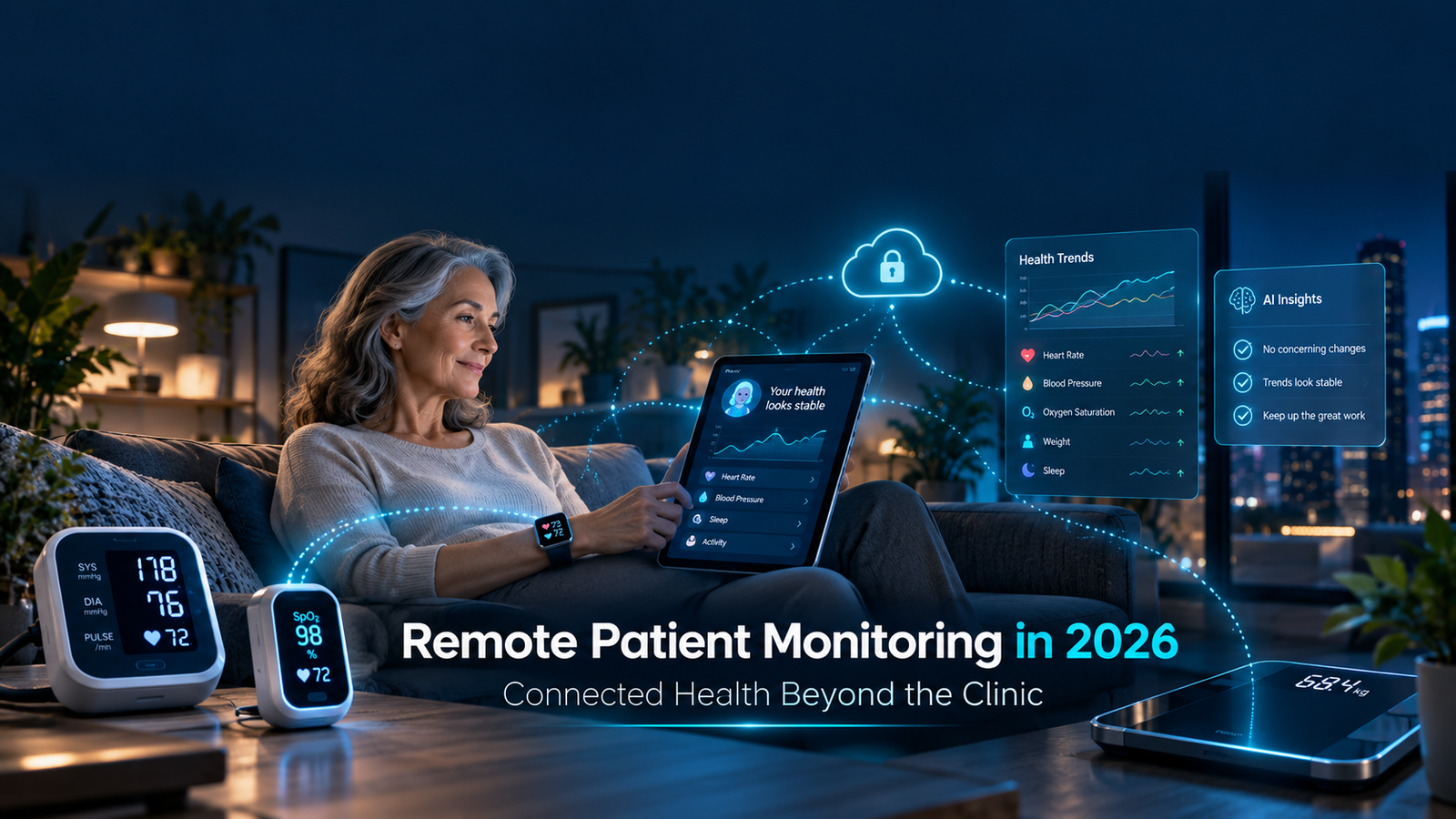
Health care is becoming more connected, continuous, and increasingly capable of extending beyond the walls of hospitals and clinics.
One of the technologies driving that shift is remote patient monitoring, commonly known as RPM.
Instead of relying only on occasional office visits, remote patient monitoring allows patients to collect health measurements at home and share those data with their health care team through connected devices.
A blood pressure cuff can transmit readings.
A connected scale can track changes in weight.
A glucose-monitoring system can provide ongoing information about blood sugar.
A pulse oximeter can measure oxygen saturation.
Other connected devices can capture heart rate, respiratory information, activity, or additional physiologic measurements.
The basic idea is simple:
measure health data remotely, transmit it securely, review meaningful changes, and use the information to support care.
In 2026, RPM is no longer just a temporary pandemic-era experiment. Medicare broadly covers remote physiologic monitoring for acute and chronic conditions, using internet-connected medical devices that automatically upload data. CMS currently describes RPM as including device setup and education, device supply/data transmission, and treatment management.
But remote patient monitoring is not simply about sending more numbers to doctors.
Its real value depends on what happens after the data arrive.
A successful RPM system must help patients use devices correctly, identify clinically meaningful changes, route information to the right care team, avoid overwhelming clinicians with unnecessary alerts, protect sensitive health data, and support appropriate follow-up.
This guide explains how remote patient monitoring works in 2026, the technologies behind it, where it can help, its limitations, privacy and cybersecurity concerns, the role of AI, and why connected health may become an increasingly important part of future care.
Table of Contents
Remote Patient Monitoring in 2026: Quick Overview
| Question | General Answer |
|---|---|
| What is remote patient monitoring? | The use of connected health devices to collect patient data outside traditional clinical settings and transmit it to health care providers. |
| Is RPM the same as telehealth? | No. Telehealth usually involves remote communication such as video or phone visits, while RPM focuses on ongoing collection and transmission of health data. |
| What can RPM devices measure? | Depending on the device, measurements can include blood pressure, weight, glucose, oxygen saturation, heart rate, respiratory data, and other physiologic information. |
| Does Medicare cover RPM? | Medicare broadly covers eligible remote physiologic monitoring services for acute and chronic conditions when applicable requirements are met. |
| Does RPM require a medical device? | For Medicare RPM, CMS states that the connected device must meet the FDA definition of a medical device and digitally upload data. |
| Can ordinary smartwatches count as RPM? | Not automatically. Consumer wellness devices and clinically used connected medical devices are not necessarily the same thing. |
| Can AI analyze RPM data? | AI and automated software can help identify patterns and prioritize alerts, but clinical decisions still require appropriate human oversight. |
| Does RPM replace doctors? | No. It is designed to extend monitoring between visits, not replace professional evaluation or necessary in-person care. |
| What are the main risks? | Data overload, false alerts, missed alerts, device problems, privacy risks, cybersecurity threats, access barriers, and poor workflow integration. |
| Why does RPM matter? | It can provide clinicians with a more continuous picture of a patient’s health instead of relying only on occasional measurements during office visits. |
1. What Is Remote Patient Monitoring?
Remote patient monitoring is a form of connected health care in which health information is collected outside a traditional clinical setting and transmitted to a health care provider.
The patient may be at home, at work, traveling, or living in a long-term care environment.
The device may collect information automatically or require the patient to take a measurement.
The information is then transmitted through a connected platform where it can be reviewed by clinicians or care teams.
The U.S. Department of Health and Human Services describes RPM as technology that allows patients to track health at home, share information with providers, and manage care between visits. Common examples include smart scales, blood pressure devices, and heart-rate monitors.
The key point is that RPM creates a data connection between the patient’s everyday environment and the health care system.
Instead of asking:
“What was your blood pressure when you visited the clinic three months ago?”
a clinician may be able to review:
“How has your blood pressure changed over the last several weeks?”
That difference can provide a much richer picture of what is happening between appointments.
2. How Does Remote Patient Monitoring Work?
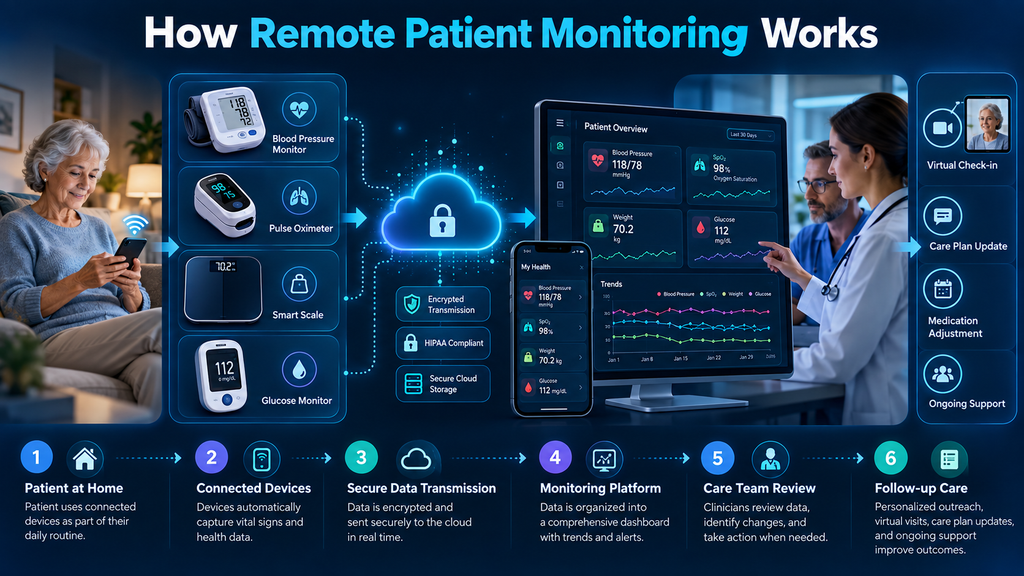
A typical RPM workflow contains several steps.
Step 1: A Clinician Determines What Should Be Monitored
The monitoring should have a clear clinical purpose.
For one patient, that may be blood pressure.
For another, it may be weight, glucose, oxygen saturation, respiratory measurements, or another physiologic parameter.
Collecting data simply because technology makes it possible is not enough.
The information should support a meaningful care goal.
Step 2: The Patient Receives a Connected Device
The device might be:
- A connected blood pressure cuff
- A digital scale
- A pulse oximeter
- A glucose-monitoring device
- A heart-rate monitor
- Another appropriate connected medical device
The patient must understand how to use the device correctly.
Incorrect placement, poor technique, low batteries, or inconsistent use can reduce data quality.
Step 3: Measurements Are Collected
The patient takes readings according to the monitoring plan.
Some devices transmit data automatically.
Others may synchronize through a smartphone, tablet, home hub, or cellular connection.
Step 4: Data Are Sent to a Monitoring Platform
The readings travel to a software platform used by the health care organization.
Ideally, the system organizes the data into trends rather than forcing clinicians to examine hundreds of isolated readings.
Step 5: Rules or Software Identify Important Changes
The platform may use thresholds, trend analysis, or other logic to identify measurements that deserve attention.
For example, the system might flag:
- Repeated unusually high blood pressure
- Rapid weight changes
- Low oxygen readings
- Unusual glucose patterns
- Missing measurements
Step 6: A Care Team Reviews the Information
This is where RPM becomes health care rather than simply data collection.
Clinical staff may review trends, contact the patient, provide education, arrange follow-up, or escalate concerns to an appropriate practitioner.
Step 7: Care May Be Adjusted When Appropriate
The monitoring information becomes one source of evidence used in managing the patient.
The device does not independently decide treatment.
The health care team interprets the information in the context of the patient’s condition and broader clinical picture.
3. Remote Patient Monitoring vs. Telehealth
Remote patient monitoring and telehealth are related, but they are not identical.
A telehealth visit usually involves direct communication between a patient and a clinician.
Examples include:
- Video consultations
- Telephone visits
- Virtual follow-up appointments
RPM focuses on data collection between visits.
A patient may take blood pressure readings every day without having a video call each time.
The two approaches can work together.
For example:
- A patient collects blood pressure measurements at home.
- The connected cuff sends them automatically.
- The care team notices a concerning trend.
- A virtual appointment is scheduled.
- The clinician discusses the readings with the patient.
In this workflow, RPM provides the data and telehealth provides the conversation.
4. Remote Patient Monitoring vs. Remote Therapeutic Monitoring
Another term commonly encountered is remote therapeutic monitoring, or RTM.
Although the names sound similar, they are not identical.
Remote physiologic monitoring generally focuses on physiologic measurements such as blood pressure, weight, oxygen saturation, or similar data.
Remote therapeutic monitoring can focus more on therapy adherence, therapy response, and related information.
CMS treats RPM and RTM as separate remote-monitoring code families. In 2026, CMS also added new RTM codes covering shorter device-use periods and treatment-management time.
For ordinary patients, the technical billing distinction may not be particularly important.
For health care organizations, however, understanding which service is actually being provided matters for documentation, workflow, and reimbursement.
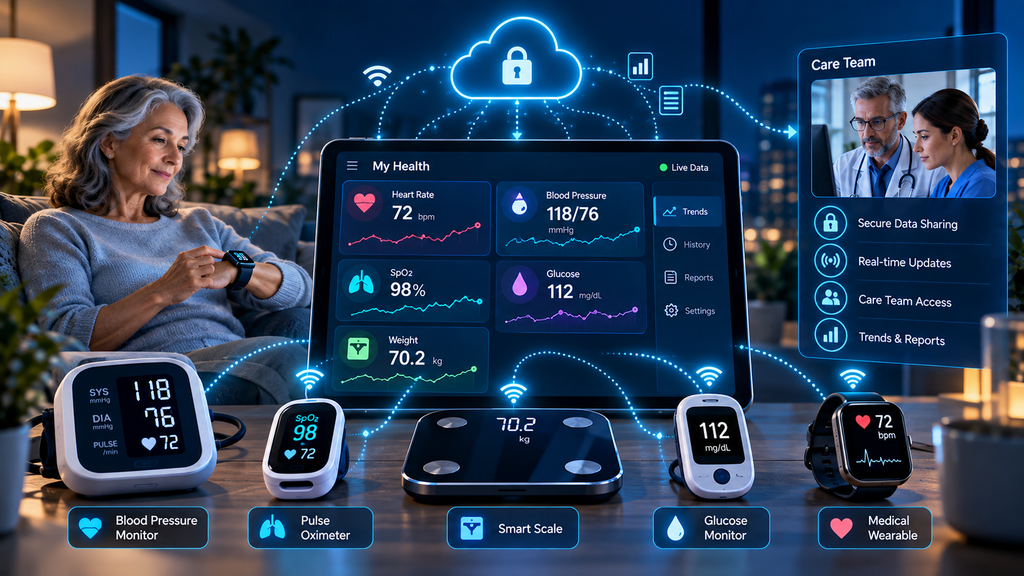
5. What Devices Are Used for Remote Patient Monitoring?
There is no single RPM device.
The technology depends on what needs to be measured.
Connected Blood Pressure Monitors
These are among the most recognizable RPM devices.
Patients take measurements at home, and readings are transmitted to a health care platform.
Instead of relying on one office measurement, clinicians can review trends across multiple days.
Connected Weight Scales
Weight can be important in the management of certain conditions.
A connected scale can automatically transmit measurements and help a care team identify notable changes.
Pulse Oximeters
Pulse oximeters estimate blood oxygen saturation and pulse rate.
Connected versions can transmit measurements for remote review when clinically appropriate.
Glucose-Monitoring Technologies
Connected glucose systems can provide information about blood sugar patterns over time.
Depending on the system, data may be transmitted automatically or synchronized through another device.
Cardiac Monitoring Technologies
Various technologies can collect heart-related information.
Some are intended for longer-term diagnostic monitoring, while others may support ongoing management.
Not all heart-monitoring products are used under the same regulatory or reimbursement framework.
Wearable Sensors
Wearables can measure variables such as heart rate, activity, sleep-related signals, movement, or other physiological information.
However, a critical distinction is necessary:
A consumer wearable is not automatically a clinical RPM device.
A smartwatch marketed for general wellness is not necessarily equivalent to a medical device being used within an RPM program.
6. Consumer Wearables vs. Medical Monitoring Devices
Connected health is increasingly blurring the boundary between consumer electronics and medical technology.
Modern smartwatches can measure impressive amounts of information.
But collecting health-related data does not automatically make a device suitable for clinical RPM.
For Medicare RPM, CMS currently states that the connected device must meet the FDA definition of a medical device and digitally upload the data.
That distinction matters.
A consumer fitness tracker might be useful for:
- Personal activity tracking
- General wellness goals
- Exercise monitoring
- Sleep trends
A medical monitoring device may need stronger validation, reliability, regulatory oversight, and integration into clinical workflows.
The future will likely contain more overlap between the two categories.
But users should not assume that every health feature on a consumer device has the same clinical meaning.
7. What Changed for RPM in 2026?
Remote monitoring policy continues to evolve.
CMS materials for 2026 describe RPM as available for acute or chronic conditions and include device-data collection requirements that vary according to the applicable code descriptor. The current CMS remote-monitoring booklet notes collection windows of 2–15 days or 16+ days in a 30-day period, depending on the service being reported.
This matters because older explanations of RPM often referred broadly to a 16-day threshold.
Health care organizations should therefore rely on current CMS and coding guidance rather than outdated summaries.
Another important trend is that remote monitoring is increasingly being treated as a long-term health care capability rather than a temporary emergency solution.
CMS began covering RPM years before the COVID-19 pandemic, and the program has continued to expand.
8. Why Is Remote Patient Monitoring Growing?
Several forces are driving RPM adoption.
Chronic Disease Requires Ongoing Management
Many health conditions do not change only during clinic visits.
They evolve every day.
Monitoring information between appointments can provide a more continuous picture.
Health Care Systems Face Capacity Pressure
In-person appointments require clinic space, staff time, transportation, and scheduling.
RPM cannot replace necessary visits, but it may allow some monitoring to occur remotely.
Connected Devices Are Becoming Easier to Use
Devices are increasingly capable of transmitting information automatically through cellular, Wi-Fi, Bluetooth, or connected hubs.
Patients Are More Comfortable With Digital Health
Online portals, virtual appointments, wearable devices, digital prescriptions, and health apps have made technology a routine part of health care for many people.
Health Care Is Moving Toward Continuous Data
Traditional medicine often relies on snapshots.
Connected health creates longitudinal information.
That can change how clinicians think about trends.
9. The Biggest Potential Benefit: Seeing Trends Between Visits
Consider a patient whose blood pressure looks acceptable during a clinic appointment.
That single reading may not represent what happens during the rest of the month.
At home, readings could be consistently higher.
Or the opposite could occur.
RPM makes it possible to observe patterns over time.
HHS notes that remote monitoring can provide patients and providers with a fuller picture across days, weeks, or months rather than only the snapshot captured during a health care visit.
This is one of the most compelling ideas behind RPM.
More measurements do not automatically produce better care.
But when reliable measurements are combined with good clinical interpretation, they can provide context that a single office reading cannot.
10. Which Conditions Can Be Monitored?
RPM can be used in different clinical scenarios, depending on the patient, condition, device, and care plan.
CMS states that Medicare RPM can support both chronic and acute conditions.
Common examples of areas where remote monitoring may be considered include:
- Hypertension
- Diabetes
- Certain cardiovascular conditions
- Chronic respiratory conditions
- Weight-related monitoring
- Some post-discharge situations
- Other conditions where repeated physiologic measurements are clinically useful
The important word is may.
RPM should not be treated as a universal solution for every condition or every patient.
Its usefulness depends on the specific clinical context.
11. Can RPM Reduce Hospital Visits?
This question requires a careful answer.
Remote monitoring can help identify changes earlier and may support proactive management in selected populations.
But research results are not identical across every condition or RPM program.
A systematic review of acute-care utilization found that some RPM programs reduced hospital use, particularly in certain cardiovascular and COPD populations, while many studies reported no significant change. Effectiveness varied substantially across patient groups and implementation models.
That is an important lesson.
The technology alone does not determine the outcome.
Results can depend on:
- Which patients are selected
- What is measured
- How frequently data are reviewed
- How alerts are designed
- How quickly the care team responds
- Whether the patient understands the device
- Whether the health organization has a clear intervention pathway
A connected scale sitting in someone’s home does not reduce hospitalizations by itself.
The value comes from the care system built around the data.
12. Remote Monitoring and Clinical Research
The same technologies used in connected care can also play a role in medical research.
The FDA has formal guidance covering the use of digital health technologies to collect data remotely from participants in clinical investigations.
These technologies can include hardware, software, sensors, and connected systems.
FDA says remote data acquisition can make participation more convenient and may improve the efficiency of clinical investigations.
This can be particularly useful when researchers want information about participants in their normal environment rather than only during scheduled study visits.
For example, digital technologies can potentially collect:
- Activity information
- Physiologic measurements
- Movement data
- Symptoms
- Other digital measures
In 2026, FDA also launched a funding opportunity focused on advancing digital health technologies in drug development, including technologies such as actigraphy, photography, and contactless sensors.
This demonstrates that remote health data are becoming important not only for clinical care but also for the future of medical research.
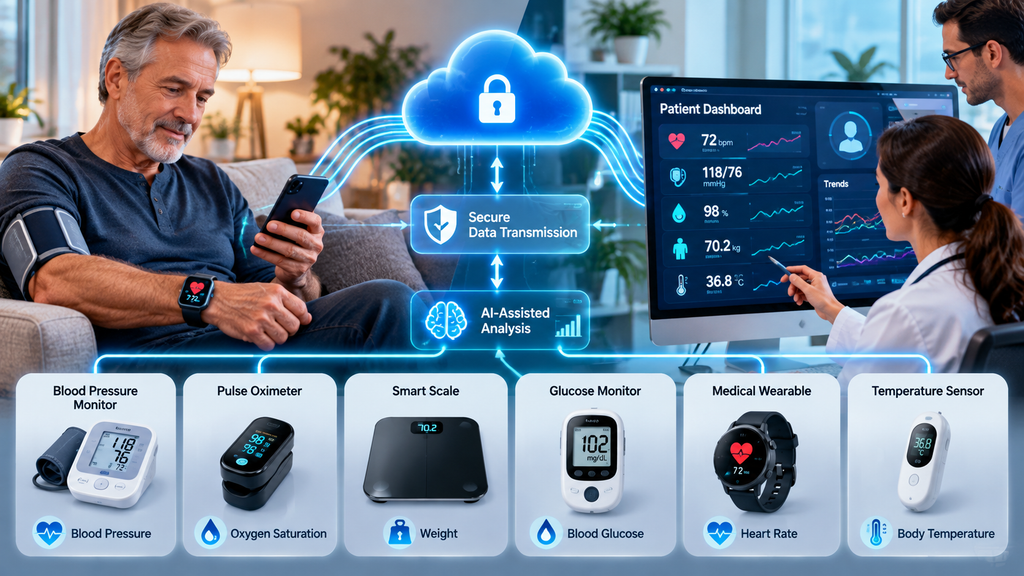
13. How AI Could Change Remote Patient Monitoring
RPM can generate a large volume of data.
That creates an obvious role for artificial intelligence and advanced analytics.
Imagine thousands of patients transmitting readings every day.
A care team cannot manually examine every measurement with equal attention.
Software can help identify patterns that deserve review.
Potential applications include:
- Trend detection
- Risk prioritization
- Alert filtering
- Identification of missing data
- Detection of unusual patterns
- Summarization of longitudinal measurements
- Support for care-team workflows
But this is where connected health must be designed carefully.
An AI system that generates too many alerts can create alert fatigue.
A system that misses a meaningful change can create false reassurance.
A model trained on poorly representative data may perform differently across patient populations.
Therefore the goal should not be:
“Let AI make the medical decision.”
A safer goal is:
“Use AI to help qualified professionals navigate large amounts of information more effectively.”
14. The Problem of Alert Fatigue
Imagine an RPM program monitoring thousands of people.
If every measurement outside a narrow threshold generates an alert, staff may receive hundreds or thousands of notifications.
Many may not require immediate action.
Over time, excessive notifications can make it harder to identify the few alerts that truly matter.
This is known as alert fatigue.
A well-designed RPM program therefore needs more than simple thresholds.
It may need:
- Personalized ranges
- Repeated-reading confirmation
- Trend-based rules
- Escalation levels
- Clinical prioritization
- Clear ownership of alerts
The question is not simply whether the system can create alerts.
The more important question is:
Can it create the right alerts for the right people at the right time?
15. Data Quality Is More Important Than Data Quantity
More health data can look impressive.
But low-quality data can create confusion.
Measurements may become unreliable because of:
- Incorrect device placement
- Poor patient technique
- Device malfunction
- Weak connectivity
- Incorrect pairing
- Calibration problems
- Missing readings
- Accidental duplicate readings
This is why education and device setup are fundamental components of RPM.
CMS specifically lists education/setup as one of the three main components of remote patient monitoring.
A sophisticated dashboard cannot compensate for consistently incorrect measurements.
16. Cybersecurity and Privacy
A traditional blood pressure cuff that stores nothing has a very different risk profile from a connected device that sends health data across networks.
Strong cybersecurity practices are therefore essential whenever connected medical devices and cloud platforms handle sensitive health data.
RPM systems may involve:
- Medical devices
- Smartphones
- Home Wi-Fi
- Cellular connections
- Cloud platforms
- Electronic health records
- Third-party software
Every connection creates another part of the system that must be secured.
Cybersecurity concerns can include:
- Unauthorized access
- Weak passwords
- Compromised devices
- Unpatched software
- Insecure data transmission
- Vendor vulnerabilities
- Account takeover
- Excessive data access
The FDA maintains specific cybersecurity guidance for medical-device manufacturers, and its digital-health guidance emphasizes the importance of data integrity and privacy when digital technologies collect information remotely.
Security should therefore be part of RPM design from the beginning—not an afterthought added after deployment.
17. What Happens When the Internet Fails?
Connected health depends on connectivity.
That creates practical problems.
Not every patient has:
- Reliable broadband
- Strong cellular coverage
- A modern smartphone
- Unlimited data
- Technical confidence
Some patients may struggle with:
- Bluetooth pairing
- Account passwords
- Software updates
- Charging devices
- App permissions
- Wi-Fi configuration
A good RPM program must therefore consider what happens when technology fails.
Possible solutions include:
- Cellular-enabled devices
- Simplified interfaces
- Preconfigured equipment
- Technical support
- Automatic data buffering
- Alternative contact methods
- Clear escalation procedures
Health technology becomes less useful if the people who might benefit most cannot reliably use it.
18. The Digital Divide
RPM can improve access in some situations.
It can also create new barriers.
Patients in rural areas may benefit from reducing unnecessary travel.
Patients with mobility limitations may find home monitoring more convenient.
But the same populations may have weaker internet access or fewer digital resources.
Other barriers can include:
- Language
- Disability
- Health literacy
- Digital literacy
- Device affordability
- Lack of caregiver support
The future of remote care therefore depends not only on better devices.
It depends on inclusive design.
A system that works perfectly for a technically confident user but fails for everyone else will not deliver equitable connected care.
19. Remote Patient Monitoring Does Not Mean Constant Surveillance
The phrase “remote monitoring” can sound invasive.
It is important to distinguish clinical RPM from continuous surveillance.
A typical RPM program is designed around specific health measurements.
For example:
- Blood pressure
- Weight
- Glucose
- Oxygen saturation
The program does not necessarily track everything a patient does.
Patients should understand:
- What information is collected
- How often it is collected
- Who can access it
- Why it is being collected
- How it will be used
Transparency is essential for trust.
20. Why Workflow Matters More Than the Dashboard
Health technology companies often focus heavily on dashboards.
Dashboards can be beautiful.
They can display charts, colors, alerts, and trends.
But the central question is operational:
What happens after the dashboard identifies a problem?
A successful RPM program needs a defined workflow.
For example:
- A concerning trend appears.
- The system assigns an alert priority.
- A qualified team member reviews it.
- The patient is contacted when appropriate.
- The issue is escalated if necessary.
- The action is documented.
- Follow-up occurs.
Without this process, RPM risks becoming a large data-collection system with limited clinical impact.
21. The Risk of Fraud and Overuse
Growth in RPM has also attracted greater regulatory attention.
The HHS Office of Inspector General reported that Medicare RPM use continued to increase in 2024 and that payments exceeded $500 million that year. OIG developed billing measures intended to help identify practices that may warrant additional scrutiny and emphasized the need to prevent fraud, waste, and abuse.
This does not mean RPM itself is problematic.
It means rapidly growing health technologies require oversight.
Potential concerns include:
- Billing without meaningful monitoring
- Supplying unnecessary devices
- Weak patient engagement
- Duplicate monitoring
- Poor documentation
- Programs designed around reimbursement rather than patient need
The long-term credibility of RPM will depend on demonstrating that connected monitoring provides legitimate clinical value.
22. Is Remote Patient Monitoring Cost-Effective?
The answer varies.
A 2025 systematic review of cost-effectiveness analyses found growing interest in active remote monitoring for long-term conditions but also highlighted the importance of how programs are designed and evaluated.
Potential savings could come from:
- Fewer unnecessary visits
- Earlier interventions
- Reduced travel
- More efficient follow-up
- Better targeting of clinical resources
But RPM also creates costs:
- Devices
- Software platforms
- Connectivity
- Technical support
- Clinical staff time
- Cybersecurity
- Integration
- Training
The correct question is therefore not:
“Is RPM cheaper?”
It is:
“Does this particular RPM program provide enough clinical and operational value to justify its total cost?”
23. Could Remote Monitoring Move More Care Into the Home?
This is one of the larger implications of connected health.
Historically, many health measurements required patients to travel to a medical facility.
Connected devices allow some of those measurements to occur at home.
That does not mean the hospital disappears.
Instead, care may become distributed across multiple environments.
A future care model could combine:
- In-person appointments
- Video consultations
- Home measurements
- Wearable sensors
- Electronic health records
- Remote clinical teams
- AI-assisted analytics
The clinic may remain the center of clinical expertise while becoming less dependent on every interaction happening physically inside the building.
24. The Future: From Remote Monitoring to Connected Care
The phrase “remote patient monitoring” focuses on the device.
The future may be better described as connected care.
In connected care, multiple systems work together.
For example:
sensor → smartphone or hub → cloud platform → AI analysis → electronic health record → care team → patient
More capable AI agents could eventually help coordinate parts of these multi-step digital workflows while keeping appropriate human oversight in place.
The goal is not simply to produce more readings.
The goal is to make relevant health information available when it can support better decisions.
Future systems may become better at:
- Personalizing alert thresholds
- Integrating multiple data streams
- Detecting subtle trends
- Summarizing long histories
- Predicting deterioration risk
- Coordinating care teams
- Connecting RPM with virtual care
But the most important improvements may not come from algorithms.
They may come from better workflow design.
25. Will Remote Patient Monitoring Replace Clinic Visits?
No.
Some health problems require physical examination.
Others require:
- Imaging
- Laboratory testing
- Procedures
- Hands-on assessment
- Direct observation
- Emergency evaluation
RPM is better understood as an additional layer of care.
It can help fill the gap between appointments.
The future is likely to be hybrid:
in-person care when needed + remote monitoring when useful + virtual communication when appropriate.
26. What Patients Should Understand Before Using RPM
Patients entering an RPM program should know what the system is designed to do.
Useful questions include:
- What will the device measure?
- How often should I use it?
- Does it transmit automatically?
- Who reviews the information?
- How quickly are alerts reviewed?
- What should I do in an emergency?
- Who do I contact if the device stops working?
- How is my information protected?
- Are there costs associated with the service?
Most importantly:
RPM should never be assumed to function as an emergency-response system unless the specific service explicitly provides that capability.
A patient experiencing urgent or severe symptoms should follow the emergency instructions provided by their health care team rather than relying on a remote dashboard to detect the problem.
27. What Health Care Organizations Need to Get Right
A strong RPM program requires more than buying devices.
Organizations need to design the entire system.
Key questions include:
Patient Selection
Which patients are likely to benefit?
Device Selection
Is the device reliable and appropriate for the intended use?
Education
Can patients use it correctly?
Connectivity
How will readings reach the platform?
Data Integration
Can the information integrate with existing health records and workflows?
Alert Design
Which measurements require action?
Staffing
Who reviews the data?
Escalation
What happens when a concerning trend appears?
Privacy and Cybersecurity
How are patient data protected?
Evaluation
Is the program actually improving care?
Without answers to these questions, RPM can create more complexity rather than less.
28. Why Remote Patient Monitoring Matters for Future Tech
Remote patient monitoring represents an important change in how technology interacts with everyday life.
The most significant shift is not the device itself.
Digital blood pressure cuffs have existed for years.
Scales have existed for far longer.
The transformation comes from connectivity.
A measurement can now move from:
patient → device → network → clinical platform → health care team
within a connected workflow.
That creates the possibility of health care becoming more continuous.
Instead of waiting for a patient to return months later, a care team may have access to meaningful trends between visits.
This does not guarantee better outcomes.
But it creates a new technological foundation on which better care models can potentially be built.
Frequently Asked Questions
What is remote patient monitoring in simple terms?
Remote patient monitoring uses connected devices to collect health measurements outside a clinic and transmit those measurements to a health care team.
Is RPM the same as telemedicine?
No. Telemedicine or telehealth usually involves remote communication with a health professional. RPM focuses mainly on collecting and transmitting health data between visits.
What devices are commonly used for RPM?
Examples include connected blood pressure cuffs, digital scales, pulse oximeters, glucose-monitoring technologies, and other appropriate connected medical devices.
Does Medicare cover remote patient monitoring?
CMS broadly covers eligible remote physiologic monitoring services for acute and chronic conditions when Medicare requirements are satisfied. Coverage and billing details depend on the service and current rules.
Can a smartwatch be used for remote patient monitoring?
Possibly in some care programs, but a consumer smartwatch is not automatically equivalent to a clinical RPM device. Medicare RPM device requirements specifically involve devices meeting the FDA definition of a medical device.
Does RPM work without a smartphone?
Some devices can transmit through built-in cellular connectivity or dedicated hubs, so a smartphone is not always necessary.
Can AI monitor RPM data?
AI and analytics can help identify patterns, summarize trends, and prioritize alerts. They should support rather than replace appropriate clinical judgment.
Is remote patient monitoring safe?
RPM can be useful when implemented correctly, but risks include inaccurate measurements, missed alerts, excessive alerts, cybersecurity problems, privacy concerns, and poor workflow design.
Does RPM replace emergency care?
No. Remote monitoring should not be treated as a substitute for emergency evaluation unless a specific service explicitly provides emergency-response capabilities.
Can RPM reduce hospitalizations?
Some research has found reductions in acute-care use for selected conditions and patient groups, while other studies show little or no difference. Results depend greatly on how the monitoring program is designed and used.
What is the difference between RPM and RTM?
RPM generally focuses on remotely collected physiologic information, while remote therapeutic monitoring focuses on therapy adherence, therapy response, and related therapeutic information.
Why is RPM important in 2026?
Connected devices, virtual care, digital health platforms, AI-assisted analytics, and evolving reimbursement are making remote monitoring an increasingly important part of the broader connected-health ecosystem.
Final Thoughts
Remote patient monitoring in 2026 is not simply about putting connected devices in patients’ homes.
It represents a broader transition from episodic health care toward more continuous, data-informed care.
A traditional appointment provides a snapshot.
Remote monitoring can provide a trend.
That trend may help clinicians understand what happens between visits, identify changes earlier, and maintain a stronger connection with patients outside traditional health care settings.
But technology alone is not enough.
Good RPM requires:
reliable devices, accurate data, patient education, secure systems, intelligent alerts, well-designed workflows, qualified clinical oversight, and appropriate follow-up.
The future will likely bring smarter sensors, improved connectivity, stronger electronic-health-record integration, and more AI-assisted analysis.
At the same time, the most important principle should remain unchanged:
health data only become valuable when they lead to responsible and clinically appropriate action.
Remote patient monitoring will not replace hospitals, physicians, nurses, clinics, or necessary face-to-face care.
Its most promising role is to connect them more effectively with what happens in patients’ lives between visits.
That is why RPM may become one of the foundations of connected health:
not care without clinicians, but care that can remain connected even when the patient and clinician are miles apart.
Sources
- Centers for Medicare & Medicaid Services — Remote Patient Monitoring
- Centers for Medicare & Medicaid Services — Telehealth & Remote Monitoring
- Telehealth.HHS.gov — How Can I Use Remote Patient Monitoring?
- U.S. Food and Drug Administration — Digital Health Technologies for Remote Data Acquisition in Clinical Investigations
- U.S. Food and Drug Administration — Digital Health Technologies for Drug Development
- U.S. Food and Drug Administration — Guidances With Digital Health Content
- HHS Office of Inspector General — Billing for Remote Patient Monitoring in Medicare
- npj Digital Medicine — A Systematic Review of the Impacts of Remote Patient Monitoring Interventions
- npj Digital Medicine — Active Remote Monitoring of Long-Term Conditions With Mobile Devices: A Systematic Review of Cost-Effectiveness Analyses
- BMJ Open — Does Remote Patient Monitoring Reduce Acute Care Use? A Systematic Review