Artificial intelligence is increasingly moving beyond chatbots, image generation, and productivity tools into some of the most complex areas of science.
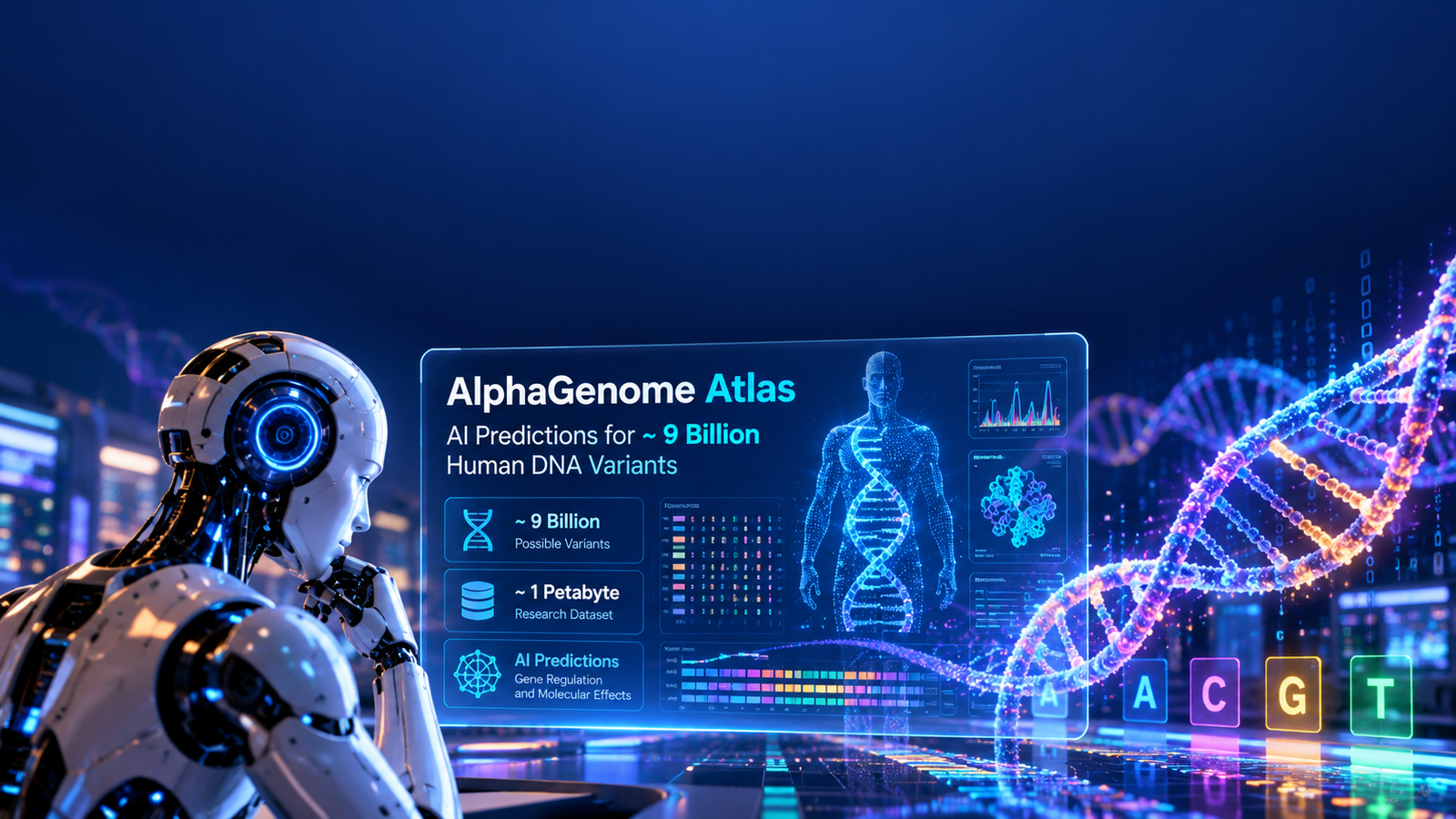
One of the clearest examples arrived in September 2026, when Google DeepMind introduced AlphaGenome Atlas, a large-scale resource containing AI-generated predictions for the molecular effects of roughly 9 billion possible single-letter changes in the human genome.
The number sounds extraordinary, but there is a simple reason for it. The human genome contains roughly three billion DNA letters. At almost every position, a DNA letter could theoretically be replaced by one of the other three letters, creating billions of possible single-nucleotide variants.
Testing every possible change experimentally would be unrealistic.
AlphaGenome Atlas approaches the problem differently.
Instead of performing billions of laboratory experiments, Google DeepMind used its AlphaGenome artificial intelligence model to precompute predictions across the genome and organize those results into a searchable atlas for researchers.
The result is a dataset of roughly one petabyte designed to help scientists prioritize genetic variants, study how DNA changes may affect gene regulation, and generate better hypotheses for laboratory investigation.
But AlphaGenome Atlas should not be misunderstood.
It is not a DNA diagnosis machine, it does not determine whether a person will develop a disease, and its predictions do not replace experimental or clinical evidence.
Its real importance lies in something more fundamental: helping researchers navigate an enormous biological search space that would otherwise
be practically impossible to explore variant by variant.
Table of Contents
AlphaGenome Atlas in 2026: Quick Overview
| Question | General Answer |
|---|---|
| What is AlphaGenome Atlas? | A large research resource containing AlphaGenome predictions for roughly 9 billion possible single-letter variants in the human genome. |
| Who created it? | Google DeepMind. |
| When was it announced? | September 8, 2026. |
| Is AlphaGenome Atlas a new AI model? | Not exactly. It is a precomputed atlas built primarily from predictions generated by the AlphaGenome model. |
| What is AlphaGenome? | An AI model that predicts how DNA sequences and genetic variants may affect molecular processes involved in gene regulation. |
| How large is the Atlas? | Google DeepMind describes it as approximately a 1-petabyte dataset. |
| What is the AVI score? | The AlphaGenome Variant Impact score, designed to help researchers prioritize variants by summarizing predictive information. |
| Does it cover coding and non-coding DNA? | Yes. The Atlas is designed to support analysis of both protein-coding and regulatory/non-coding variants. |
| Can it diagnose genetic diseases? | No. It predicts molecular effects and is intended to support research, not replace clinical diagnosis. |
| Why does it matter? | It can help researchers narrow billions of possible DNA changes to a much smaller set of variants worth investigating experimentally. |
1. What Is AlphaGenome?
To understand the Atlas, it helps to begin with the underlying AI system.
AlphaGenome is a DNA sequence model developed by Google DeepMind to predict how genomic sequences influence molecular biology.
The model was first introduced publicly in 2025 and its research was published in Nature in January 2026.
AlphaGenome can process DNA sequences as long as approximately one million base pairs and generate predictions at very high resolution across thousands of genomic measurements.
These predictions can include molecular processes related to:
- Gene expression
- Transcription initiation
- Chromatin accessibility
- Histone modifications
- Transcription-factor binding
- RNA splicing
- Chromatin interactions
- Other regulatory activity
This matters because many genetic changes do not directly alter a protein.
Instead, they affect the complex regulatory machinery that determines when a gene is active, where it is active, how strongly it is expressed, or how its RNA is processed.
Understanding these regulatory effects has historically been extremely difficult.
AlphaGenome is designed to help researchers predict some of those effects directly from DNA sequence.
2. AlphaGenome vs. AlphaGenome Atlas
The names are similar, but they describe different things.
AlphaGenome is the AI model.
AlphaGenome Atlas is the large collection of predictions produced using that model.
A useful analogy is weather forecasting.
A weather model performs calculations to predict atmospheric conditions.
A weather map presents the resulting predictions in a form people can explore.
Similarly, AlphaGenome can evaluate particular DNA sequences or genetic variants, while AlphaGenome Atlas takes the concept to a much larger scale by precomputing predictions across billions of possible variants.
This distinction is important.
The Atlas does not require a researcher to begin every investigation by running billions of new AlphaGenome predictions.
Much of that computational work has already been performed.
Researchers can instead search, compare, prioritize, and interpret precomputed results.
3. Why Are There About 9 Billion Possible DNA Variants?
DNA is written using four chemical bases commonly represented by the letters:
A, C, G, and T.
The human genome contains roughly three billion positions.
At any individual position, the existing DNA letter could theoretically be replaced by one of the other three.
For example:
A → C
A → G
A → T
When this type of change affects a single DNA position, it is called a single-nucleotide variant, or SNV.
Across billions of positions and multiple alternative letters, the theoretical search space reaches roughly nine billion possible single-letter changes.
Most of these changes will never occur in any particular individual.
Many may have little or no biological effect.
Some may influence molecular activity.
A much smaller number could contribute to meaningful changes in traits or disease-related biological processes.
The challenge is determining which variants actually deserve further attention.
That is the problem AlphaGenome Atlas is designed to help researchers tackle.
4. Why Understanding Genetic Variants Is So Difficult
The human genome is sometimes described as a biological instruction manual, but that analogy can make genetics sound simpler than it really is.
DNA does not function as a straightforward list of independent instructions.
Genes interact with regulatory elements, proteins, molecular signals, three-dimensional chromosome structures, cell types, environmental conditions, and other genes.
A genetic variant may therefore have very different consequences depending on where it occurs and what biological process it affects.
This is especially challenging in non-coding DNA.
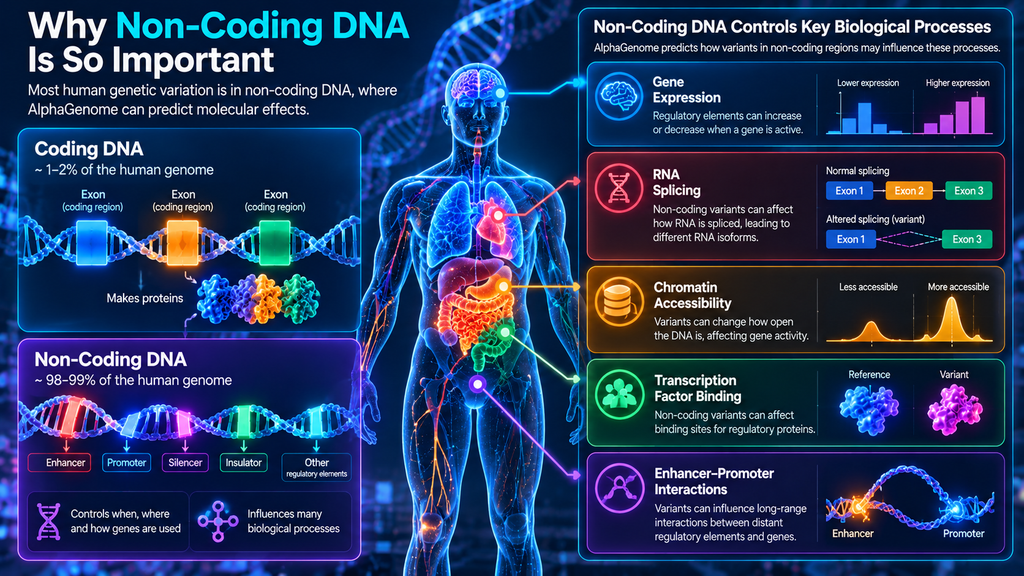
Only around 2% of the human genome directly encodes proteins.
Much of the remaining genome contains sequences involved in controlling gene activity and other biological functions.
A non-coding variant may alter:
- Whether a gene turns on
- How strongly a gene is expressed
- Which cells express it
- How RNA is spliced
- How regulatory proteins bind to DNA
- How different genomic regions interact
These effects can be difficult to identify experimentally.
AI models such as AlphaGenome provide researchers with another way to prioritize which possibilities are worth investigating.
5. How AlphaGenome Predicts Variant Effects
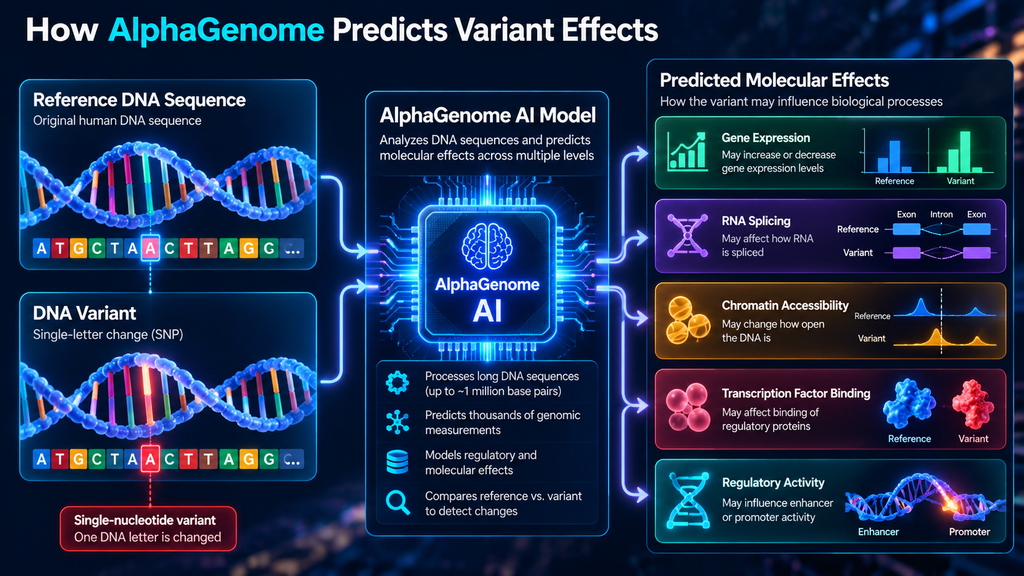
At a simplified level, AlphaGenome can compare two versions of a DNA sequence.
One contains the reference DNA sequence.
The other contains a genetic variant.
The model predicts molecular properties for both sequences and evaluates how those predictions change when the variant is introduced.
For example, a single-letter change might be predicted to alter:
- Gene expression
- RNA splicing
- Chromatin accessibility
- Transcription-factor binding
- Regulatory activity
This does not prove that the predicted biological change will occur in a real person.
Instead, it produces a computational hypothesis about how that genetic change could affect molecular biology.
Researchers can then combine those predictions with experimental results, population data, clinical observations, or other biological evidence.
That is a key principle to remember throughout this article:
Prediction helps prioritize experiments. It does not eliminate the need for experiments.
6. What Makes AlphaGenome Technically Important?
Earlier genomic AI systems often faced an important trade-off.
Some models could analyze long DNA regions but produced relatively low-resolution predictions.
Others could make highly detailed predictions but only across shorter DNA sequences.
AlphaGenome was designed to combine both advantages.
According to the research published in Nature, the model can analyze sequences up to around one million DNA base pairs while producing predictions at or near single-base resolution for many genomic outputs.
That combination is useful because gene regulation occurs at multiple scales.
A single nucleotide may affect a nearby molecular feature, while other regulatory interactions may involve genomic regions located thousands or even hundreds of thousands of bases apart.
Capturing both fine detail and broader genomic context is therefore valuable.
The published evaluation also found that AlphaGenome matched or exceeded strong external models across most of the variant-effect prediction benchmarks tested.
That does not mean AlphaGenome is perfect.
It means it represents an important step forward in sequence-to-function modeling.
7. From AlphaGenome to AlphaGenome Atlas
Running AlphaGenome on one variant is manageable.
Running it across every possible single-letter change in the human genome is a completely different challenge.
Google DeepMind addressed this by performing the predictions at enormous scale and storing the results in AlphaGenome Atlas.
The result is approximately a 1-petabyte research dataset.
One petabyte equals roughly one million gigabytes.
Instead of researchers individually computing every possible prediction, the Atlas provides a large precomputed map.
This changes the workflow.
A scientist investigating a genomic region can begin by searching existing predictions rather than building the entire computational analysis from scratch.
That can make exploratory research considerably faster.
8. What Is the AlphaGenome Variant Impact Score?
Billions of predictions create another problem.
Even if researchers can access the data, how do they decide which variants deserve attention first?
To help with this, DeepMind introduced the AlphaGenome Variant Impact score, or AVI score.
The purpose of the AVI score is to provide a compact way to prioritize genetic variants.
According to DeepMind, the score combines predictive information from AlphaGenome with information from AlphaMissense.
This is significant because the two systems focus on complementary parts of genetics.
AlphaGenome is particularly valuable for understanding regulatory and sequence-to-function effects.
AlphaMissense was designed to help predict the potential impact of missense variants that alter proteins.
Combining these perspectives gives researchers a way to rank variants across both protein-coding and regulatory regions.
The AVI score should still be interpreted as a research prioritization tool—not as a clinical verdict.
A high predicted impact does not automatically mean that a variant causes disease.
9. AlphaGenome vs. AlphaMissense
Google DeepMind now has several AI systems related to molecular biology, and their names can easily become confusing.
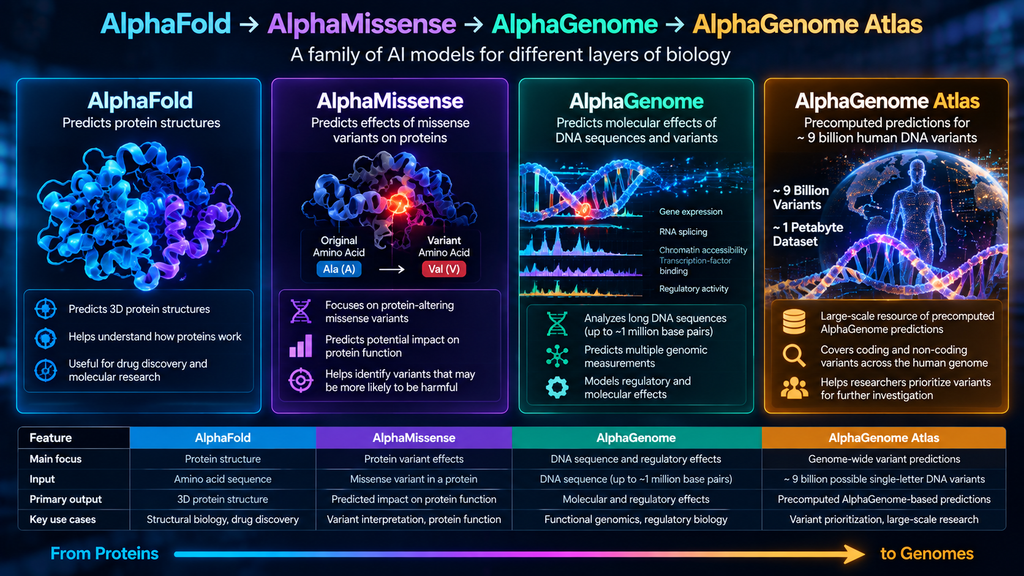
| System | Primary Purpose |
|---|---|
| AlphaFold | Predict protein structures and related molecular properties |
| AlphaMissense | Predict potential effects of missense variants on proteins |
| AlphaGenome | Predict molecular effects of DNA sequences and genetic variants across regulatory processes |
| AlphaGenome Atlas | Provide precomputed AlphaGenome-based predictions across billions of possible single-letter variants |
These tools address related biological questions, but they are not interchangeable.
AlphaFold asks questions primarily about proteins and their structures.
AlphaMissense focuses on protein-altering missense variants.
AlphaGenome looks more broadly at how DNA sequence affects gene regulation and molecular activity.
AlphaGenome Atlas scales that approach into a genome-wide resource.
Together, they illustrate a broader trend: AI systems are becoming increasingly specialized for different layers of biology.
10. Why Non-Coding DNA Is So Important
For many years, genetic research naturally focused heavily on protein-coding regions because changes to proteins can be relatively straightforward to study.
But most of the human genome is non-coding.
That does not mean it is useless.
Non-coding regions contain large numbers of regulatory sequences involved in controlling biological activity.
Many genetic associations with human traits and disease are also found outside protein-coding regions.
The difficulty is interpreting them.
If a variant changes a protein directly, researchers may be able to investigate the altered amino acid or protein structure.
If a variant occurs in a regulatory region, its effect may be less obvious.
It could influence gene activity only in a particular tissue.
It might alter RNA processing.
It may affect binding of a regulatory protein.
Or it may have almost no measurable effect at all.
AlphaGenome is particularly relevant to this challenge because it attempts to predict a wide range of molecular regulatory effects.
11. How Researchers Could Use AlphaGenome Atlas
AlphaGenome Atlas is designed primarily for scientific research.
One major application is variant prioritization.
Imagine a research team investigating thousands of variants associated with a rare disease.
Experimentally testing every candidate might require enormous amounts of time and money.
Researchers could use the Atlas to identify variants predicted to produce stronger molecular effects and investigate those first.
Another potential workflow involves population studies.
Large genetic datasets may contain huge numbers of rare variants.
AI-generated impact predictions can help researchers identify a smaller subset that appears biologically interesting.
Other potential research applications include:
- Rare-disease investigations
- Regulatory genomics
- Gene-expression studies
- RNA-splicing research
- Functional genomics
- Population genetics
- Complex-trait research
- Drug-target discovery
- Experimental prioritization
The central advantage is reducing the search space.
Instead of asking:
“Which of millions of variants should we examine?”
researchers can ask:
“Which variants does the model predict are most likely to alter molecular biology?”
12. Early Research Applications
Google DeepMind says external collaborators have already used AlphaGenome Atlas predictions in research involving rare diseases and common traits.
One example described by DeepMind involved researchers analyzing cohort data from more than 54,000 UK Biobank participants to investigate rare non-coding variants associated with measurable biological traits.
Other researchers have explored how genetic risk signals related to complex conditions may operate across different tissues and regulatory systems.
These examples are promising, but they should not be interpreted as proof that the Atlas can directly diagnose disease.
The correct interpretation is more modest and scientifically useful:
AlphaGenome Atlas can help researchers identify hypotheses that may deserve deeper investigation.
The final evidence must still come from biological experiments, replication, clinical research, and other independent data.
13. Could AlphaGenome Atlas Accelerate Rare-Disease Research?
Rare diseases often present a difficult genetic puzzle.
Sequencing may identify many variants in a patient’s genome, but identifying which one is biologically meaningful can be challenging.
Protein-coding variants sometimes provide clearer clues.
Regulatory variants can be much harder to interpret.
A system capable of predicting molecular effects across non-coding regions could help researchers prioritize candidates that might otherwise receive less attention.
This could be especially useful in unsolved cases where conventional analysis has not produced a clear explanation.
However, this should be viewed as an additional research layer.
AlphaGenome Atlas does not replace:
- Clinical genetics
- Family-history analysis
- Laboratory testing
- Functional experiments
- Medical interpretation
- Genetic counseling
AI can narrow the search.
It cannot independently establish a diagnosis.
14. Could It Help Drug Discovery?
Potentially, but indirectly.
Drug development often depends on understanding biological mechanisms.
If researchers can better identify which DNA variants alter gene regulation, they may gain new clues about:
- Disease pathways
- Molecular targets
- Regulatory mechanisms
- Tissue-specific biological effects
This information could contribute to target discovery or improve understanding of why particular genes are associated with disease.
AlphaGenome may also support researchers designing biological sequences or evaluating molecular hypotheses.
But there is a long path between a computational prediction and a successful medicine.
A prediction may help scientists decide where to look.
It does not establish that a target is safe, effective, or clinically useful.
15. What AlphaGenome Atlas Cannot Do
The scale of the Atlas can make it sound almost omniscient.
It is not.
Several limitations are important.
It Predicts Molecular Effects, Not Complete Human Outcomes
A person’s health is influenced by much more than one DNA letter.
Genes interact with other genes, development, age, environment, lifestyle, immune activity, and many other biological processes.
AlphaGenome primarily predicts molecular consequences close to the sequence-to-function level.
It does not model an entire human being.
Real Genomes Contain More Than Single-Letter Changes
The Atlas focuses on single-nucleotide variants.
Human genomes also contain:
- Insertions
- Deletions
- Copy-number changes
- Structural variants
- Repeated sequences
- Combinations of multiple variants
These can produce effects that are more complicated than changing a single DNA base.
Cellular Context Matters
A variant may behave differently depending on cell type, tissue, developmental stage, or biological condition.
The published AlphaGenome research acknowledges that accurately modeling all tissue-specific and condition-specific effects remains challenging.
Long-Range Regulation Is Still Difficult
Some regulatory elements can influence genes across very large genomic distances.
Although AlphaGenome processes long sequences, accurately capturing every distant regulatory interaction remains an open research problem.
Predictions Can Be Wrong
AI models learn patterns from training data.
They can identify powerful statistical relationships, but they are not direct measurements of biology.
Laboratory validation remains essential.
16. Why AlphaGenome Atlas Is Not a Medical Diagnosis Tool
The distinction between research prediction and medical diagnosis is especially important in genetics.
Suppose AlphaGenome Atlas predicts that a particular DNA variant has a strong molecular impact.
That prediction alone does not establish that:
- The person has a disease
- The person will develop a disease
- The variant is clinically pathogenic
- A treatment should be started
- A medical decision should be changed
Clinical genetics requires additional evidence.
Researchers and clinicians may consider population frequency, family segregation, functional studies, patient characteristics, medical history, established clinical guidelines, and many other sources.
AI-generated genomic predictions could eventually become one component of this broader evidence ecosystem.
But they should not be confused with the final clinical interpretation.
17. The Bigger Shift: AI as a Scientific Mapping Tool
AlphaGenome Atlas represents something larger than a single genomics project.
AI is increasingly being used to create predictive maps of scientific spaces too large to explore experimentally one point at a time.
This trend is closely related to the rise of AI reasoning models, which use additional computational effort to analyze increasingly complex scientific problems.
Protein structure is one example.
Genomic variation is another.
Weather and climate modeling provide others.
In each case, AI does not eliminate scientific experiments.
Instead, it can help scientists decide:
- Which hypotheses are promising
- Which experiments are most informative
- Which possibilities deserve priority
- Where unusual patterns may exist
This can change the economics of research.
Laboratory experiments are expensive and time-consuming.
Computer predictions are not free, but once calculated at scale, they can help direct limited experimental resources toward the most promising questions.
18. Why a 1-Petabyte Genomic Atlas Matters
The size of AlphaGenome Atlas illustrates how scientific AI is evolving.
Many consumer AI systems generate an answer only after a user submits a request.
AlphaGenome Atlas takes a different approach.
A massive body of predictions has been computed in advance.
The Atlas then becomes scientific infrastructure.
Researchers can query the resource instead of repeatedly performing the same underlying computation.
This architecture may become increasingly common in science.
AI models can generate huge predictive datasets once, and researchers around the world can explore those datasets many times.
The value therefore comes not only from the model itself, but from turning model predictions into usable scientific resources.
19. How Researchers Can Access AlphaGenome
Google DeepMind provides several ways to work with AlphaGenome and AlphaGenome Atlas.
AlphaGenome Atlas Interface
Researchers can explore predictions through a web-based visual interface.
This is useful for researchers who want to examine particular genomic regions or variants without building a complete computational pipeline.
AlphaGenome API
Computational researchers can access AlphaGenome programmatically for larger workflows and automated analyses.
AlphaGenome Skills
DeepMind has also integrated AlphaGenome capabilities into AI-assisted scientific workflows, allowing researchers to use natural-language tools to explore variants, prioritize candidates, and generate visualizations.
These workflows also reflect the broader rise of AI agents that can combine reasoning, tools, data access, and multi-step execution.
Google Cloud
Commercial and enterprise access to AlphaGenome is also being expanded through Google Cloud infrastructure.
Together, these options show how scientific AI is moving from isolated research demonstrations toward practical tools researchers can incorporate into everyday workflows.
20. Will AI Replace Genomics Researchers?
No.
AlphaGenome Atlas is most useful precisely because researchers know what biological questions to ask.
AI can analyze enormous amounts of data and identify patterns that humans could not practically calculate manually.
But scientific interpretation still requires expertise.
A genomics researcher must consider:
- Experimental design
- Biological plausibility
- Data quality
- Population differences
- Statistical evidence
- Clinical context
- Confounding variables
- Reproducibility
- Ethical implications
AI can make scientists more productive.
The same productivity shift is already visible in everyday AI tools used for research, writing, analysis, and knowledge work.
It cannot remove the need for scientific judgment.
The likely future is collaboration:
AI narrows the search space. Humans decide what the results mean and how to test them.
21. What Could Come Next?
AlphaGenome Atlas currently focuses on an enormous but still relatively specific problem: predicting effects of possible single-letter DNA variants.
Future genomic AI systems could expand in several directions.
They may improve predictions for:
- Insertions and deletions
- Structural variants
- Combinations of variants
- Personal genomes
- Additional species
- More cell types
- Developmental stages
- Disease-specific cellular states
- Environmental interactions
AI systems may also become increasingly connected.
A future research workflow might combine:
genomic variant prediction → protein modeling → pathway analysis → literature research → experiment design
Rather than using isolated tools, scientists could work with integrated AI systems capable of moving across multiple levels of biology.
That future is not here yet.
But AlphaGenome Atlas is an important example of the direction scientific AI is moving.
22. Why AlphaGenome Atlas Matters for the Future of Technology
When people think about future technology, they often imagine robots, autonomous cars, quantum computers, or artificial general intelligence.
But some of the most important technological changes may happen inside laboratories.
AlphaGenome Atlas demonstrates how AI can transform scientific research by turning an impossibly large search problem into something more navigable.
Nine billion possible DNA changes are far too many to study one by one in the laboratory.
AI cannot tell scientists with certainty what every variant means.
But it can help organize the possibilities.
That difference matters.
Science often advances by asking better questions.
Tools such as AlphaGenome Atlas can help researchers determine which questions are worth asking first.
Frequently Asked Questions
What is AlphaGenome Atlas?
AlphaGenome Atlas is a Google DeepMind research resource containing precomputed predictions for the molecular effects of roughly nine billion possible single-letter variants across the human genome.
Is AlphaGenome Atlas the same as AlphaGenome?
No. AlphaGenome is the underlying AI model used to predict molecular effects from DNA sequence. AlphaGenome Atlas is a large-scale resource containing precomputed variant predictions generated using AlphaGenome and related scoring methods.
Why are there 9 billion variants?
The human genome contains roughly three billion DNA positions. At many positions, the existing nucleotide could theoretically be changed to any of the other three DNA letters, producing roughly nine billion possible single-nucleotide substitutions.
How large is AlphaGenome Atlas?
Google DeepMind describes the complete Atlas as approximately a 1-petabyte dataset.
What is the AlphaGenome Variant Impact score?
The AVI score is designed to help researchers rank genetic variants according to their predicted molecular impact. DeepMind says it combines information from AlphaGenome and AlphaMissense.
What is AlphaMissense?
AlphaMissense is another Google DeepMind AI system designed to predict the potential effects of missense genetic variants that alter proteins.
Can AlphaGenome Atlas diagnose genetic diseases?
No. It is a research tool for predicting molecular effects and prioritizing variants. Clinical diagnosis requires much broader medical and genetic evidence.
Can AlphaGenome predict whether someone will get a disease?
No. It predicts molecular consequences of genetic variants, not complete individual disease outcomes.
Does AlphaGenome analyze non-coding DNA?
Yes. One of its most important capabilities is predicting regulatory effects in non-coding genomic regions, which are particularly difficult to interpret.
Is AlphaGenome Atlas free?
Google DeepMind provides a free interactive portal for research use, alongside API and other access options. Access conditions may differ depending on the type of research or commercial use.
Does AlphaGenome eliminate the need for laboratory experiments?
No. Its predictions can help researchers prioritize experiments, but experimental validation remains essential.
When was AlphaGenome Atlas launched?
Google DeepMind announced AlphaGenome Atlas on September 8, 2026.
Final Thoughts
AlphaGenome Atlas in 2026 is an important example of how artificial intelligence is becoming infrastructure for scientific discovery.
Its most striking number is 9 billion: approximately nine billion possible single-letter DNA changes mapped with AI-generated molecular predictions.
But the real significance is not the number itself.
The breakthrough is the ability to make an enormous biological search space easier for researchers to navigate.
AlphaGenome can examine long stretches of DNA and predict how variants may influence gene expression, RNA splicing, chromatin accessibility, regulatory activity, and other molecular processes.
AlphaGenome Atlas takes those capabilities and applies them at unprecedented scale.
Researchers can use the Atlas to prioritize variants, investigate regulatory biology, study rare diseases and complex traits, and identify hypotheses worth testing experimentally.
At the same time, its limitations are important.
Predictions are not diagnoses.
A molecular effect is not the same as a disease outcome.
Single-letter variants represent only part of human genetic variation.
And real biology remains more complicated than any current AI model can fully capture.
The most realistic future is therefore not one in which AI replaces geneticists or laboratory science.
It is one in which AI helps researchers search billions of possibilities more intelligently.
That may be AlphaGenome Atlas’s most important contribution:
not replacing scientific discovery, but helping scientists decide where discovery should begin.
Sources
- Google DeepMind — AlphaGenome Atlas: A Predictive Map of Every Possible DNA Letter Change in the Human Genome
- Google DeepMind — AlphaGenome: AI for Better Understanding the Genome
- Google DeepMind — AlphaGenome
- Nature — Advancing Regulatory Variant Effect Prediction with AlphaGenome
- Cell Research — Predicting Non-Coding Variant Effects with AlphaGenome
- Nature Structural & Molecular Biology — The AlphaGenome Deep Learning Model Predicts Effects of Non-Coding Variants