

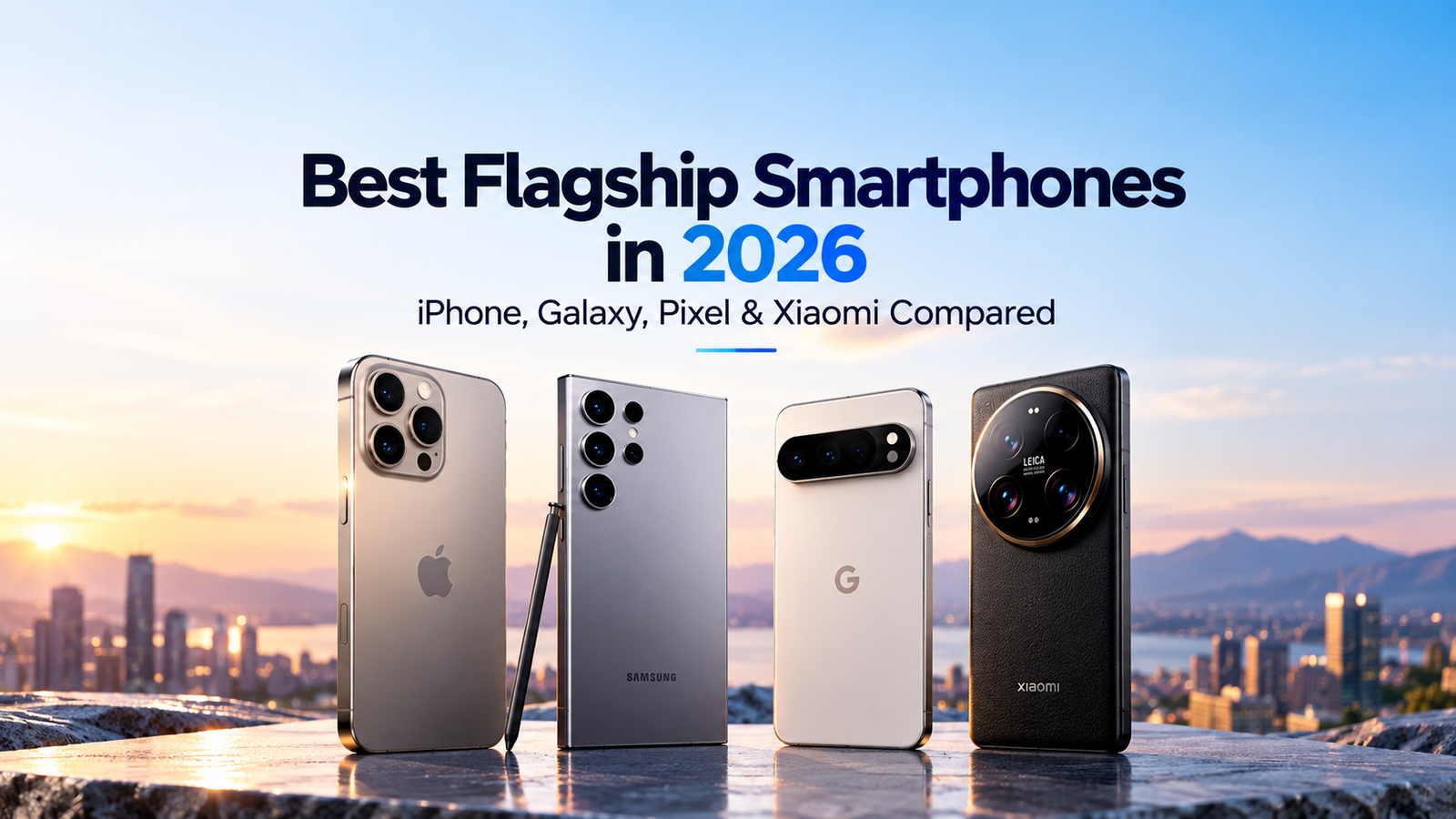
Flagship smartphones in 2026 are no longer differentiated by processor speed alone.
The latest premium phones compete across several areas at the same time:
- Camera quality
- AI capabilities
- Battery life
- Charging speed
- Display quality
- Gaming performance
- Software experience
- Ecosystem integration
- Long-term support
- Productivity features
Four devices stand out as major premium choices in the current 2026 flagship market:
- Apple iPhone 18 Pro Max
- Samsung Galaxy S26 Ultra
- Google Pixel 11 Pro XL
- Xiaomi 17 Ultra
Each follows a different philosophy.
Apple focuses heavily on performance, video, ecosystem integration, and its new A20 Pro platform.
Samsung combines a large display, S Pen support, advanced zoom hardware, Galaxy AI, and extensive productivity features.
Google builds the Pixel 11 Pro XL around Tensor G6, Gemini Intelligence, computational photography, and long-term software support.
Xiaomi emphasizes high-end Leica photography, fast charging, a large battery, and powerful Snapdragon hardware.
This comparison looks at their major strengths, hardware specifications, cameras, performance, battery systems, software, and the type of user each phone is designed to serve.
Table of Contents
Best Flagship Smartphones in 2026: Quick Comparison
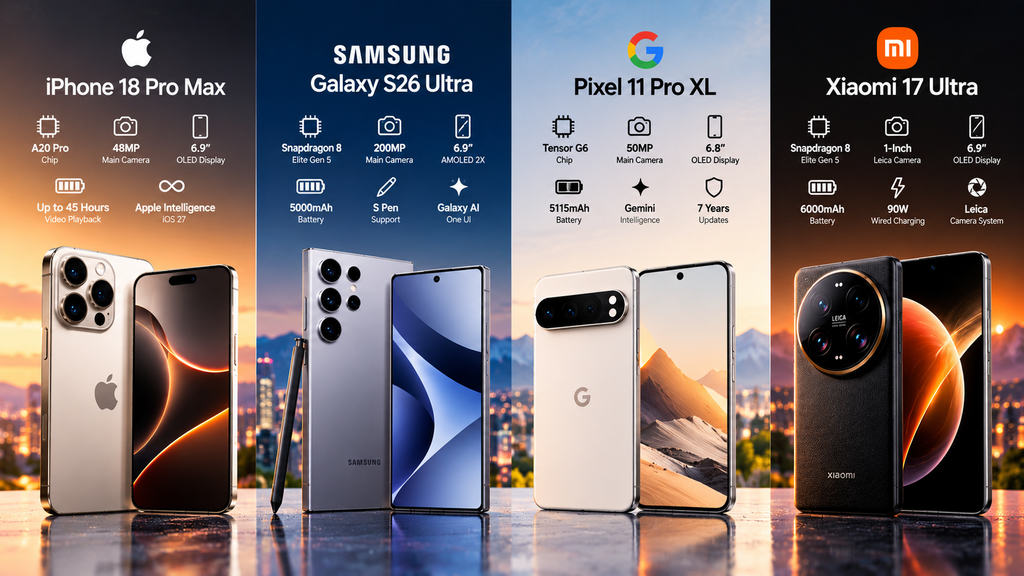
| Feature | iPhone 18 Pro Max | Galaxy S26 Ultra | Pixel 11 Pro XL | Xiaomi 17 Ultra |
|---|---|---|---|---|
| Display | 6.9-inch OLED ProMotion | 6.9-inch Dynamic AMOLED 2X | 6.8-inch LTPO OLED | 6.9-inch HyperRGB OLED |
| Refresh Rate | Up to 120Hz | Up to 120Hz | 1–120Hz | 1–120Hz |
| Processor | Apple A20 Pro | Snapdragon 8 Elite Gen 5 for Galaxy | Google Tensor G6 | Snapdragon 8 Elite Gen 5 |
| Main Camera | 48MP Fusion, variable aperture | 200MP | 50MP | 50MP Leica, 1-inch sensor |
| Telephoto | 48MP Fusion telephoto | 50MP + 10MP telephoto system | 48MP 5x telephoto | 200MP 75–100mm mechanical optical zoom |
| Ultrawide | 48MP | 50MP | 48MP | 50MP |
| Battery | Apple does not publish mAh capacity | 5000mAh | 5115mAh typical | 6000mAh typical |
| Wired Charging | Fast charging supported | Up to 60W | Up to 45W class charging | 90W HyperCharge |
| Wireless Charging | Supported | Supported | Qi2.2 / Pixelsnap up to 25W | 50W HyperCharge |
| AI Platform | Apple Intelligence + Siri AI | Galaxy AI | Gemini Intelligence | Xiaomi HyperAI |
| Operating System | iOS 27 | Android / One UI | Android | Xiaomi HyperOS |
Specifications and availability can vary by market, storage configuration, software version, and region.
What Makes a Flagship Smartphone Worth Buying in 2026?
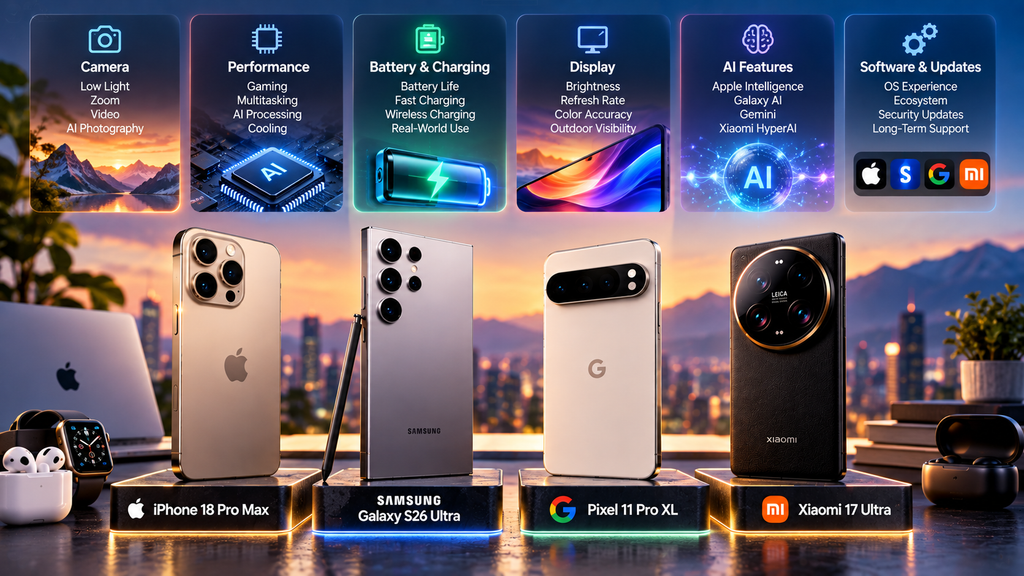
A flagship phone should offer more than high benchmark scores.
For most buyers, the important questions are:
- Is the camera reliable in different lighting conditions?
- Does the battery comfortably last through normal use?
- Is charging fast enough for your routine?
- Does the display remain readable outdoors?
- Will the phone receive software and security updates for years?
- Are the AI features actually useful?
- Does the phone work well with your laptop, tablet, watch, earbuds, or smart-home devices?
- Can it maintain performance during gaming or other demanding tasks?
The best choice depends on which of these priorities matters most to you.
Apple iPhone 18 Pro Max
The iPhone 18 Pro Max is Apple’s largest current Pro iPhone.
It uses a 6.9-inch Super Retina XDR OLED display with ProMotion adaptive refresh rates up to 120Hz.
The device is powered by Apple’s A20 Pro chip, built around a 6-core CPU, 7-core GPU, and a dual 16-core Neural Engine.
Apple has also introduced a redesigned vapor-chamber thermal system to improve sustained performance during demanding workloads.
iPhone 18 Pro Max Display
The iPhone 18 Pro Max uses a:
- 6.9-inch OLED display
- 2868 × 1320 resolution
- 460 pixels per inch
- ProMotion up to 120Hz
- Always-On display
- HDR support
- Up to 3000 nits outdoor peak brightness
Apple has also added an anti-reflective coating.
This combination is designed to improve visibility in bright outdoor environments while maintaining smooth animations and scrolling.
iPhone 18 Pro Max Performance
The A20 Pro is one of the biggest hardware changes in the iPhone 18 Pro generation.
It includes:
- 6-core CPU
- 7-core GPU
- Hardware-accelerated ray tracing
- Dual 16-core Neural Engine
- Dedicated Neural Accelerators
- Next-generation vapor-chamber cooling
The increased AI-processing capability is especially important because Apple is moving more Apple Intelligence workloads directly onto the device.
For users who edit video, play demanding games, process photos, or use AI features frequently, sustained performance may matter as much as peak benchmark performance.
iPhone 18 Pro Max Cameras
Apple has significantly expanded the Pro camera system.
The rear cameras include:
48MP Fusion Main Camera
The main camera now supports a variable aperture.
Available aperture settings include:
- ƒ/1.48
- ƒ/1.8
- ƒ/2.8
- ƒ/4.0
This gives the camera greater control over light and depth of field.
48MP Fusion Ultra-Wide
The ultra-wide camera offers a 13mm equivalent focal length and supports high-resolution photography.
48MP Fusion Telephoto
The telephoto system provides a 100mm equivalent 4x perspective and additional optical-quality zoom options.
Apple also offers extensive professional video features, including Dolby Vision HDR, ProRes workflows, advanced stabilization, and cinematic controls.
For creators already working with Mac, Final Cut Pro, or other Apple devices, this integration can be particularly useful.
iPhone 18 Pro Max Battery and Charging
Apple states that the iPhone 18 Pro Max provides its strongest Pro-model battery performance yet.
For eSIM-only models, Apple rates it for up to 45 hours of video playback under its testing conditions.
Actual battery life will vary with:
- Screen brightness
- Cellular signal
- Gaming
- Camera use
- AI workloads
- Background applications
- Network conditions
Apple does not publicly list the battery’s mAh capacity, so comparing battery capacity directly with Android phones can be misleading.
Who Is the iPhone 18 Pro Max For?
It is particularly suitable for users who prioritize:
- iOS
- Apple ecosystem integration
- Video recording
- Mobile content creation
- Long sustained performance
- FaceTime and Apple services
- Mac, iPad, Apple Watch, and AirPods integration
Samsung Galaxy S26 Ultra
The Galaxy S26 Ultra remains Samsung’s large-screen productivity-focused flagship.
It combines:
- 6.9-inch Dynamic AMOLED 2X display
- Snapdragon 8 Elite Gen 5 for Galaxy
- S Pen support
- 200MP main camera
- Multiple telephoto cameras
- Galaxy AI
- Samsung DeX
- 5000mAh battery
Samsung has also improved the phone’s cooling system to help maintain performance under sustained workloads.
Galaxy S26 Ultra Display
The S26 Ultra uses a 6.9-inch Dynamic AMOLED 2X panel.
Key specifications include:
- 3120 × 1440 resolution
- Up to 120Hz refresh rate
- Up to 2600 nits peak brightness
- Integrated privacy-display technology
That privacy feature can reduce side-angle visibility while keeping the display readable from the front.
For users who work with sensitive information in public places, this is a distinctive feature.
Galaxy S26 Ultra Performance
Samsung uses the:
Snapdragon 8 Elite Gen 5 for Galaxy
The processor is customized specifically for Galaxy devices.
Samsung also redesigned the vapor chamber and states that thermal performance has improved compared with the previous generation.
This is important for:
- Gaming
- Galaxy AI
- Video editing
- Multitasking
- Samsung DeX
- Sustained workloads
Galaxy S26 Ultra Cameras
Samsung’s rear camera system includes:
- 200MP wide camera
- 50MP ultra-wide
- 50MP telephoto
- 10MP telephoto
The phone supports multiple optical and optical-quality zoom levels, giving it considerable flexibility for distant subjects.
Samsung also continues to emphasize Nightography, computational processing, and AI-assisted photo editing.
Galaxy S26 Ultra Battery and Charging
The S26 Ultra has a:
5000mAh typical battery
Samsung rates the phone for up to 31 hours of video playback under its test conditions.
Charging has also improved.
Samsung states that Super Fast Charging 3.0 can charge the phone to approximately:
75% in around 30 minutes
using compatible charging equipment.
S Pen and Productivity
One of the Galaxy S26 Ultra’s most distinctive advantages is built-in S Pen support.
The S Pen can be useful for:
- Handwritten notes
- Document annotation
- Drawing
- Precise editing
- Screenshots
- Productivity tasks
Samsung DeX also allows the phone to provide a desktop-style interface when connected to compatible displays and accessories.
Who Is the Galaxy S26 Ultra For?
It is especially suitable for users who value:
- Large displays
- Android flexibility
- S Pen
- Zoom photography
- Multitasking
- Samsung DeX
- Galaxy ecosystem integration
- Productivity features
Google Pixel 11 Pro XL
Google’s Pixel 11 Pro XL takes a different approach.
Rather than focusing primarily on maximum raw hardware specifications, Google combines its Tensor G6 processor with advanced computational photography and Gemini Intelligence.
The Pixel 11 Pro XL includes:
- 6.8-inch Super Actua OLED display
- Google Tensor G6
- Titan M3 security coprocessor
- 50MP main camera
- 48MP ultra-wide
- 48MP 5x telephoto
- Pro Zoom up to 120x
- 5115mAh typical battery
- Seven years of OS, security, and Pixel Drop updates
Pixel 11 Pro XL Display
The Pixel 11 Pro XL uses a:
- 6.8-inch LTPO OLED display
- 1344 × 2992 resolution
- Adaptive 1–120Hz refresh rate
- Up to 2400 nits HDR brightness
- Up to 3600 nits peak brightness
Google also introduced a new anti-scratch display coating.
Pixel 11 Pro XL Performance
The Pixel 11 series is powered by:
Google Tensor G6
Google designed the chip around its own AI and imaging workloads.
Tensor G6 works alongside the Titan M3 security coprocessor and Gemini Nano.
Google says the new chip improves:
- App performance
- Web browsing
- On-device AI processing
- Computational photography
- Security
Pixel phones often emphasize intelligent software experiences rather than competing purely through benchmark numbers.
Pixel 11 Pro XL Cameras
The rear camera system includes:
- 50MP wide camera
- 48MP ultra-wide with Macro Focus
- 48MP 5x telephoto
The telephoto camera supports optical image stabilization.
Google also offers:
Pro Zoom up to 120x
This combines optical hardware with computational processing.
Pixel photography continues to rely heavily on software for:
- HDR
- Night photography
- Portrait processing
- Motion capture
- Zoom enhancement
- AI-assisted editing
Pixel 11 Pro XL Battery and Charging
The Pixel 11 Pro XL has a typical:
5115mAh battery
Google rates it for more than 30 hours of battery life under its testing conditions.
Using compatible wired charging equipment, Google states that the phone can charge to approximately:
75% in about 30 minutes
It also supports:
Pixelsnap Qi2.2 wireless charging up to 25W
Seven Years of Software Support
Google provides the Pixel 11 family with:
Seven years of OS, security, and Pixel Drop updates.
That makes software-support duration an important part of the Pixel value proposition.
For buyers planning to keep a phone for many years, update policy can be just as important as processor speed.
Who Is the Pixel 11 Pro XL For?
It is particularly attractive to users who prioritize:
- Google’s Android experience
- Gemini
- Computational photography
- Long software support
- AI-assisted features
- Call and messaging intelligence
- Google ecosystem integration
Xiaomi 17 Ultra
The Xiaomi 17 Ultra places a particularly strong emphasis on photography hardware.
Its Leica camera system includes:
- 50MP 1-inch main sensor
- 200MP 75–100mm telephoto
- 50MP ultra-wide
- 50MP front camera
It also combines this camera hardware with:
- Snapdragon 8 Elite Gen 5
- 6000mAh battery
- 90W wired charging
- 50W wireless charging
- 6.9-inch OLED display
Xiaomi 17 Ultra Display
The Xiaomi 17 Ultra uses a:
- 6.9-inch HyperRGB OLED panel
- 2608 × 1200 resolution
- 1–120Hz refresh rate
- Up to 3500 nits multi-scenario peak brightness
- Dolby Vision
- HDR10+
The phone also uses Xiaomi Shield Glass 3.0.
Xiaomi 17 Ultra Performance
The processor is:
Snapdragon 8 Elite Gen 5
It is paired with:
- LPDDR5X memory
- UFS 4.1 storage
- Xiaomi’s cooling system
- Xiaomi HyperAI
This hardware places the device firmly in the high-performance Android flagship category.
Xiaomi 17 Ultra Leica Camera System
Photography is one of the Xiaomi 17 Ultra’s central features.
50MP Leica Main Camera
The primary camera uses a:
1-inch sensor
with optical image stabilization and a Leica Summilux optical system.
Large image sensors can help improve light capture and provide more flexibility in difficult lighting situations.
200MP Leica Telephoto
The telephoto system is particularly unusual.
It provides a:
75–100mm mechanical optical zoom range
rather than relying only on fixed focal lengths and digital cropping.
The sensor is 200MP and measures 1/1.4 inch.
This system is designed for:
- Portraits
- Distant subjects
- Street photography
- Detail shots
- Telephoto video
50MP Ultra-Wide
The phone also includes a 14mm-equivalent 50MP ultra-wide camera.
Xiaomi 17 Ultra Battery and Charging
The Xiaomi 17 Ultra includes a:
6000mAh typical battery
and supports:
- 90W wired HyperCharge
- 50W wireless HyperCharge
- Reverse wired charging
For buyers who frequently need to recharge during the day, charging speed is one of Xiaomi’s biggest practical differentiators.
Display Comparison
All four phones now offer high-refresh-rate OLED displays, but they emphasize different characteristics.
iPhone 18 Pro Max
Strong emphasis on:
- Color consistency
- ProMotion
- HDR
- Outdoor visibility
- Apple ecosystem calibration
Galaxy S26 Ultra
Strong emphasis on:
- High resolution
- Large workspace
- Privacy display
- S Pen interaction
Pixel 11 Pro XL
Strong emphasis on:
- High peak brightness
- Adaptive refresh rate
- Google UI integration
- Improved scratch resistance
Xiaomi 17 Ultra
Strong emphasis on:
- High peak brightness
- Dolby Vision
- 1–120Hz LTPO-style operation
- Multimedia consumption
Display quality at this level is extremely high across all four devices.
The differences are more about features and ecosystem than basic screen quality.
Performance and Gaming
Two of the Android phones use variants of Qualcomm’s flagship platform:
- Galaxy S26 Ultra — Snapdragon 8 Elite Gen 5 for Galaxy
- Xiaomi 17 Ultra — Snapdragon 8 Elite Gen 5
Apple uses:
- A20 Pro
Google uses:
- Tensor G6
Raw benchmark numbers alone should not determine the choice.
Gaming performance also depends on:
- Thermal management
- Game optimization
- Display resolution
- Frame-rate limits
- Battery temperature
- Software
- Sustained performance
Apple, Samsung, and Xiaomi all place significant emphasis on sustained high-performance workloads.
Google’s Tensor G6 prioritizes a combination of performance, computational photography, security, and AI.
AI Features in 2026
AI has become a major differentiator between flagship phones.
Apple Intelligence and Siri AI
Apple integrates AI deeply into iOS 27.
Its approach emphasizes:
- Personal context
- Privacy
- On-device processing
- Siri integration
- Writing and productivity
- Visual intelligence
Galaxy AI
Samsung integrates AI into:
- Photo editing
- Search
- Translation
- Productivity
- Notes
- Communication
- Galaxy ecosystem features
Gemini Intelligence
Google’s Pixel 11 family is closely connected to Gemini.
Google emphasizes:
- Personal assistance
- Contextual intelligence
- Camera intelligence
- Voice processing
- Search
- Productivity
Xiaomi HyperAI
Xiaomi provides AI tools including:
- Writing
- Speech recognition
- Translation
- Search
- Creative tools
AI capabilities evolve rapidly through software updates, so feature availability can differ by region and language.
If AI-driven productivity is an important part of your workflow, our guide to the best AI tools for productivity in 2026 compares additional tools for writing, research, automation, meetings, and everyday work.
Camera Comparison
There is no single camera specification that determines image quality.
Sensor size, optics, stabilization, software processing, autofocus, and computational photography all matter.
iPhone 18 Pro Max
Strong emphasis on:
- Video
- Consistency
- Variable-aperture main camera
- Pro workflows
- Apple ecosystem integration
Galaxy S26 Ultra
Strong emphasis on:
- Versatile zoom
- 200MP main sensor
- Multiple focal lengths
- Night photography
- AI editing
Pixel 11 Pro XL
Strong emphasis on:
- Computational photography
- HDR
- Portraits
- Night photography
- AI processing
- Long-range computational zoom
Xiaomi 17 Ultra
Strong emphasis on:
- Large 1-inch main sensor
- Leica optics
- Mechanical telephoto zoom
- Manual photography
- High-resolution telephoto work
Which system is preferable depends heavily on what you photograph.
Battery and Charging Comparison
Battery specifications differ substantially.
iPhone 18 Pro Max
Apple does not publish mAh capacity but rates the device for very long video playback under its standardized testing.
Galaxy S26 Ultra
- 5000mAh
- Up to 60W wired charging
- Approximately 75% in around 30 minutes with compatible equipment
Pixel 11 Pro XL
- 5115mAh typical
- Fast wired charging
- Approximately 75% in around 30 minutes
- Qi2.2 wireless charging up to 25W
Xiaomi 17 Ultra
- 6000mAh
- 90W wired
- 50W wireless
Do not assume that the largest battery automatically provides the longest real-world endurance.
Processor efficiency, display behavior, software optimization, modem efficiency, camera use, gaming, and background activity all affect battery life.
Software and Ecosystem
Hardware specifications matter, but ecosystem can have an even larger effect on everyday experience.
Apple Ecosystem
The iPhone integrates closely with:
- Mac
- iPad
- Apple Watch
- AirPods
- iCloud
- Apple TV
Samsung Galaxy Ecosystem
Galaxy devices integrate with:
- Galaxy Watch
- Galaxy Buds
- Galaxy Tab
- Windows PCs
- SmartThings
- Samsung DeX
Google Ecosystem
Pixel integrates closely with:
- Gemini
- Google Photos
- Google Workspace
- Pixel Watch
- Pixel Buds
- Android services
Xiaomi Ecosystem
Xiaomi integrates smartphones with a broad range of:
- Wearables
- Tablets
- Smart-home devices
- TVs
- IoT devices
- Xiaomi ecosystem products
Existing devices and services should therefore influence the purchasing decision.
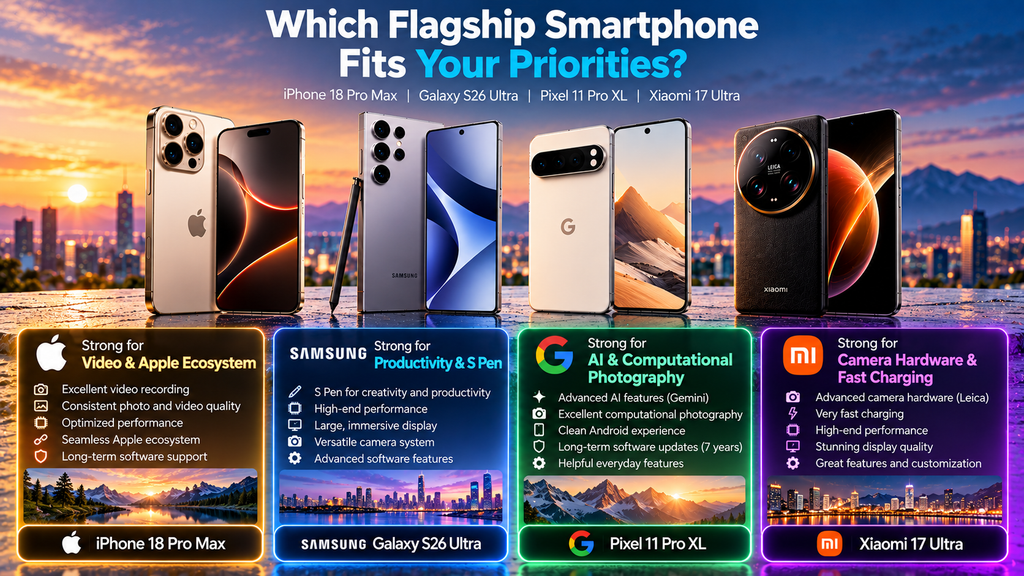
Which Flagship Smartphone Fits Your Priorities?
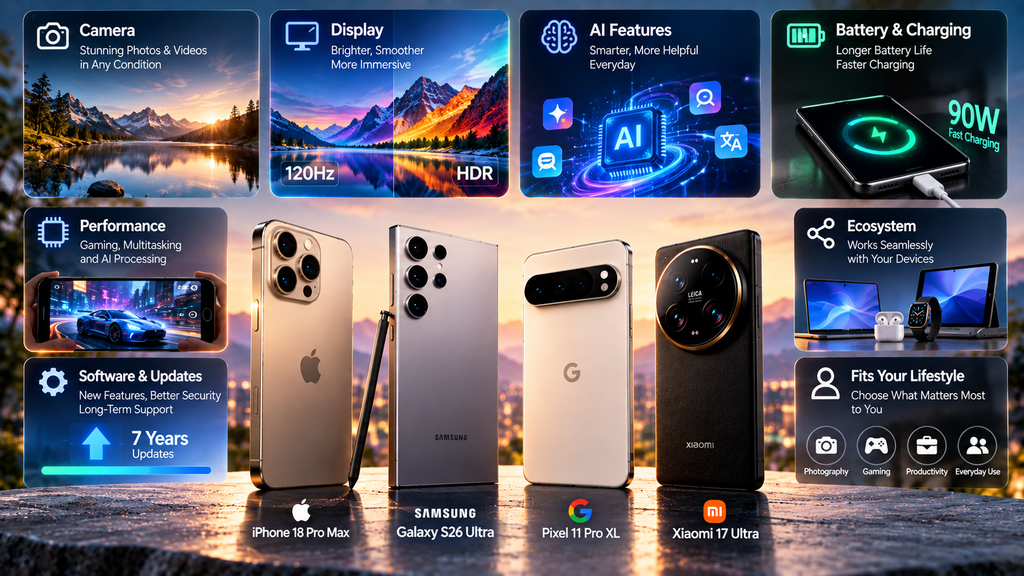
Rather than declaring one universal winner, match the phone to your priorities.
Consider iPhone 18 Pro Max if you prioritize:
- iOS
- Video creation
- Apple ecosystem integration
- Strong sustained performance
- Pro camera workflows
Consider Galaxy S26 Ultra if you prioritize:
- S Pen
- Large-screen productivity
- Zoom flexibility
- Samsung DeX
- Android customization
Consider Pixel 11 Pro XL if you prioritize:
- Google’s software experience
- Gemini
- Computational photography
- Long-term software updates
- AI-driven features
Consider Xiaomi 17 Ultra if you prioritize:
- Large camera sensors
- Leica photography
- Mechanical telephoto zoom
- Very fast charging
- Large battery capacity
What Should You Check Before Buying a Flagship Phone?
Before choosing a premium smartphone, consider:
- Operating system preference
- Camera priorities
- Video requirements
- Battery expectations
- Charging speed
- Storage capacity
- Display size
- Phone weight
- Software support
- AI features
- Accessories
- Watch and earbuds compatibility
- Laptop and tablet ecosystem
- Local repair options
- Warranty
- Regional feature availability
A device with stronger specifications in one category may still be less suitable for your daily workflow.
Should You Upgrade to a 2026 Flagship?
An upgrade may make sense if your current phone has:
- Poor battery health
- Limited software support
- Insufficient storage
- Damaged hardware
- Camera limitations that affect your work
- Performance problems
- Missing connectivity or AI features you genuinely need
If your existing phone still performs well, receives security updates, and meets your needs, replacing it purely because a newer flagship exists may provide limited practical value.
If you are deciding which devices are actually worth replacing this year, see our guide to tech products worth upgrading in 2026.
Frequently Asked Questions About 2026 Flagship Smartphones
Which flagship has the largest battery?
Among the four phones compared here, Xiaomi lists the Xiaomi 17 Ultra with a 6000mAh typical battery.
Which phone supports the fastest wired charging?
Among these four models, Xiaomi 17 Ultra lists 90W wired HyperCharge.
Which phone has S Pen support?
The Galaxy S26 Ultra supports Samsung’s S Pen.
Which phone uses a 1-inch main camera sensor?
The Xiaomi 17 Ultra uses a 50MP Leica main camera with a 1-inch sensor.
Does Apple publish the battery capacity of the iPhone 18 Pro Max?
Apple generally emphasizes battery-life measurements rather than publishing an official mAh specification.
How long will Pixel 11 Pro XL receive updates?
Google states that the Pixel 11 series receives seven years of OS, security, and Pixel Drop updates.
Which phone has the highest-resolution main camera?
Galaxy S26 Ultra lists a 200MP main wide camera.
However, megapixel count alone does not determine overall photo quality.
Which phone is better for AI?
All four platforms now include extensive AI capabilities.
The more useful question is which ecosystem and AI tools fit your workflow: Apple Intelligence, Galaxy AI, Gemini Intelligence, or Xiaomi HyperAI.
Final Thoughts
The premium smartphone market in 2026 offers four very different approaches to flagship design.
The iPhone 18 Pro Max combines Apple’s A20 Pro platform, advanced video capabilities, variable-aperture photography, and deep ecosystem integration.
The Galaxy S26 Ultra emphasizes productivity, S Pen functionality, flexible zoom hardware, Galaxy AI, and Samsung DeX.
The Pixel 11 Pro XL combines Google’s Tensor G6 platform with Gemini Intelligence, computational photography, security, and seven years of software support.
The Xiaomi 17 Ultra focuses heavily on photographic hardware, including its Leica 1-inch main camera, mechanical telephoto zoom, large battery, and fast charging.
There is therefore no need to reduce the comparison to a single “best phone.”
The better choice is the device that fits your camera needs, software preferences, ecosystem, battery expectations, and daily workflow.
For a purchase this expensive, those practical differences matter more than a single benchmark score.
Sources
- Apple — iPhone 18 Pro and iPhone 18 Pro Max Technical Specifications.
- Apple Newsroom — Apple Debuts iPhone 18 Pro and iPhone 18 Pro Max.
- Samsung — Galaxy S26 Ultra Official Specifications and Product Information.
- Google — Pixel 11 Pro and Pixel 11 Pro XL Technical Specifications.
- Google — The Pixel 11 Series: Your Most Personal Pixel Yet.
- Xiaomi — Xiaomi 17 Ultra Official Specifications.









Comments 1