

Artificial intelligence is moving beyond simply answering questions.
For years, most people interacted with AI through chatbots: you typed a question, the system generated an answer, and the interaction largely ended there. AI agents represent a significant shift from that model.
Instead of only generating responses, an AI agent can work toward a goal, decide what steps are needed, use available tools, gather information, perform actions, evaluate results, and continue working until the task is completed or human input is required.
That transition—from AI that primarily assists to AI that can execute—is one of the most important technology developments of 2026.
But what exactly is an AI agent? How does one work, and how is it different from a chatbot or AI assistant? More importantly, what happens when AI systems are given the ability to interact with software, files, databases, APIs, and the web?
This guide explains the technology, its practical applications, its limitations, and the security challenges that come with giving AI greater autonomy.
What Is an AI Agent?
An AI agent is an artificial intelligence system designed to pursue a goal by reasoning about a task and interacting with tools or environments to accomplish it.
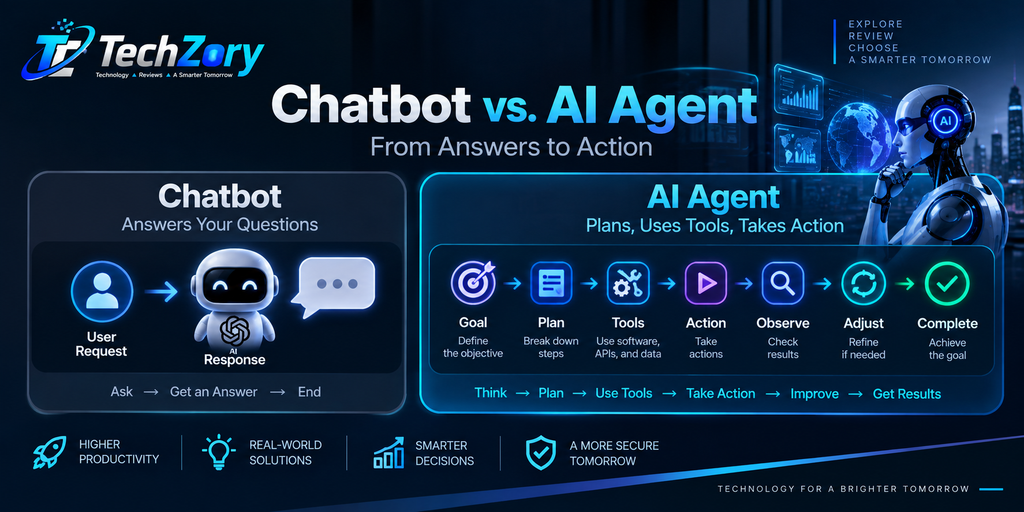
A conventional chatbot generally follows a simple pattern:
User request → AI response
An agentic system can operate more like:
Goal → Plan → Use tools → Take action → Observe results → Adjust → Continue
For example, imagine asking an AI system:
“Research five laptops suitable for machine-learning students, compare their specifications and prices, and prepare the findings in a spreadsheet.”
A conventional chatbot might recommend several laptops and provide a text comparison.
An AI agent with appropriate tools could potentially do much more. It could research current information, collect specifications, organize the data, create or edit a spreadsheet, check its work, and return the finished result.
The distinction is important: the AI is no longer limited to producing information. It can participate in completing the workflow.
How Do AI Agents Work?
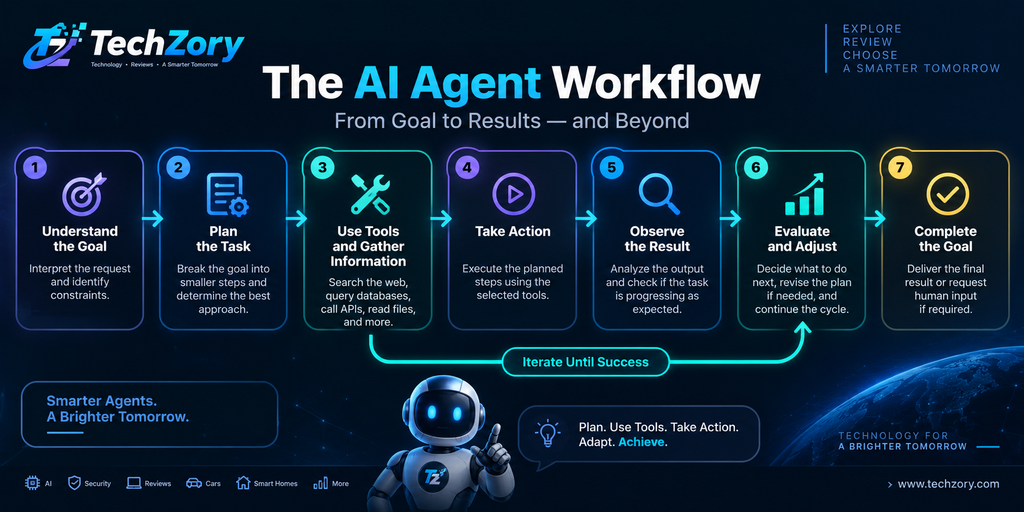
AI agents can vary significantly in design and complexity, but most agentic systems follow a recurring cycle: they receive a goal, reason about what needs to be done, interact with tools or data, observe the outcome, and decide what to do next.
1. Understand the Goal
The process begins with a goal provided by the user or another system. Rather than treating the request as something that requires only a text response, the agent interprets the desired outcome and identifies the constraints it needs to follow.
For example, a request such as “find three highly rated laptops under $1,500 and compare their specifications” gives the agent an objective, a budget constraint, and a specific deliverable.
2. Plan the Task
Once the goal is understood, the agent can break the task into smaller steps. This planning stage helps determine what information is needed, which tools should be used, and the order in which actions should be performed.
For a product-comparison task, the plan might include researching suitable products, collecting current specifications and prices, verifying important details, organizing the findings, and preparing the final comparison.
3. Use Tools and Gather Information
Tools are what allow an AI agent to move beyond text generation. Depending on its permissions and environment, an agent may be able to search the web, query databases, call APIs, read or modify files, execute code, interact with business applications, or retrieve information from connected services.
The agent selects an appropriate tool for a particular step, provides the necessary input, and receives the result. Importantly, access to tools does not mean unrestricted access: well-designed agent systems should operate with clearly defined permissions and security controls.
4. Take Action and Observe the Result
After choosing a tool, the agent performs an action and observes what happens. The result becomes new information that the system can use to determine whether the task is progressing as expected.
For example, if an agent searches for a product and discovers that the model is discontinued or unavailable, it can use that observation to revise its approach rather than blindly continuing with outdated information.
5. Evaluate, Adjust, and Continue
One of the defining characteristics of an AI agent is its ability to evaluate intermediate results and decide what should happen next. If an action fails, produces incomplete information, or reveals a better path, the agent can revise its plan and try another approach.
This creates a feedback loop: plan → act → observe → evaluate → adjust. The cycle can continue until the goal is reached, a predefined stopping condition is met, or the agent determines that human input or approval is required.
This ability to adapt across multiple steps is what makes agentic systems fundamentally different from AI systems that simply generate a single response to a prompt.
AI Agents vs. Chatbots: What’s the Difference?
Chatbots, AI assistants, and AI agents all use artificial intelligence to help users, but they differ significantly in how much they can do. The main distinction is not simply how well they generate text; it is whether the system can plan, use tools, take actions, and continue working toward a goal with limited human intervention.
Key Differences Between Chatbots and AI Agents
| Feature | Chatbot | AI Agent |
|---|---|---|
| Primary Role | Responds to user prompts | Works toward a defined goal |
| Workflow | Usually one request, one response | Can perform multiple connected steps |
| Tool Use | Limited or optional | Can use tools, APIs, files, and external systems |
| Adaptability | Mainly reacts to each new prompt | Can evaluate results and adjust its approach |
| Human Interaction | Requires frequent user input | Can continue working until completion or human approval is needed |
The practical difference is that a chatbot is primarily designed to respond, while an AI agent is designed to pursue an outcome. That means an agent can potentially handle longer workflows with fewer interruptions, provided it has the right tools, permissions, and safeguards.
Why AI Agents Matter in 2026
AI agents matter in 2026 because organizations are moving beyond using AI only for assistance and are increasingly testing or deploying it for execution. Instead of asking AI to simply generate an answer, companies are connecting models to tools, data, and repeatable workflows so they can complete more substantial tasks with less step-by-step guidance. Recent enterprise research from OpenAI and McKinsey shows that this shift is especially visible in larger organizations and in areas such as software development, IT, knowledge work, and business operations.
1. From Assistance to Execution
The significance of AI agents becomes clearer when looking at how quickly larger organizations are moving from experimentation to deployment. In McKinsey’s 2026 global AI survey, 40% of respondents from organizations with more than $1 billion in annual revenue said their companies were scaling AI agents in at least one business function, up from 27% the previous year.
This does not mean that every company is already operating autonomous AI systems at scale. Instead, it shows that agentic AI is moving beyond isolated demonstrations and into real workflows—particularly in software engineering, IT, and knowledge management, where organizations can connect AI models to tools, internal data, and repeatable processes.
2. AI Can Handle Longer, Multi-Step Work
One of the biggest reasons AI agents matter is their ability to manage longer tasks that would normally require a person to move between several tools or applications. Instead of asking an AI system to complete one small step at a time, a user can define the outcome and allow the agent to coordinate the sequence of actions needed to reach it.
For example, an agent could research a topic, collect information from multiple sources, organize the findings, update a document or spreadsheet, check whether important requirements were met, and then return the finished result for review. The value comes not only from generating content, but from connecting reasoning, tools, and actions into a single workflow.
3. Agents Can Increase Productivity Across Digital Workflows
AI agents can improve productivity by reducing the amount of manual coordination required between different digital tasks. In many workflows, employees spend significant time gathering information, copying data between applications, checking routine details, and following repetitive processes. An agent can potentially automate parts of this coordination while still allowing a person to review important decisions or final outputs.
The biggest productivity gains are likely to come from workflows that are repetitive enough to automate but flexible enough to benefit from AI reasoning. Examples include preparing reports, triaging support requests, organizing research, analyzing operational data, and assisting with software development.
4. Agentic AI Expands What Automation Can Do
Traditional automation works best when every step can be defined in advance. Agentic AI extends automation into situations where the system may need to interpret context, choose between several possible actions, and adapt when conditions change.
This makes agents useful for workflows that are too flexible for simple scripts but still structured enough to benefit from automation. Rather than replacing traditional automation, AI agents can complement it by handling the reasoning and decision points between fixed processes.
5. Greater Autonomy Makes Security and Governance More Important
The more authority an AI agent has, the more carefully its permissions and behavior need to be controlled. An agent that can only summarize text presents a very different risk profile from one that can access private data, modify files, send messages, execute code, or interact with business systems.
This is why security, governance, logging, least-privilege access, and human approval are becoming central to serious agent deployments. Greater autonomy can create more value, but it also increases the importance of ensuring that agents act within clearly defined boundaries.
Real-World Uses of AI Agents
1. Software Development
Software development is one of the clearest real-world applications of AI agents. A coding agent can inspect a codebase, identify relevant files, generate or modify code, run tests, investigate errors, and iterate on its work instead of waiting for a developer to issue a new prompt after every step.
This can reduce the time spent on repetitive development tasks such as debugging, refactoring, documentation, test generation, and implementing well-defined changes. Human developers still remain essential for architecture, requirements, security reviews, and accountability, but agents can help accelerate the execution of many routine technical tasks.
2. Research and Knowledge Work
Research often involves many small but connected tasks: finding reliable sources, reading documents, extracting useful information, comparing evidence, organizing notes, and preparing a final summary. AI agents can coordinate several of these steps within a single workflow instead of requiring the user to manage each action manually.
A research agent might search approved sources, collect relevant information, identify conflicting claims, organize findings by topic, and prepare a structured report for human review. The quality of the final result still depends heavily on source reliability, verification, and clear instructions, so human oversight remains important.
3. Customer Service and Support
AI agents can improve customer support by combining natural-language interaction with access to approved business systems. Instead of only answering questions, an agent may be able to retrieve account information, check order status, update service requests, guide users through troubleshooting steps, or escalate complex cases to a human representative.
The key requirement is controlled access. A customer-service agent should only be able to view or modify the information necessary for its role, and sensitive actions should follow clear approval and security rules.
4. Cybersecurity and IT Operations
AI agents can assist cybersecurity and IT teams by analyzing alerts, reviewing logs, identifying suspicious activity, investigating vulnerabilities, and supporting incident-response workflows. In IT operations, agents can also help diagnose system issues, summarize technical events, and coordinate routine maintenance tasks across approved tools.
These capabilities can reduce response time and help teams manage large volumes of technical data, but they also introduce additional risk. An agent with access to sensitive systems must operate with strict permissions, monitoring, and human oversight to prevent unauthorized or unintended actions.
5. Business Process Automation
Many business processes involve repetitive digital steps such as collecting information, updating records, preparing reports, routing requests, and checking whether required conditions have been met. AI agents can help coordinate these activities across approved applications and systems, reducing the amount of manual work required.
The strongest use cases are usually processes that follow a recognizable structure but still require some interpretation or adaptation. In these situations, an agent can combine automation with AI reasoning while escalating unusual or high-impact decisions to a human.
The Biggest Benefits of AI Agents
1. Multi-Step Automation
One of the biggest advantages of AI agents is their ability to coordinate multiple steps within a single workflow. Instead of requiring a person to manually move from one task to the next, an agent can plan a sequence of actions, use the appropriate tools, and continue working toward the final objective.
This can reduce repetitive effort in workflows such as research, reporting, software development, customer support, and data processing. The result is not simply faster text generation, but more complete task execution across connected steps.
2. Better Use of Tools and Data
AI agents become far more useful when they can work with trusted tools and relevant data. Instead of relying only on what the underlying model already knows, an agent can retrieve up-to-date information, access approved databases, use APIs, analyze files, and interact with software needed to complete the task.
This allows organizations to connect AI reasoning with real operational systems. The quality of the result still depends on data accuracy, permissions, and system design, but tool access can make an agent significantly more practical than a standalone chatbot.
3. Greater Adaptability
Unlike rigid automation scripts, AI agents can adapt when conditions change. If a tool returns an error, required information is missing, or a better path becomes available, the agent can revise its plan and try a different approach instead of stopping immediately.
This flexibility makes agents especially useful in workflows where not every situation can be predicted in advance. However, adaptability should still operate within clear rules so the agent does not take actions beyond its intended role.
4. Scalability Across Repetitive Work
AI agents can help scale repetitive digital work by handling large numbers of similar tasks without requiring the same level of manual coordination each time. This can be useful in areas such as support triage, document processing, data review, routine reporting, and recurring operational workflows.
Scalability does not mean that every task should be fully automated. The most effective deployments usually combine automation with clear escalation rules, allowing agents to handle routine work while sending unusual, sensitive, or high-impact cases to a human.
5. More Continuous, Goal-Oriented Work
AI agents are designed to keep working toward an objective rather than stopping after a single response. This makes them useful for tasks that require several connected steps, ongoing evaluation, and repeated interaction with tools or data.
In the right environment, an agent can continue progressing until the task is completed, a limit is reached, or human approval is required. This goal-oriented behavior is one of the key characteristics that separates agentic systems from simpler conversational AI.
The Risks and Limitations of AI Agents
1. Prompt Injection
Prompt injection is one of the most important security risks for AI agents. An agent that reads websites, emails, documents, or other external content may encounter hidden or malicious instructions designed to influence its behavior.
The risk becomes more serious when the agent also has access to sensitive data or tools that can perform actions. A malicious instruction could attempt to make the agent ignore the user’s original goal, reveal information, or take an unauthorized action. For this reason, agentic systems need strong separation between trusted instructions and untrusted content, along with carefully restricted permissions.
2. Excessive Permissions
An AI agent should not have more access than it needs to complete its assigned task. Giving an agent unnecessary permissions can increase the impact of mistakes, security failures, or malicious manipulation.
For example, if an agent only needs to read a dataset, it should not automatically receive permission to modify or delete records. Applying the principle of least privilege helps reduce risk by limiting each agent to the minimum level of access required for its role.
3. Hallucinations and Incorrect Decisions
AI agents can still make mistakes. They may misunderstand a goal, rely on inaccurate information, choose an inappropriate tool, or reach a flawed conclusion during a multi-step workflow.
When an AI system only produces text, an error may result in a poor answer. When an agent can also take actions, the consequences can be more serious. For high-impact tasks, important outputs should be verified and sensitive actions should require appropriate safeguards or human approval.
4. Accountability and Oversight
Organizations remain responsible for how AI agents are designed, deployed, monitored, and governed. Even when an agent can operate autonomously for part of a workflow, people still need to define acceptable boundaries, review important outcomes, and respond when something goes wrong.
Strong accountability requires clear ownership, activity logs, audit trails, escalation procedures, and appropriate human oversight. The goal is not to remove people from the process entirely, but to ensure that AI autonomy remains visible, traceable, and controllable.
How Can AI Agents Be Made Safer?
1. Apply Least-Privilege Access
AI agents should receive only the permissions they genuinely need to complete a task. Limiting access reduces the potential impact of mistakes, compromised instructions, or unexpected behavior.
For example, an agent that only needs to analyze a document should not automatically receive permission to delete files, send emails, or modify business records. Restricting access at the system level is one of the most effective ways to reduce unnecessary risk.
2. Require Human Approval for Sensitive Actions
Sensitive or irreversible actions should not always be left entirely to an autonomous system. Requiring human approval for high-impact steps can provide an important safety barrier before an agent sends a message, changes permissions, modifies critical data, executes a financial transaction, or performs another consequential action.
Human-in-the-loop controls are especially valuable when the cost of an incorrect decision is high. The goal is to automate routine work while keeping people responsible for decisions that require judgment, accountability, or additional verification.
3. Separate Trusted Instructions from Untrusted Content
AI agents often process information from websites, emails, documents, and other external sources. Because that content may contain misleading or malicious instructions, agent systems should clearly distinguish between trusted commands and untrusted data.
This separation is especially important when an agent can also use tools or access sensitive information. External content should not be allowed to silently override system rules, user intent, or security policies.
4. Log and Monitor Agent Activity
AI agent activity should be observable and traceable. Logging important actions, tool calls, decisions, and outcomes makes it easier to investigate errors, identify unusual behavior, and understand how a task was completed.
Monitoring is especially important for agents that interact with sensitive systems or operate for long periods. Organizations should be able to review what an agent did, detect unexpected patterns, and intervene when behavior falls outside approved boundaries.
5. Test Agents Against Adversarial Inputs
AI agents should be tested against malicious, misleading, and unexpected inputs before they are trusted with important workflows. This includes attempts to manipulate the agent through prompt injection, malformed data, deceptive instructions, and unusual tool responses.
Adversarial testing helps reveal weak points in the agent’s reasoning, permission boundaries, and safety controls. The goal is to identify failure modes early and strengthen the system before those weaknesses can cause real-world problems.
6. Provide Clear Escalation and Stop Conditions
AI agents should have clear rules that define when they must stop, ask for help, or escalate a task to a human. An agent should not continue acting indefinitely when information is missing, confidence is low, or the requested action falls outside its approved scope.
Well-designed stop conditions can prevent unnecessary errors and reduce the risk of unintended behavior. They also make it easier to balance automation with human control, especially in complex or high-impact workflows.
Will AI Agents Replace Jobs?
AI agents are likely to change how many jobs are performed, but it is too simplistic to assume that every role will be replaced entirely. Most jobs are made up of multiple tasks, and those tasks vary widely in how suitable they are for automation.
Repetitive digital work, routine analysis, data gathering, and structured administrative tasks may be easier to automate. Other responsibilities—such as strategic judgment, accountability, relationship building, complex decision-making, physical work, and domain expertise—remain much harder to delegate completely.
In many cases, the more realistic near-term outcome is workflow redesign rather than full job replacement. Employees may spend less time on repetitive steps and more time supervising AI systems, reviewing important outputs, handling exceptions, and making consequential decisions.
What Comes After AI Agents?
The next stage of agentic AI is likely to involve systems that can operate for longer periods, use increasingly specialized tools, and coordinate with other agents to complete more complex workflows. Instead of relying on one general-purpose agent, future systems may divide work among specialized agents responsible for research, coding, analysis, verification, or other tasks.
As agents become more capable, reliability will become just as important as autonomy. The most valuable systems will not necessarily be those that act with the least human involvement, but those that can perform substantial work while remaining predictable, observable, secure, and easy to control.
Final Thoughts
AI agents represent an important shift in how people interact with artificial intelligence. Instead of only generating answers, agentic systems can reason about goals, use tools, take actions, observe results, and continue working across multiple steps.
This creates major opportunities in software development, research, cybersecurity, customer service, business operations, and many other digital workflows. At the same time, greater autonomy increases the importance of security, permissions, monitoring, and human oversight.
The future of AI agents will not be defined by autonomy alone. The most successful systems will be those that combine useful AI capabilities with strong controls, reliable behavior, and clear human accountability.
Frequently Asked Questions
What is an AI agent in simple terms?
An AI agent is an artificial intelligence system that can work toward a goal by deciding what steps to take, using available tools, performing actions, and responding to the results. Unlike a basic chatbot, an AI agent can continue working across multiple steps instead of stopping after a single answer.
What is the difference between an AI agent and a chatbot?
A chatbot is primarily designed to respond to user prompts, while an AI agent can work toward a goal through multiple steps. An agent may be able to plan, use tools, access approved data, take actions, evaluate results, and continue until the task is completed or human input is required.
Can AI agents work without human supervision?
Some AI agents can operate independently for parts of a workflow, but the appropriate level of autonomy depends on the task. Routine and low-risk activities may require less supervision, while sensitive, irreversible, or high-impact actions should include clear limits, monitoring, and human approval.
Are AI agents safe to use?
AI agents can be safe when they are designed with appropriate security controls, limited permissions, monitoring, and human oversight. However, risks such as prompt injection, excessive access, inaccurate decisions, and unintended actions mean that agentic systems should not be given unrestricted authority.
What are AI agents used for?
AI agents are used for tasks such as software development, research, customer support, cybersecurity, IT operations, data analysis, knowledge management, and business-process automation. Their main advantage is the ability to coordinate multiple steps and tools toward a defined goal.
Will AI agents replace human jobs?
AI agents are likely to automate some tasks and change how many jobs are performed, but that does not mean every role will be replaced. In many cases, people will continue to provide judgment, expertise, accountability, and oversight while AI agents handle repetitive or structured parts of the workflow.
Sources and Further Reading
- OpenAI — From Assistance to Execution: How Enterprises Put AI to Work — August 2026
- McKinsey & Company — The State of AI in 2026: On the Road to ROI — August 2026
- OpenAI — Designing AI Agents to Resist Prompt Injection — March 2026
- Google Cloud / Mandiant — AI Risk and Resilience Report 2026 — September 2026







Comments 4