

Charging an electric vehicle at home is one of the biggest differences between owning an EV and owning a gasoline-powered car.
Instead of visiting a fuel station every few days, many EV owners simply plug in when they arrive home and start the next morning with enough energy for another day of driving.
But home EV charging can initially seem confusing.
What is the difference between Level 1 and Level 2 charging? Do you need a dedicated charger? How much electrical capacity does your home need? Should you choose NACS or J1772? Can a charger be installed outdoors? And how fast does home charging really need to be?
This guide explains EV charging at home in 2026 from a beginner’s perspective, covering charging levels, installation requirements, connector types, safety, smart charging, electricity costs, and the factors to consider before buying home charging equipment.
Charging standards, electrical systems, installation regulations, and connector types vary by country. Much of the technical information below focuses on the North American market, so homeowners should always follow local electrical codes and vehicle-manufacturer guidance.
Table of Contents
EV Charging at Home in 2026: Quick Overview
| Home Charging Option | Typical Power Source | Relative Speed | Best Use |
|---|---|---|---|
| Level 1 | Standard household outlet | Slowest | Low daily mileage and overnight charging |
| Level 2 | Dedicated higher-voltage circuit | Much faster | Most EV owners and regular daily driving |
| Smart Level 2 Charger | Dedicated higher-voltage circuit + connectivity | Similar charging speed to Level 2 | Scheduling, monitoring, and energy management |
| Portable EV Charger | Compatible household or higher-voltage outlet | Depends on outlet and charger | Travel, backup charging, or flexible installations |
For many EV owners, Level 2 charging offers the most practical balance of speed and convenience.
However, not every driver needs it.
Someone who drives relatively few miles each day may be perfectly comfortable using Level 1 charging overnight.
EV charging at home in 2026 is easier and more flexible than ever, but choosing the right setup depends on your vehicle, daily mileage, electrical system, and budget.
How Home EV Charging Works
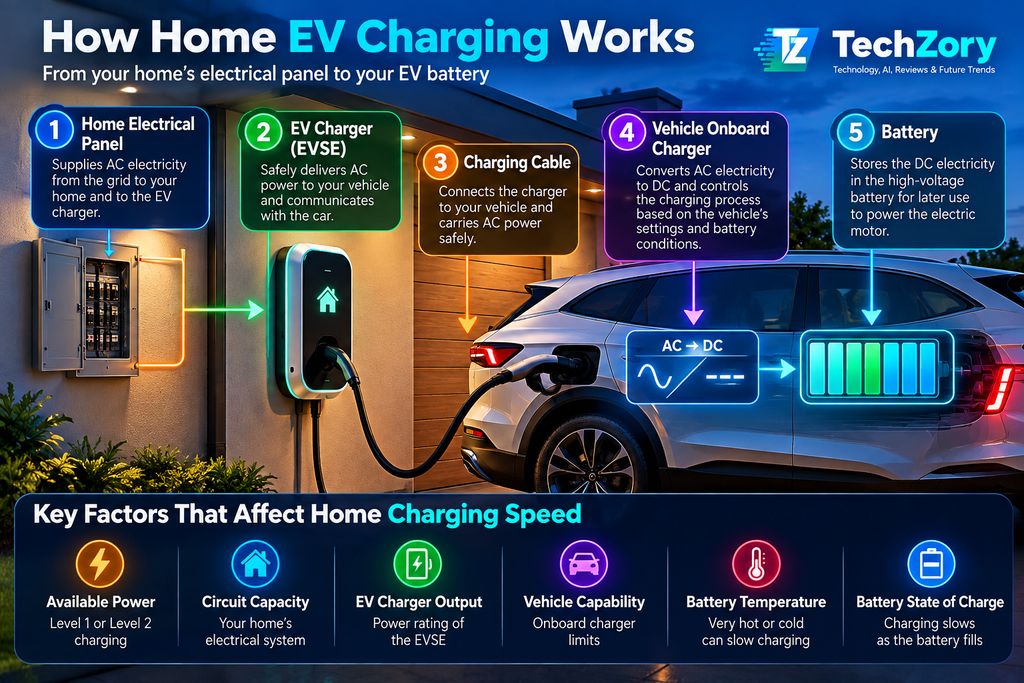
An electric vehicle contains an onboard charger that converts alternating current from the electrical grid into energy that can be stored in the battery.
When charging at home, the wall-mounted charger is technically known as Electric Vehicle Supply Equipment, or EVSE.
The EVSE communicates with the vehicle and safely controls the electrical connection.
The actual charging rate depends on several factors, including:
- Available electrical power
- Circuit capacity
- EVSE output
- Vehicle onboard-charger capability
- Battery temperature
- Battery state of charge
- Vehicle software settings
This means buying a charger with a very high advertised output does not automatically make every EV charge at that maximum rate.
The vehicle itself must support the available AC charging power.
Level 1 EV Charging
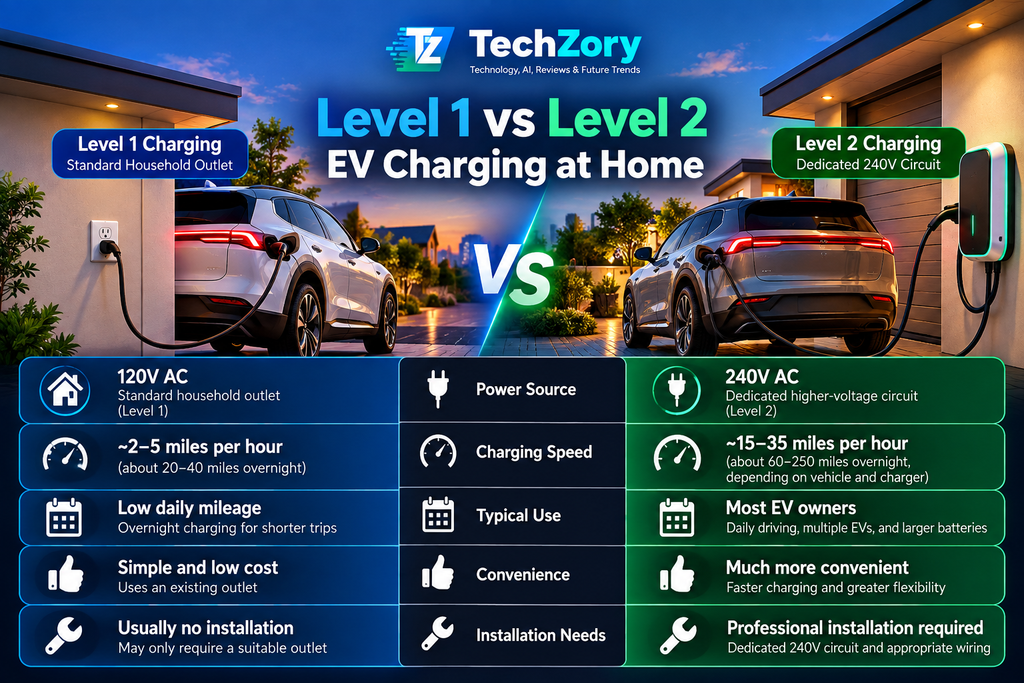
Level 1 charging is the simplest form of home EV charging in North America.
It generally uses a standard household electrical outlet and often requires no dedicated wall-mounted charging station.
For some drivers, this is enough.
When Level 1 Makes Sense
Level 1 can work well if:
- Your daily commute is short
- The vehicle remains parked overnight for many hours
- You drive only occasionally
- You own a plug-in hybrid with a smaller battery
- You have easy access to public charging when necessary
One major advantage is simplicity.
If an appropriate dedicated household outlet is already available near the parking location, additional installation may not be necessary.
Limitations of Level 1 Charging
The biggest disadvantage is speed.
A large-battery EV can take a very long time to recover substantial range using a standard outlet.
That may become inconvenient when:
- Daily mileage is high
- The battery frequently arrives home at a low state of charge
- Multiple EVs share the same charging location
- The vehicle is used again shortly after arriving home
- You regularly return from long road trips with a depleted battery
For these situations, Level 2 charging is generally more practical.
Level 2 EV Charging
Level 2 charging is the most common upgrade for homeowners who want faster and more predictable EV charging.
It uses a higher-voltage electrical circuit and normally requires installation by a qualified electrician.
The exact charging speed depends on the electrical circuit, charging equipment, and vehicle.
Why Level 2 Is Popular
Level 2 charging can recover substantially more energy during an overnight parking period than a standard household outlet.
That makes it particularly useful for drivers who:
- Commute every day
- Drive moderate or high daily mileage
- Own an EV with a large battery
- Have two EVs
- Want to schedule charging during off-peak electricity hours
- Prefer to begin most mornings with a high state of charge
For many households, Level 2 effectively turns the garage or driveway into the vehicle’s primary charging station.
Do You Really Need a Level 2 Charger?
Not necessarily.
The right answer depends more on how you drive than on the size or price of your EV.
Consider a driver who travels only 20 to 30 miles most days.
If the vehicle remains parked for 10 or 12 hours every night, slower charging may recover enough energy to replace that day’s driving.
Now consider someone traveling 80 or 100 miles per day.
That driver may find Level 1 increasingly restrictive.
If you are still choosing an EV, compare the best electric cars in 2026 by range, charging, practicality, and value before deciding on a home charging setup.
Before installing Level 2 equipment, ask:
- How many miles do I normally drive each day?
- How long is the vehicle parked overnight?
- Do I regularly take long trips?
- How often do I need the battery near full?
- Will another EV use the charger?
- Are cheaper overnight electricity rates available?
- Does my electrical panel have sufficient capacity?
The goal is not necessarily to install the most powerful charger available.
It is to install enough charging capacity for your real driving needs.
Hardwired Charger vs. Plug-In Charger
Level 2 EV chargers can generally be installed in two ways.
Hardwired Installation
A hardwired charger is permanently connected to the home’s electrical system.
Potential advantages include:
- Clean installation
- Fewer plug-and-outlet connection points
- Suitability for higher-power configurations
- Good option for permanent outdoor installations
- Reduced temptation to repeatedly unplug equipment
A hardwired installation is often attractive when the homeowner expects the charger to remain in the same location for many years.
Plug-In Installation
A plug-in charger connects to an appropriate higher-voltage receptacle.
Potential advantages include:
- Equipment may be easier to replace
- Charger can sometimes be removed when moving home
- Some portable chargers can use the same outlet
- Greater flexibility in certain installations
However, the receptacle, wiring, breaker, and installation must all be appropriate for continuous EV charging.
Do not assume that every existing high-voltage outlet is automatically suitable.
Have the electrical system evaluated by a qualified professional.
How Much Charging Power Do You Need?
Home charging equipment is available at many different power levels.
More power can mean faster charging, but faster is not always necessary.
For example, a car parked for 10 hours overnight has plenty of time to recover energy.
A moderate charging rate may easily restore the energy used during a normal commute.
Before choosing charger output, check:
- The maximum AC charging capability of your EV
- The available capacity of your electrical panel
- Your daily driving distance
- How many hours the vehicle is normally parked
- Whether more than one EV will charge at the property
Installing equipment far beyond the vehicle’s onboard charging capability will not make that vehicle charge faster.
Check Your Electrical Panel Before Installation
One of the most important steps in home EV charger installation is evaluating the home’s electrical system.
A qualified electrician may check:
- Main service capacity
- Existing electrical loads
- Available breaker spaces
- Wiring route to the parking area
- Distance between the electrical panel and charger
- Grounding
- Required permits
- Local electrical-code requirements
- Need for load-management equipment
Some homes can accommodate an EV charger with minimal work.
Others may require additional electrical upgrades.
Installation complexity often depends more on the property than on the charger itself.
A charger located a few feet from the electrical panel may be much simpler to install than one located on the opposite side of a large property.
What Is Smart EV Charging?
Many modern home chargers include Wi-Fi or other connectivity.
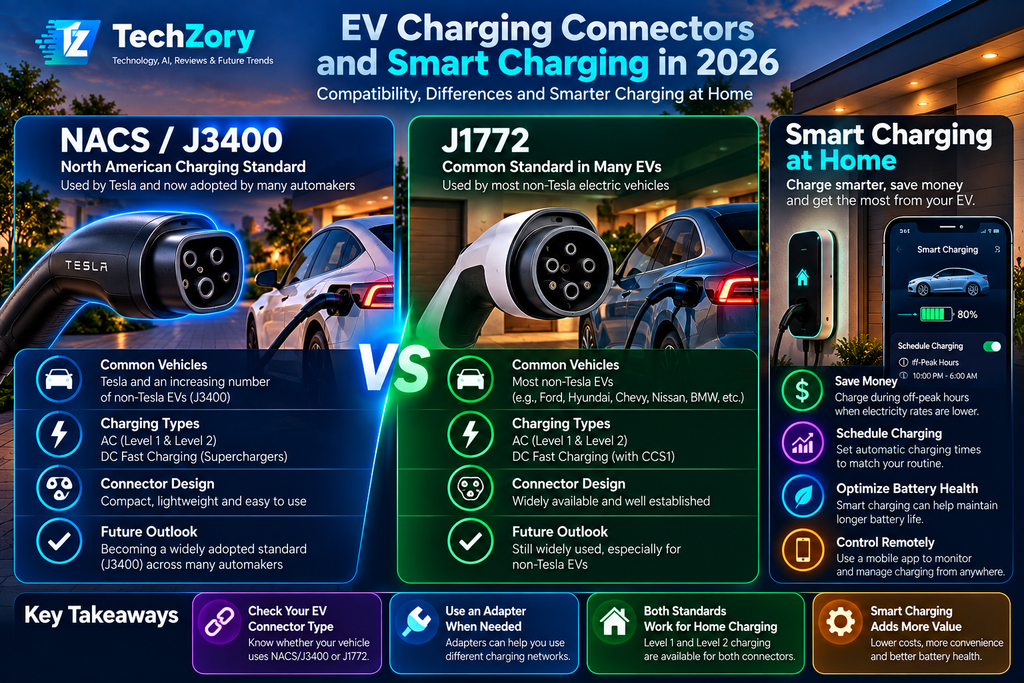
Smart charging features can include:
- Charging schedules
- Energy-use monitoring
- Charging-history reports
- Remote start and stop
- Access control
- Utility-rate scheduling
- Power sharing
- Dynamic load management
- Firmware updates
These features do not necessarily make the battery charge faster.
Instead, they can make charging more convenient and potentially more economical.
For example, homeowners with time-of-use electricity pricing may schedule charging to begin after electricity rates fall at night.
Charging During Off-Peak Hours
Electricity prices can vary by location and utility company.
Some utilities offer time-of-use pricing where electricity is cheaper during certain hours.
In those situations, scheduled EV charging can potentially reduce operating costs.
A typical routine might be:
Arrive home at 6:00 PM
↓
Plug the EV into the charger
↓
Charging remains paused
↓
Lower-cost electricity period begins later at night
↓
Charging starts automatically
↓
Vehicle is ready before morning
The exact savings depend entirely on local electricity tariffs.
Drivers should check their utility provider’s current EV rates or time-of-use plans.
NACS, J3400, J1772, and Connector Compatibility
Connector standards are changing rapidly in North America.
Tesla originally developed the connector known as the North American Charging Standard, or NACS.
SAE International subsequently standardized the system as SAE J3400.
At the same time, many existing North American EVs use the J1772 connector for AC charging.
This means households buying charging equipment in 2026 may encounter:
- SAE J3400 / NACS chargers
- J1772 chargers
- Chargers that support both
- Manufacturer-approved adapters
Before buying a charger, check the charging inlet on your exact vehicle.
Do not choose equipment based only on the vehicle brand because connector configurations can differ by model year.
Should You Use a Charging Adapter?
Adapters can improve compatibility between vehicles and charging equipment, but they must be used carefully.
The safest approach is to use:
- Vehicle-manufacturer-approved adapters
- Charger-manufacturer-approved accessories
- Equipment that meets appropriate electrical and safety standards
Avoid unknown adapters with unclear electrical ratings or safety certification.
Charging equipment may handle significant continuous electrical loads, so connector quality matters.
Can You Install an EV Charger Outdoors?
Yes, suitable EV charging equipment can be installed outdoors.
The U.S. Department of Energy notes that residential charging equipment can be installed and used outdoors, including during rain, provided the equipment is appropriately rated for outdoor installation.
Outdoor installations should consider:
- Weather rating
- Cable management
- Drainage
- Direct sunlight
- Extreme heat or cold
- Physical impact protection
- Distance from parking space
- Mounting location
- Local electrical requirements
Do not assume an indoor-only charger is appropriate for an exposed driveway.
Check the manufacturer’s environmental rating.
Where Should You Install the Charger?
The ideal location allows the charging cable to comfortably reach the vehicle without stretching across walkways.
Consider:
- Vehicle charging-port location
- Current parking direction
- Future EVs
- Garage-door movement
- Cable length
- Trip hazards
- Distance from the electrical panel
- Outdoor exposure
- Wi-Fi signal for smart chargers
If two vehicles may eventually use the charger, think about both parking positions before installation.
A slightly more central charger location today can prevent expensive relocation later.
Charging One EV vs. Two EVs at Home
Households with two EVs do not always need two completely independent high-power circuits.
Some charging systems support power sharing.
Instead of both chargers drawing maximum power simultaneously, the system divides available electrical capacity between vehicles.
For example:
Two cars plug in overnight
↓
Available charging power is shared
↓
One vehicle finishes or reduces demand
↓
More power becomes available to the other vehicle
This can potentially reduce the need for major electrical upgrades, depending on the system and local installation requirements.
What Is Dynamic Load Management?
Dynamic load management allows charging equipment to adjust EV charging power based on the home’s total electrical demand.
Imagine the home’s available electrical capacity as a budget.
When appliances are using significant power, the charger can reduce its demand.
When household demand decreases, more power may become available for charging.
This technology can be particularly useful in homes where the electrical service has limited spare capacity.
However, compatibility and installation requirements vary, so this should be evaluated by a qualified installer.
How Long Does Home EV Charging Take?
There is no universal answer.
Charging time depends on:
- Battery capacity
- Starting battery percentage
- Target battery percentage
- Vehicle AC charging limit
- Charger output
- Electrical supply
- Temperature
- Battery-management system
A driver usually does not arrive home with a completely empty battery.
That is why the more useful question is often:
How long does it take to replace the energy I used today?
If you drive 40 miles during the day, you may only need to replace approximately those 40 miles overnight—not recharge the entire battery from 0% to 100%.
This makes even moderate home charging speeds practical for many drivers.
Do You Need to Charge an EV to 100% Every Night?
Usually not.
Battery charging recommendations vary by manufacturer and battery chemistry.
Some vehicles recommend a lower daily charge limit and higher levels only before longer trips.
Other battery chemistries may have different recommendations.
Follow the charging guidance provided by the manufacturer of your specific EV.
For everyday driving, the important goal is having enough energy for your expected trips plus a reasonable reserve.
Charging habits can also influence long-term battery health, so our EV battery lifespan in 2026 guide explains degradation, temperature effects, warranties, charging behavior, and battery longevity.
Is Home EV Charging Safe?
Properly installed EV charging equipment is designed for regular residential use.
Safety depends heavily on:
- Correct wiring
- Appropriate breaker protection
- Proper grounding
- Quality charging equipment
- Professional installation where required
- Following manufacturer instructions
- Keeping connectors and cables in good condition
Home EV charging should not rely on improvised wiring, overloaded extension cords, or questionable adapters.
If you notice unusual heat, damaged connectors, discoloration, burning smells, repeated breaker trips, or charging faults, stop using the equipment and have it inspected.
Extension Cords and EV Charging
Avoid using ordinary extension cords unless the vehicle or charging-equipment manufacturer explicitly approves a particular setup.
EV charging can create a substantial continuous electrical load.
A cable or connector that appears adequate for occasional household use may not be suitable for hours of continuous charging.
The best installation places the appropriate outlet or permanently installed EVSE where the vehicle is actually parked.
How Much Does Home EV Charging Cost?
There are two separate costs:
Equipment and Installation
This can include:
- EV charging equipment
- Electrical wiring
- Circuit breaker
- Conduit
- Labor
- Permits
- Panel upgrades
- Load-management equipment
Installation costs vary significantly because every property is different.
A simple installation near the electrical panel may be relatively straightforward.
A long wiring run, detached garage, complicated conduit route, or electrical-service upgrade can increase costs considerably.
Electricity
Charging cost depends on:
- Local electricity price
- Vehicle efficiency
- Miles driven
- Charging losses
- Time-of-use pricing
A useful calculation is:
Energy used × electricity rate = approximate charging cost
For example, if your EV consumes 40 kWh from the grid and your electricity price is $0.15 per kWh:
40 × $0.15 = $6.00
Actual costs will vary by location, charger efficiency, vehicle, and electricity plan.
Home Charging vs. Public Fast Charging
Home charging and public DC fast charging serve different purposes.
Drivers who take frequent highway trips can also compare the best EVs for long-distance driving in 2026 by range, charging speed, comfort, and road-trip practicality.
Charging is only one part of EV ownership costs, so our EV maintenance costs in 2026 guide explains routine service, tires, brakes, filters, cooling systems, and other long-term expenses.
Home Charging
Best for:
- Daily driving
- Overnight charging
- Convenience
- Routine commuting
- Potentially lower electricity rates
DC Fast Charging
Best for:
- Road trips
- Emergency range recovery
- Drivers without reliable home charging
- Long-distance travel
Most EV owners do not need DC fast-charging speeds at home.
Residential charging is usually designed around the fact that the vehicle remains parked for many hours.
Can You Charge an EV Using Solar Panels?
Yes, but the relationship between solar generation and EV charging depends on the home’s electrical system.
Solar energy may help offset household electricity consumption, including EV charging.
Potential considerations include:
- Solar-system capacity
- Time of charging
- Battery storage
- Utility net-metering rules
- Smart charger integration
- Household electrical demand
Some smart charging systems can prioritize periods when solar generation is high.
However, solar panels do not normally connect directly to the vehicle without the home’s electrical infrastructure and appropriate charging equipment.
Renting or Living in an Apartment
Home charging is more complicated for renters and multifamily housing residents.
Challenges may include:
- Assigned parking
- Shared garages
- Landlord approval
- Electrical metering
- Billing
- Installation ownership
- Homeowners association rules
- Limited electrical capacity
Possible solutions include:
- Shared Level 2 chargers
- Assigned charging spaces
- Networked chargers with individual billing
- Workplace charging
- Nearby public charging
Before buying an EV, apartment residents should investigate charging availability around both home and work.
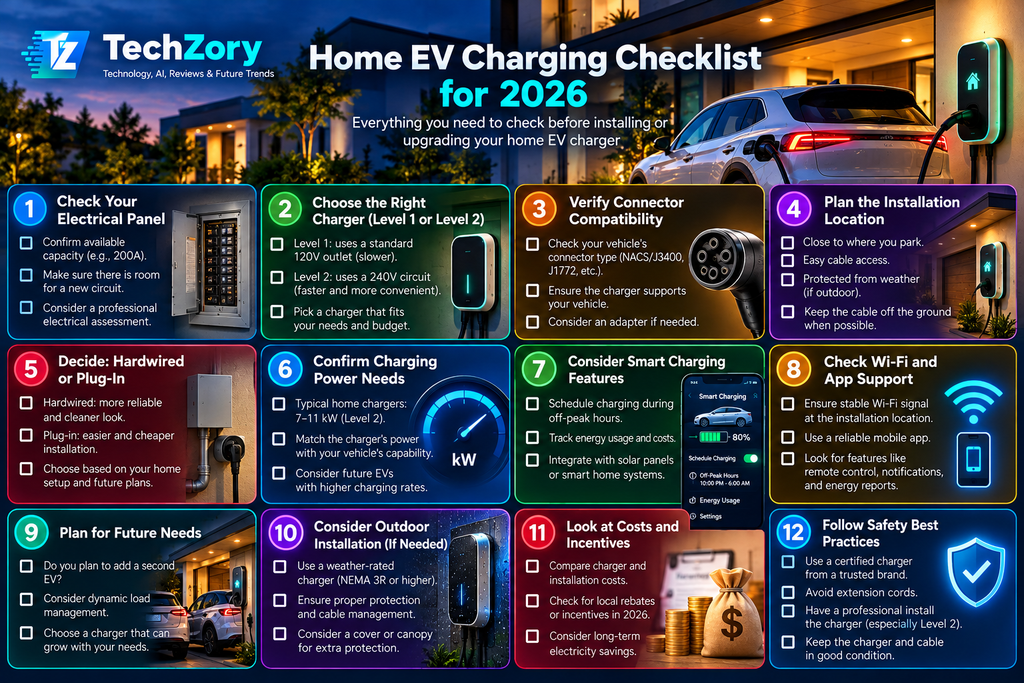
Home EV Charging Checklist for 2026
Before purchasing or installing charging equipment, verify:
Vehicle
- Charging-port type
- Maximum AC charging capability
- Manufacturer charging recommendations
- Adapter compatibility
Driving Needs
- Average daily mileage
- Longest regular commute
- Overnight parking time
- Frequency of road trips
Electrical System
- Panel capacity
- Available breaker space
- Wiring requirements
- Installation distance
- Permit requirements
Charger
- Connector compatibility
- Power output
- Indoor/outdoor rating
- Cable length
- Wi-Fi connectivity
- Scheduling
- Energy monitoring
- Load management
- Power sharing
Installation
- Qualified electrician
- Correct circuit protection
- Local electrical codes
- Convenient charger position
- Safe cable routing
A few minutes of planning before installation can make home charging much easier for years.
Common Home EV Charging Mistakes
Buying More Charging Power Than the Vehicle Can Use
A high-output charger provides no additional speed if the vehicle’s onboard charger cannot accept that much AC power.
Ignoring Electrical Capacity
Do not purchase charging hardware before confirming what your home’s electrical system can support.
Choosing the Wrong Connector
Verify your exact model year and charging inlet.
Installing the Charger Too Far From the Vehicle
Charging cables should reach comfortably without being stretched.
Ignoring Future Vehicles
Today’s charging port may be on the rear left side.
Your next EV’s port might be somewhere completely different.
Assuming Public Charging Can Replace Home Charging Easily
It can, but regular public charging may require more time and planning than plugging in at home overnight.
Frequently Asked Questions About Home EV Charging
What is the best home charging option for most EV owners?
For many drivers, Level 2 charging provides a useful combination of overnight charging speed and everyday convenience.
However, low-mileage drivers may find Level 1 sufficient.
Can I plug an EV into a normal household outlet?
Many EVs can use Level 1 charging from a suitable household outlet with compatible charging equipment.
The outlet and circuit must be appropriate and in good condition.
Do I need an electrician to install a Level 2 charger?
In most cases, a new Level 2 circuit or hardwired charger should be installed by a qualified electrician in accordance with local codes.
Can an EV charger be installed outside?
Yes, if the charging equipment is appropriately rated for outdoor installation and installed according to manufacturer instructions and electrical codes.
Should I buy a NACS/J3400 or J1772 charger?
Choose based on your current vehicle, likely future vehicles, and adapter support.
North American connector standards are transitioning, so compatibility deserves careful attention.
Is a smart charger necessary?
No.
A basic charger can charge an EV perfectly well.
Smart chargers add features such as scheduling, monitoring, load management, and remote control.
Can two EVs share one charger?
Yes, if drivers alternate charging.
Some systems also support multiple chargers with automatic power sharing.
Is faster home charging always better?
No.
The ideal charging speed is the one that reliably restores the energy you need before your next trip without unnecessary electrical upgrades.
Final Thoughts
Home charging is one of the biggest practical advantages of owning an electric vehicle.
For many drivers, the ideal routine is remarkably simple:
Drive during the day.
Park at home.
Plug in.
Charge overnight.
Start the next morning ready to drive again.
EV charging at home in 2026 can be simple, convenient, and cost-effective when the charger, electrical capacity, and vehicle requirements are properly matched.
The most important decision is not choosing the fastest or most expensive charger.
It is choosing a charging setup that matches your vehicle, daily mileage, home’s electrical capacity, parking location, and future needs.
For low-mileage drivers, Level 1 may be sufficient.
For regular EV use, Level 2 provides significantly more flexibility.
And for households with multiple EVs or limited electrical capacity, technologies such as power sharing and load management can make home charging much easier.
Plan the installation carefully, use properly rated equipment, follow manufacturer recommendations, and have electrical work completed according to local requirements.
A well-designed home charging setup can make EV ownership easier every single day.
Sources
- U.S. Department of Energy — Alternative Fuels Data Center: Charging Electric Vehicles at Home. Guidance on Level 1 and Level 2 residential charging, electrical capacity, installation, outdoor charging, smart charging equipment, and home-charging considerations.
- U.S. Department of Energy — Alternative Fuels Data Center: Electric Vehicles for Consumers. General guidance on EV ownership, charging options, range, and charging infrastructure.
- SAE International — SAE J3400 North American Charging System (NACS) for Electric Vehicles. Official standard covering the physical, electrical, functional, safety, and performance requirements of the J3400/NACS charging system.
- SAE International — J3400/2 Connectors and Inlets for the North American Charging System. Technical standard defining J3400/NACS connectors and vehicle inlets.
- ENERGY STAR — Electric Vehicle Supply Equipment. Information on safety-certified EV charging equipment and ENERGY STAR requirements for EVSE.
- Tesla — Wall Connector Power Management. Manufacturer information explaining static, dynamic, and group power management for residential EV charging.
- Tesla — Wall Connector App and Charging Schedule. Information about Wi-Fi connectivity, remote monitoring, software updates, and scheduled/off-peak home charging.







Comments 3