

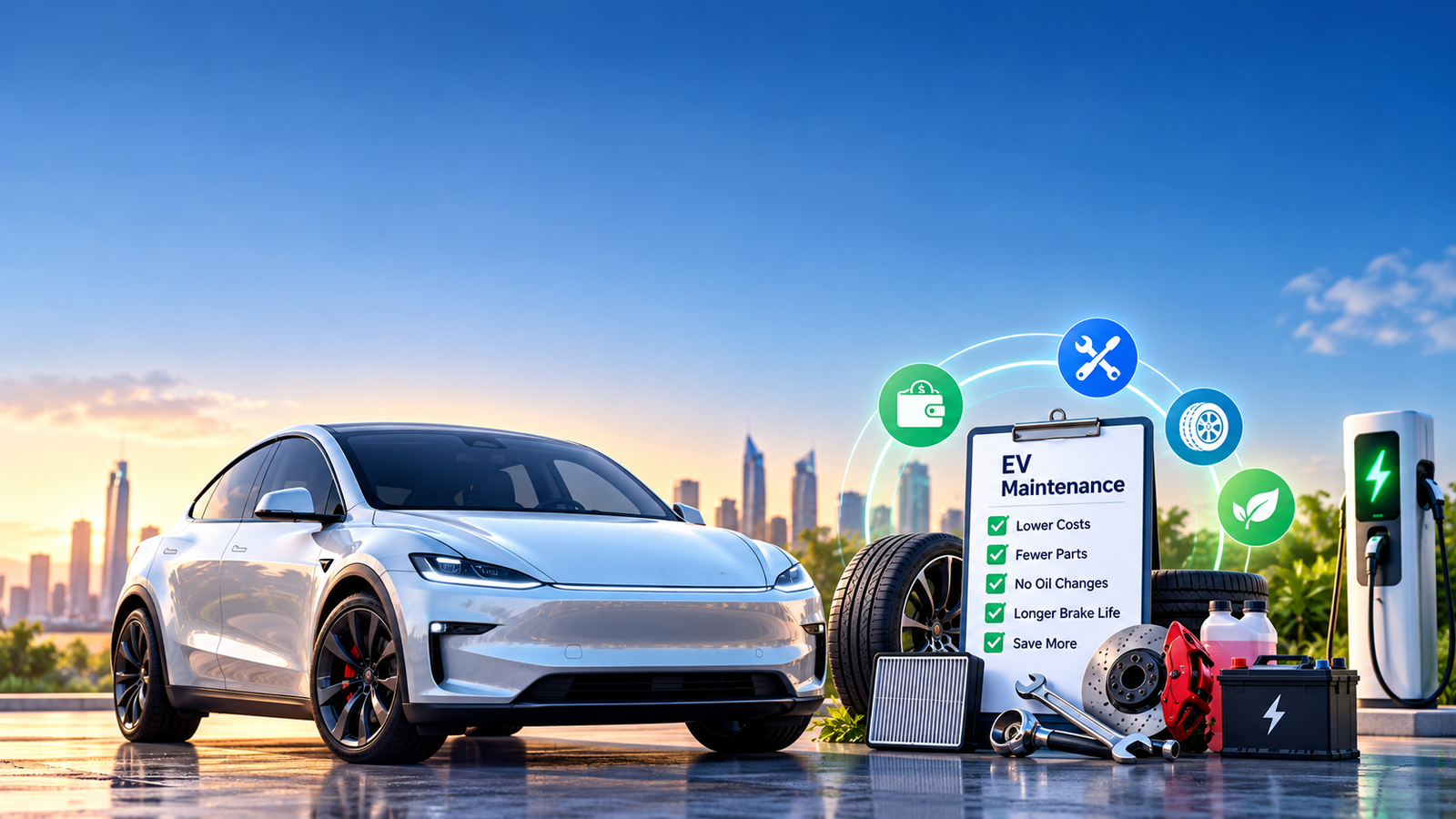
Electric vehicles are often described as cheaper to maintain than gasoline cars.
But what does that actually mean in 2026?
An EV does not need engine oil changes, spark plugs, timing belts, or many of the other service items associated with an internal-combustion engine. However, electric cars still have tires, brakes, suspension components, cooling systems, air-conditioning equipment, filters, wipers, and other parts that require inspection or replacement.
Some repairs can also be expensive once a vehicle is outside its warranty.
So the real question is not whether an electric vehicle requires maintenance.
It does.
The better question is:
Which maintenance costs disappear, which ones remain, and what should an EV owner realistically budget for?
This guide explains EV maintenance costs in 2026, including routine service, tires, brakes, fluids, battery-related maintenance, repair costs, EV vs. gasoline-car maintenance, and what used-EV buyers should check before purchasing.
Table of Contents
EV Maintenance Costs in 2026: Quick Overview
| Maintenance Item | Typical EV Requirement |
|---|---|
| Engine oil changes | Not required on a battery-electric vehicle |
| Spark plugs | Not required |
| Timing belt | Not required |
| Engine air filter | Normally not applicable to a BEV powertrain |
| Tire rotation and replacement | Required |
| Wheel alignment | Required when needed |
| Brake inspection | Required |
| Brake pads and rotors | Usually experience less friction wear because of regenerative braking |
| Brake fluid | Inspection or replacement depends on manufacturer guidance |
| Cabin air filter | Usually requires periodic replacement |
| Wiper blades and washer fluid | Required |
| Battery thermal-management system | Inspection/service requirements vary by vehicle |
| Suspension and steering | Normal inspection and repairs still apply |
| High-voltage battery | Usually not a routine replacement item |
| Software | Increasingly important for diagnostics and vehicle management |
The main maintenance advantage of a battery-electric vehicle comes from having a simpler powertrain with fewer moving parts and fewer fluids that require regular service. The U.S. Department of Energy notes that all-electric vehicles generally require less maintenance than conventional vehicles for these reasons.
Why EVs Usually Require Less Scheduled Maintenance
A gasoline-powered vehicle contains many components that simply do not exist in a battery-electric vehicle.
A conventional car may require service related to:
- Engine oil
- Oil filters
- Spark plugs
- Fuel system components
- Exhaust system
- Timing belts or related engine components
- Engine air intake system
- Various internal engine parts
A battery-electric vehicle replaces the combustion engine with an electric motor, battery pack, power electronics, and reduction gearing.
According to the U.S. Department of Energy, an EV’s battery, motor, and associated electronics generally require little regular scheduled maintenance, while the vehicle also has fewer fluids and far fewer moving parts than a conventional gasoline vehicle.
This does not make an EV maintenance-free.
It simply changes where the maintenance money is spent.
How Much Does EV Maintenance Cost?
There is no single annual maintenance cost that applies to every electric vehicle.
Actual spending depends on:
- Vehicle model
- Mileage
- Tire size
- Driving style
- Road conditions
- Climate
- Labor rates
- Warranty coverage
- Parts availability
- Accident history
- Manufacturer service requirements
However, the U.S. Department of Energy provides a useful reference point.
DOE data estimates average scheduled maintenance costs at approximately:
- Battery-electric vehicle: 6.1 cents per mile
- Conventional gasoline vehicle: 10.1 cents per mile
The figures come from a comprehensive vehicle total-cost-of-ownership analysis and should be treated as comparative reference estimates rather than guaranteed 2026 repair prices.
The important takeaway is the difference in the types and frequency of scheduled maintenance—not a promise that every EV owner will spend exactly 6.1 cents per mile.
EV Maintenance vs. Gas Car Maintenance
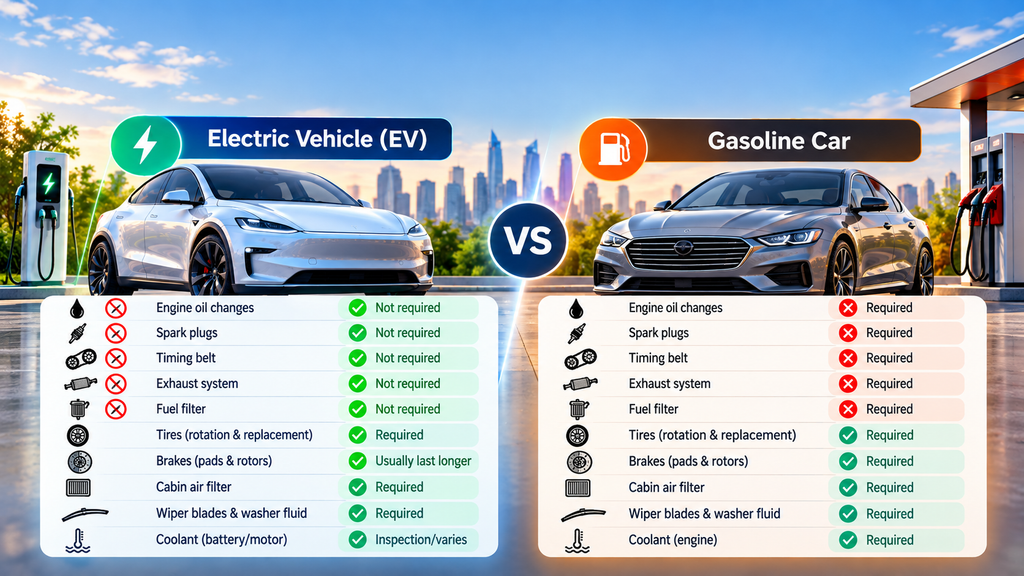
The biggest difference becomes clear when comparing service items.
Battery-Electric Vehicle
A BEV typically does not require:
- Engine oil changes
- Oil-filter changes
- Spark-plug replacement
- Engine timing-belt service
- Exhaust-system maintenance
- Fuel-filter service associated with a gasoline engine
Gasoline Vehicle
A conventional vehicle still requires many of those engine-related services in addition to shared items such as:
- Tires
- Brakes
- Suspension
- Steering
- Air conditioning
- Wipers
- Cabin filters
This is why scheduled maintenance costs are generally lower for fully electric vehicles.
What Maintenance Does an EV Still Need?
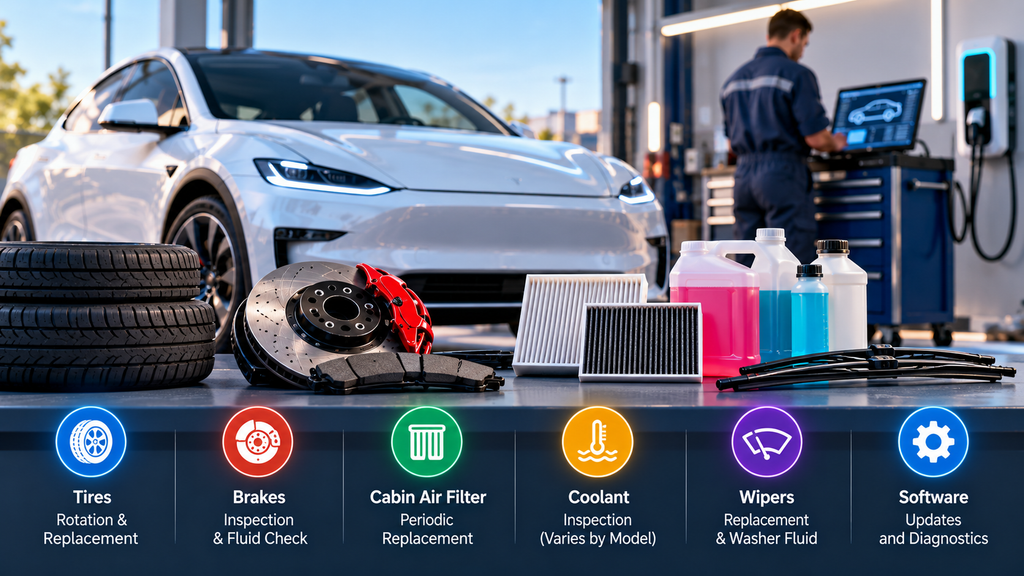
Many traditional maintenance items disappear, but several important ones remain.
EV owners should still pay attention to:
- Tires
- Tire pressure
- Tire rotation
- Wheel alignment
- Brake system
- Brake fluid
- Suspension
- Steering components
- Cabin air filters
- Wiper blades
- Washer fluid
- Air-conditioning system
- Cooling systems
- Low-voltage electrical system
- Software updates
- Safety inspections
The exact maintenance schedule depends on the manufacturer and vehicle.
If you are also planning your home setup, our EV charging at home in 2026 guide explains Level 1, Level 2, installation, connectors, and smart charging.
Always follow the service schedule for your specific model.
Tires Can Be One of the Biggest EV Maintenance Expenses
Tires are one of the most important ongoing expenses for any electric vehicle.
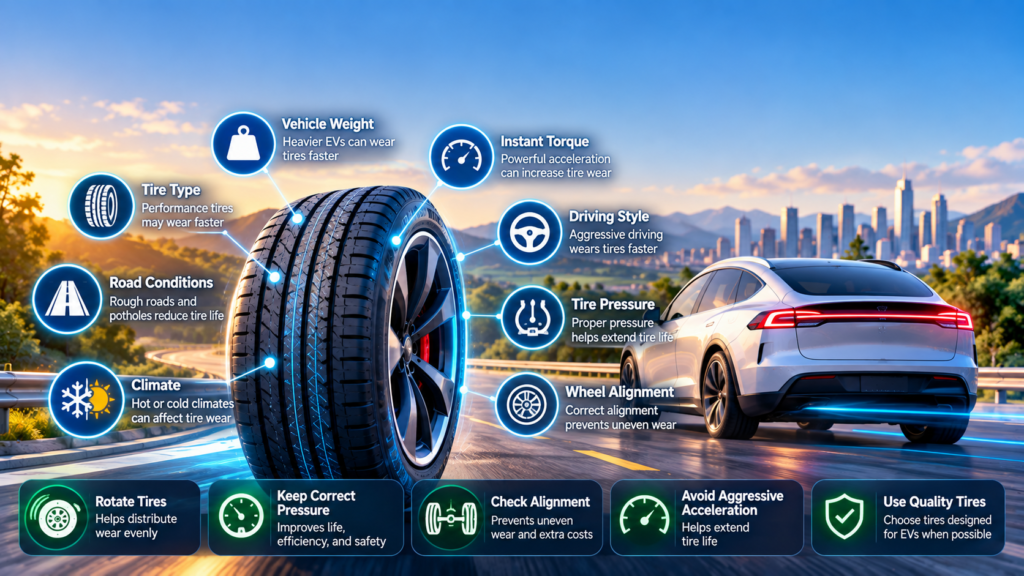
EVs can place significant demands on tires because of factors such as:
- Vehicle weight
- Instant electric-motor torque
- Powerful acceleration
- Wheel and tire size
- Performance-focused compounds
- Driving style
- Tire pressure
- Alignment
However, it would be misleading to say that every EV automatically wears through tires faster than every gasoline car.
Tire life varies considerably by model and driver.
A heavy, high-performance EV driven aggressively may consume tires much faster than an efficiently driven smaller EV.
Regular tire rotation, correct inflation, wheel alignment, and moderate acceleration can help maximize tire life.
Why Tire Rotation Matters on an EV
Tires do not always wear evenly.
Front and rear tires may experience different loads, steering forces, and acceleration forces.
Regular rotation can help distribute wear more evenly.
As an example of how schedules differ by manufacturer, Tesla recommends tire rotation based on mileage or tread-depth differences for applicable models, while Ford’s Mustang Mach-E maintenance schedule includes regular tire rotation and tire-wear inspection.
These examples should not be used as universal intervals.
Always follow your own vehicle’s manual.
Wheel Alignment Is Especially Important
Incorrect wheel alignment can:
- Increase tire wear
- Reduce efficiency
- Affect handling
- Reduce driving range
- Increase steering effort
If an EV begins pulling to one side or develops uneven tire wear, alignment should be checked.
Potholes, curbs, road impacts, and suspension wear can all affect alignment.
Because EV tires can be expensive, catching an alignment problem early may prevent unnecessary replacement costs.
Do EV Brakes Last Longer?
Often, friction brakes can experience less wear in an EV because the electric motor performs part of the vehicle’s deceleration through regenerative braking.
Regenerative braking converts some of the vehicle’s kinetic energy back into electrical energy while slowing the car.
This means the physical brake pads and rotors may be used less frequently during normal driving.
DOE notes that brake wear is significantly reduced in EVs because of regenerative braking.
However, that does not mean EV brakes can be ignored.
EV Brake Maintenance Is Still Important
An EV still has conventional friction brakes for situations such as:
- Emergency braking
- Hard braking
- Low-speed stopping
- Conditions where regenerative braking is limited
- Holding the vehicle stationary
The brake system still needs inspection.
In some environments, using friction brakes less frequently can create a different issue: corrosion.
Road salt, humidity, dirt, and long periods of limited brake use may affect brake components.
Some manufacturers therefore recommend periodic brake cleaning or lubrication under specific climate conditions.
What About Brake Fluid?
Brake fluid is still part of the hydraulic braking system.
It may require periodic inspection or testing depending on the manufacturer.
For example, Tesla currently recommends periodic brake-fluid health checks for applicable models rather than treating brake-fluid replacement as a simple universal annual service.
Other manufacturers may specify different intervals.
Use the maintenance schedule for the exact model.
Do Electric Cars Need Coolant?
Some do.
Electric vehicles may use liquid cooling to manage temperatures for:
- High-voltage battery
- Electric motors
- Power electronics
- Charging components
- Cabin climate-control systems
Cooling-system maintenance differs significantly between manufacturers.
Some EVs may require coolant inspection or eventual replacement, while other systems have very long service intervals.
For example, Ford’s Mustang Mach-E maintenance schedule includes regular cooling-system inspection and a long-term coolant replacement interval.
This is another reason not to assume all EVs have the same maintenance schedule.
Does the EV Battery Need Regular Maintenance?
The high-voltage traction battery usually does not require the kind of routine service associated with a combustion engine.
Owners generally do not open, service, or disassemble the battery pack themselves.
Battery health is primarily managed through:
- Battery-management software
- Thermal management
- Charging controls
- Diagnostic systems
- Manufacturer software
However, battery-related cooling systems may have inspection requirements depending on the vehicle.
Any battery warning or high-voltage-system alert should be inspected by qualified personnel.
Is Battery Replacement a Normal Maintenance Cost?
No.
A complete traction-battery replacement should not be treated as routine maintenance.
Modern EV batteries are designed for extended service lives and are generally covered by separate battery warranties.
Battery capacity may gradually decline over time, but degradation is different from complete battery failure.
A battery can continue working for many years with less usable capacity than when it was new.
For more detail, battery condition should be considered separately from routine EV maintenance.
For a deeper look at degradation, warranties, charging habits, and long-term battery health, see our EV battery lifespan in 2026 guide.
Cabin Air Filters Still Need Replacement
Electric vehicles still have heating, ventilation, and air-conditioning systems.
Most use cabin air filters that capture:
- Dust
- Pollen
- Road debris
- Fine particles
Filter replacement intervals vary by vehicle and environment.
Dusty regions may require more frequent attention than mild, clean environments.
Some EVs also use additional HEPA or carbon filtration systems that have their own replacement schedules.
Air Conditioning and Heat Pumps
Modern EV climate-control systems can be sophisticated.
Depending on the vehicle, they may include:
- Heat pump
- Refrigerant circuit
- Cabin heater
- Battery-conditioning functions
- Compressor
- Desiccant components
These systems can affect both passenger comfort and energy efficiency.
They are not maintenance-free.
Service should generally be performed by qualified technicians because EV climate systems may interact with high-voltage equipment and battery thermal management.
Do EVs Have Transmission Maintenance?
Most battery-electric vehicles do not have the traditional multi-speed automatic transmission found in gasoline vehicles.
Many use a single-speed reduction gear.
That eliminates much of the complexity associated with conventional transmission maintenance.
However, some electric drive units contain lubricant or reduction-gear fluid.
Inspection or replacement requirements depend on vehicle design.
Do not assume that “no conventional transmission” means there is never any drivetrain fluid to inspect.
What About the 12-Volt or Low-Voltage Battery?
EVs still have a low-voltage electrical system.
This system powers equipment such as:
- Computers
- Control modules
- Locks
- Lighting
- Safety systems
- Relays
Depending on the vehicle, the low-voltage battery may use lead-acid, lithium-ion, or another chemistry.
It can eventually require replacement.
A weak low-voltage battery can sometimes prevent an EV from operating even when the main traction battery is charged.
Suspension and Steering Costs Still Exist
An electric vehicle still has:
- Shock absorbers
- Springs
- Control arms
- Bushings
- Ball joints
- Wheel bearings
- Steering components
These components wear with mileage, road conditions, vehicle weight, and driving style.
Poor roads and potholes can increase suspension and alignment expenses regardless of powertrain type.
Heavy EVs may place additional loads on some chassis components, but actual durability varies by vehicle.
Wipers, Washer Fluid, and Other Basic Items
Some maintenance costs have nothing to do with whether a car is electric or gasoline-powered.
EV owners still need:
- Windshield wipers
- Washer fluid
- Exterior lights
- Tires
- Wheel balancing
- Glass repair
- Air-conditioning service
- General inspections
These costs should still be included when estimating real-world ownership expenses.
Does an EV Need Annual Service?
Not necessarily.
Some manufacturers use mileage-based or time-based inspection schedules.
Others recommend service primarily when needed, with individual intervals for tires, filters, fluids, and inspections.
Tesla, for example, states that its vehicles do not require a traditional annual maintenance service, while still specifying maintenance tasks for items such as filters, tires, brake fluid, and climate-system components.
Other brands use more conventional scheduled service intervals.
The correct answer therefore depends on the model.
Software Is Becoming Part of EV Maintenance
Electric vehicles rely heavily on software.
Modern EV software may control:
- Battery management
- Charging
- Thermal management
- Regenerative braking
- Energy consumption
- Driver assistance
- Diagnostics
Over-the-air updates can sometimes resolve problems or improve functionality without a workshop visit.
However, software cannot eliminate physical wear.
Tires, suspension, brakes, filters, cooling systems, and mechanical components still need inspection.
Can EV Repairs Be Expensive?
Yes.
Lower routine maintenance does not mean every repair is inexpensive.
Unexpected repairs may involve:
- Power electronics
- Charging hardware
- Electric drive units
- HVAC systems
- Sensors
- Cameras
- Displays
- Electronic modules
- Suspension components
- Bodywork
- High-voltage systems
The price depends heavily on vehicle design, warranty coverage, labor rates, and parts availability.
A simple scheduled-maintenance comparison should therefore not be confused with total lifetime repair costs.
Scheduled Maintenance vs. Unexpected Repairs
This distinction is important.
Scheduled Maintenance
Planned service such as:
- Tire rotation
- Filter replacement
- Inspections
- Fluid checks
- Wiper replacement
Repairs
Work performed because something has failed, been damaged, or worn unexpectedly.
Examples include:
- Failed electronic module
- Suspension damage
- Charging-port fault
- Air-conditioning failure
- Accident damage
EVs generally have an advantage in scheduled powertrain maintenance, but actual repair experiences vary widely between vehicles.
Warranty Coverage Can Change Your Real Cost
A new EV may have several different warranties covering:
- Vehicle
- High-voltage battery
- Electric drive components
- Corrosion
- Roadside assistance
Warranty terms vary substantially.
Before estimating long-term maintenance costs, check:
- Warranty length
- Mileage limits
- Battery coverage
- Exclusions
- Transferability
- Regional conditions
A repair that costs the original owner nothing under warranty could become a major expense once coverage expires.
EV Maintenance Costs in Hot Climates
Hot climates create additional considerations.
Heat can increase demands on:
- Air-conditioning
- Battery cooling
- Cabin filters
- Tires
- Rubber components
Drivers in very hot regions should pay particular attention to:
- Tire pressure
- Cooling-system condition
- Air-conditioning performance
- Battery thermal-management warnings
- Parking conditions
Exact service requirements still depend on the vehicle.
EV Maintenance Costs in Cold Climates
Cold regions create a different maintenance environment.
Important issues may include:
- Road salt
- Brake corrosion
- Tire choice
- Washer fluid
- Wiper performance
- Battery preconditioning
- Winter efficiency
Vehicles exposed to road salt may require additional attention to brakes and underbody components.
The manufacturer’s severe-weather recommendations should be followed where applicable.
Is EV Maintenance Cheaper for High-Mileage Drivers?
Potentially.
Drivers covering large annual distances avoid many engine-related service items that would otherwise accumulate with mileage.
However, high-mileage EV drivers may spend more frequently on:
- Tires
- Alignment
- Suspension
- Cabin filters
- General wear items
So the maintenance advantage should be evaluated across the entire vehicle rather than only the electric motor.
Drivers who regularly cover long distances can also compare the best EVs for long-distance driving in 2026 by range, charging speed, comfort, and road-trip usability.
Used EV Maintenance: What Should You Check?
When buying a used electric vehicle, examine more than the battery.
Consider checking:
Tires
Uneven tire wear may indicate:
- Poor alignment
- Suspension problems
- Aggressive driving
Brakes
Check rotors, pads, calipers, and brake-fluid condition.
Suspension
Listen for:
- Knocking
- Clunks
- Squeaks
- Steering looseness
Charging System
Confirm that AC charging works normally.
If the vehicle supports DC fast charging, verify its charging system where practical.
Climate Control
Test heating and air conditioning.
Cooling System
Check for warnings, leaks, or service history.
Software
Confirm that required updates and recalls have been completed.
Battery Warranty
Determine whether high-voltage battery coverage remains active and whether it transfers to a new owner.
If you are comparing models before buying, you can also review the best electric cars in 2026 by range, features, charging, and overall practicality.
How to Reduce EV Maintenance Costs
Good maintenance habits can help control long-term ownership costs.
Follow the Manufacturer’s Schedule
Do not rely on generic EV maintenance advice when the owner’s manual provides model-specific requirements.
Maintain Tire Pressure
Correct pressure supports:
- Tire life
- Efficiency
- Range
- Handling
Rotate Tires When Required
Rotation may reduce uneven wear and help maximize tire life.
Fix Alignment Problems Early
Uneven wear can quickly turn a minor alignment issue into an expensive tire replacement.
Monitor Brake Condition
Low friction-brake usage does not mean brakes should never be inspected.
Keep Cooling Systems Healthy
Battery and power-electronics thermal management can be important for long-term reliability.
Respond to Warning Messages
Do not ignore:
- Battery warnings
- Charging faults
- Brake alerts
- Thermal-management warnings
Early diagnosis may prevent a larger problem.
EV vs. Gasoline Maintenance: What You Stop Paying For
One of the easiest ways to understand EV maintenance savings is to look at services that disappear.
A battery-electric vehicle generally eliminates scheduled maintenance associated with:
- Engine oil
- Oil filter
- Spark plugs
- Exhaust system
- Many engine belts
- Fuel-injection maintenance
- Combustion-engine components
Those savings accumulate over time.
However, they should not be confused with zero maintenance.
What Costs Remain on Both EVs and Gas Cars?
Both powertrains still share many ownership costs:
- Tires
- Suspension
- Steering
- Wheel bearings
- Brakes
- Wipers
- Cabin filters
- Air-conditioning
- Glass
- Body repairs
- Accident repairs
This is why an EV’s maintenance cost never falls to zero.
Are Plug-In Hybrids as Cheap to Maintain as Full EVs?
Usually not.
A plug-in hybrid combines:
- Electric motor
- High-voltage battery
- Charging system
- Gasoline engine
That means it retains many combustion-engine maintenance requirements.
DOE notes that PHEVs and conventional hybrids have maintenance needs more similar to conventional vehicles because they still contain internal-combustion engines.
A full battery-electric vehicle has a greater opportunity to eliminate traditional engine service.
EV Maintenance Cost Checklist for 2026
Before buying an EV, consider:
- Manufacturer maintenance schedule
- Tire size and replacement cost
- Tire-rotation requirements
- Wheel-alignment needs
- Brake inspection requirements
- Brake-fluid schedule
- Cabin-filter schedule
- Cooling-system requirements
- HVAC maintenance
- Low-voltage battery type
- Battery and drivetrain warranty
- Local service-center availability
- Parts availability
- Labor rates
- Remaining factory warranty
These factors provide a more realistic ownership picture than simply assuming that all electric cars are inexpensive to maintain.
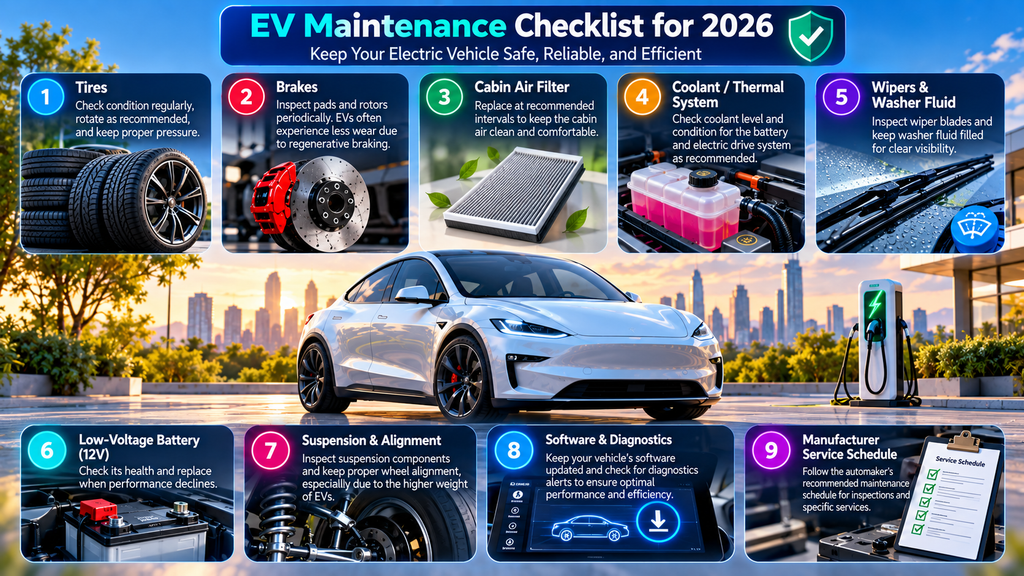
Common EV Maintenance Myths
Myth: EVs require no maintenance
False.
They require less scheduled powertrain maintenance, but tires, brakes, suspension, filters, fluids, HVAC systems, and other components still require attention.
Myth: EV brakes never wear out
False.
Regenerative braking can reduce friction-brake wear, but the brake system still needs inspection and can suffer wear or corrosion.
Myth: EVs never use fluids
False.
Although they eliminate engine oil, some EVs use coolant, brake fluid, refrigerant, washer fluid, and drivetrain lubricants.
Myth: The battery must be replaced as routine maintenance
False.
Traction-battery replacement is not a standard scheduled maintenance item.
Myth: All EVs have the same maintenance schedule
False.
Requirements differ significantly between manufacturers and models.
Frequently Asked Questions About EV Maintenance Costs
Are electric cars cheaper to maintain than gasoline cars?
Generally, battery-electric vehicles have lower scheduled maintenance requirements because they lack many combustion-engine components. DOE reference data estimates lower average maintenance cost per mile for BEVs than conventional gasoline vehicles.
Do EVs need oil changes?
A battery-electric vehicle does not have a combustion engine and therefore does not require engine-oil changes.
Do electric cars need brake service?
Yes. Regenerative braking can reduce brake wear, but pads, rotors, calipers, and brake fluid still require inspection.
How often do EV tires need replacement?
There is no universal interval. Tire lifespan depends on vehicle, tire design, pressure, alignment, road conditions, driving style, and rotation.
Do electric cars need coolant?
Some EVs use liquid cooling for batteries, motors, and electronics. Maintenance requirements differ by vehicle.
Does an EV need annual servicing?
Not always. Some manufacturers use specific mileage or time intervals, while others recommend individual maintenance items as needed.
Are EV repairs always cheaper?
No. Routine maintenance may be lower, but some electronic, high-voltage, HVAC, or accident repairs can be expensive.
Is EV battery replacement part of routine maintenance?
No. High-voltage battery replacement is not normally a scheduled maintenance item.
What is the biggest recurring EV maintenance expense?
For many drivers, tires can be one of the most significant regular expenses, but this varies by vehicle and usage.
Final Thoughts
EV maintenance costs in 2026 remain one of the strongest practical advantages of battery-electric vehicles.
An EV eliminates many familiar engine-related expenses, including oil changes, spark plugs, and numerous combustion-engine service items.
That does not mean the vehicle is maintenance-free.
Owners still need to budget for:
- Tires
- Alignment
- Brakes
- Suspension
- Filters
- Cooling systems
- HVAC components
- Low-voltage electrical systems
- General repairs
The most useful way to evaluate EV maintenance is not to ask:
“Does an EV need maintenance?”
Instead, ask:
“Which maintenance items disappear, which remain, and how expensive are the remaining items for the specific vehicle I am considering?”
For many drivers, the reduction in scheduled powertrain maintenance can produce meaningful long-term savings.
But the exact cost depends on the vehicle, mileage, climate, driving style, warranty, and local repair market.
Before buying, always review the manufacturer’s maintenance schedule and warranty terms for the exact model.
Sources
- U.S. Department of Energy — Alternative Fuels Data Center: Maintenance and Safety of Electric Vehicles.
Guidance on lower EV maintenance requirements, reduced brake wear from regenerative braking, battery cooling systems, and general maintenance differences between EVs and conventional vehicles. - U.S. Department of Energy — Alternative Fuels Data Center: Electric Vehicles for Consumers.
Information on EV ownership costs, maintenance requirements, battery life, charging, and consumer considerations. - U.S. Department of Energy — Battery-Electric Vehicles Have Lower Scheduled Maintenance Costs than Other Light-Duty Vehicles.
DOE reference data comparing average scheduled maintenance costs for battery-electric and conventional gasoline vehicles. - U.S. Department of Energy — Electric Vehicle Technology Overview: Regenerative Braking.
Official explanation of regenerative braking and how it can reduce wear on friction brakes. - Ford — Mustang Mach-E Maintenance Schedule.
Manufacturer maintenance guidance covering tires, brakes, suspension, cooling-system inspections, cabin air filters, and long-term coolant service. - Tesla — Vehicle Service Intervals.
Manufacturer guidance covering tire rotation, brake-fluid checks, cabin air filters, wiper blades, brake-caliper service, and other EV maintenance items.







Comments 2