• Login
TechZory
  • Home
  • Artificial Intelligence
  • Cybersecurity
  • Technology
    • Gadgets & Devices
    • Software
    • Apps
    • Smart Home
    • Startup
  • Reviews & Comparisons
  • Cars & EVs
  • Future Tech
  • Deals
No Result
View All Result
TechZory
  • Home
  • Artificial Intelligence
  • Cybersecurity
  • Technology
    • Gadgets & Devices
    • Software
    • Apps
    • Smart Home
    • Startup
  • Reviews & Comparisons
  • Cars & EVs
  • Future Tech
  • Deals
No Result
View All Result
TechZory
No Result
View All Result
Home
Cars & EVs

Best Electric Cars in 2026: Range, Features, and Value Compared

TechZory TeambyTechZory Team
October 2, 2026
in Cars & EVs
Reading Time: 23 mins read
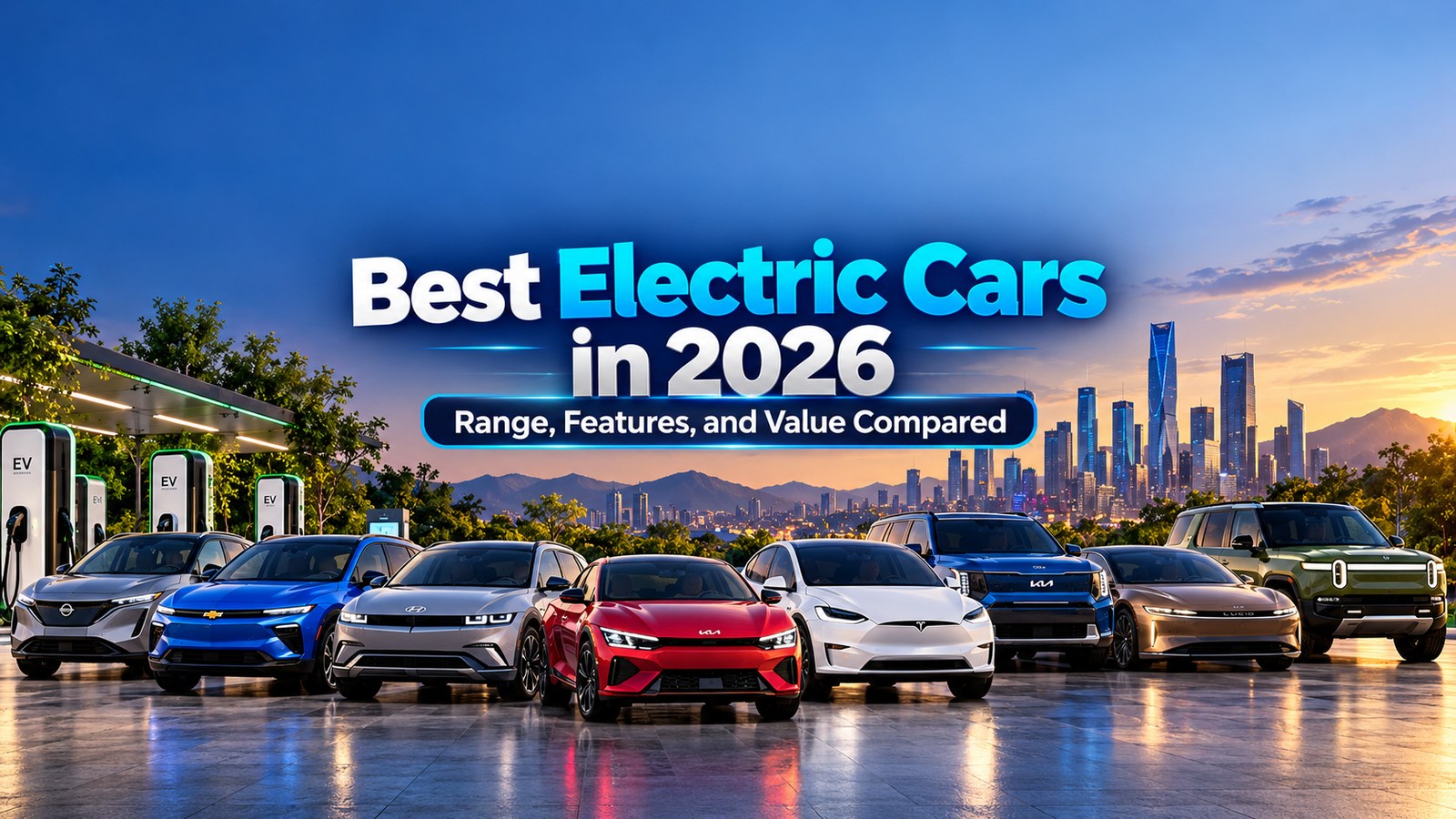
Best electric cars in 2026 compared by range features and value
Share on Facebook
Share on Twitter

Choosing among the best electric cars in 2026 is no longer simply a matter of finding the vehicle with the longest driving range.

Electric vehicles now cover a much wider range of needs, from relatively affordable daily transportation to three-row family SUVs, luxury sedans, performance-focused crossovers, and long-distance vehicles capable of traveling more than 400 miles between charges.

For buyers, that creates a new challenge: two EVs with similar prices can offer very different combinations of range, charging speed, passenger space, technology, and everyday usability.

This comparison looks at several important electric vehicles available in 2026 and focuses on measurable differences rather than declaring one model the universal winner.

Prices, specifications, and EPA range estimates can change by trim and configuration. The figures below primarily reflect U.S.-market specifications and should be treated as a starting point when comparing vehicles.

Table of Contents

  • Best Electric Cars in 2026: Quick Comparison
  • What Makes a Good Electric Car in 2026?
  • Nissan LEAF 2026
    • Chevrolet Equinox EV 2026
      • Hyundai IONIQ 5 2026
        • Kia EV6 2026
          • Tesla Model Y 2026
            • Kia EV9 2026
              • Lucid Air 2026
                • Rivian R1S 2026
                  • Which Electric Car Fits Different Needs?
                  • How Much EV Range Do You Actually Need?
                  • Charging Speed Matters as Much as Range
                  • EV Buying Checklist for 2026
                  • Frequently Asked Questions About Electric Cars in 2026
                    • Final Thoughts

                    Best Electric Cars in 2026: Quick Comparison

                    Electric VehicleStarting MSRP*Maximum or Notable EPA RangeMain Strength
                    Nissan LEAF$29,990Up to 303 milesLower-cost entry into long-range EV ownership
                    Chevrolet Equinox EV$34,995Up to 319 milesPractical range and SUV space
                    Hyundai IONIQ 5$35,000Up to 318 milesVery fast charging and flexible design
                    Kia EV6$37,900Up to 319 milesFast charging and sporty crossover design
                    Tesla Model Y$39,990Up to 321 milesCharging-network access and software ecosystem
                    Kia EV9$54,900Up to 305 milesThree-row family capability
                    Lucid Air$70,900Up to 512 miles on Grand TouringExceptional long-distance range
                    Rivian R1S$83,990Up to 410 miles with Long Range configurationAdventure capability and three-row utility

                    *Starting MSRP normally excludes destination fees, taxes, registration, options, and dealer charges.

                    Official 2026 specifications show the LEAF reaching 303 EPA-estimated miles, Equinox EV 319 miles, IONIQ 5 318 miles, EV6 319 miles, Model Y 321 miles, and EV9 305 miles in relevant configurations. Lucid’s Air Grand Touring reaches up to 512 EPA-estimated miles, while Rivian offers an R1S Long Range configuration rated at up to 410 miles.
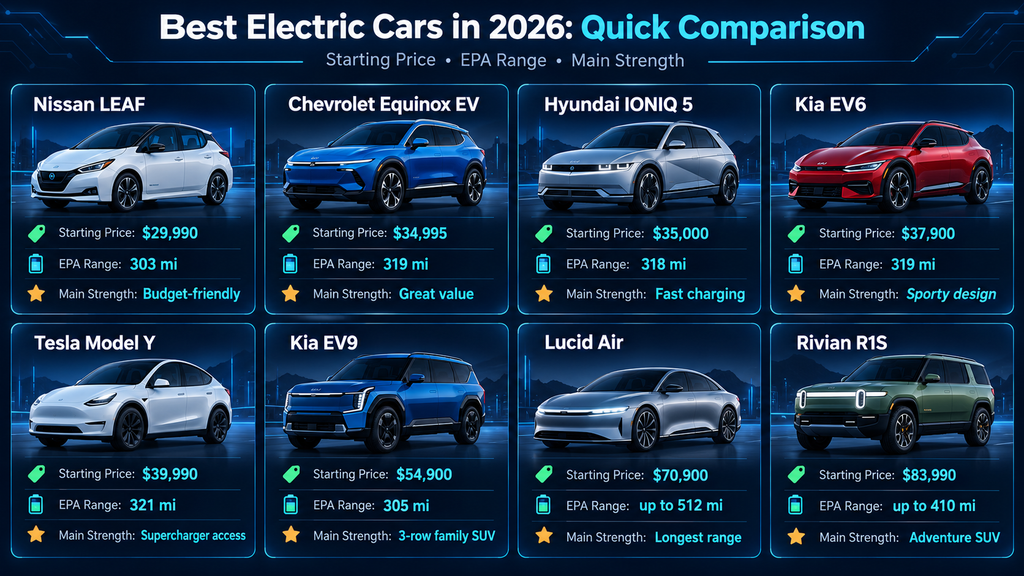
                    Best electric cars in 2026 quick comparison by price EPA range and main strength

                    What Makes a Good Electric Car in 2026?

                    Range is important, but it should not be the only number buyers compare.

                    A useful EV comparison should consider at least five areas:

                    Driving range. A higher EPA estimate can reduce charging stops, particularly for drivers who regularly travel between cities.

                    Charging speed. An EV capable of adding energy quickly may be easier to road-trip than a longer-range model that charges more slowly.

                    Home charging. For many owners, the most convenient EV experience comes from charging overnight rather than relying primarily on public chargers.

                    Interior and cargo space. A commuter, a family of seven, and someone carrying outdoor equipment have very different requirements.

                    Price and equipment. A low starting price does not always mean the configuration with the advertised maximum range is equally inexpensive.

                    For that reason, the models below are compared according to the type of buyer they may suit rather than being ranked from first to last.
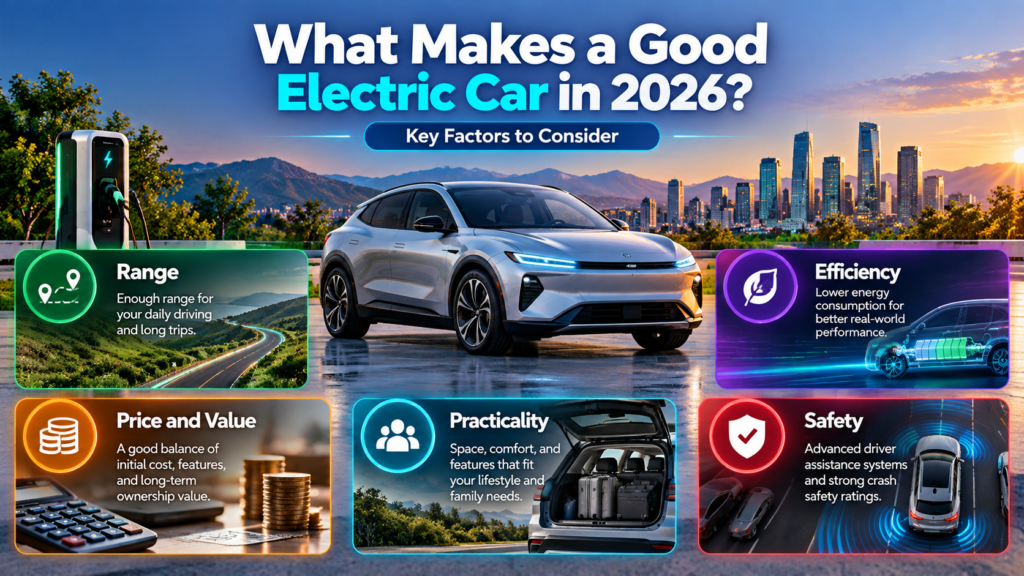
                    What makes a good electric car in 2026 range charging efficiency value practicality and safety

                    Nissan LEAF 2026

                    The redesigned 2026 Nissan LEAF is one of the most significant changes to a familiar EV name.

                    Its S+ version starts at $29,990 and uses a 75-kWh battery with an EPA-estimated range of 303 miles. Nissan also lists the SV+ at $34,230 and Platinum+ at $38,990, with range varying by trim.

                    The new generation moves the LEAF toward a crossover-style design while adding modern features such as dual displays and available Google built-in functionality.

                    Another important improvement is charging flexibility. The vehicle provides a J1772 connection for routine AC charging and a NACS port for compatible DC fast charging.

                    Who should consider it?

                    The LEAF is particularly interesting for buyers who want to enter the EV market without immediately moving into the $40,000-plus price range.

                    Its combination of a relatively low starting price and more than 300 miles of EPA-estimated range on the S+ makes it very different from earlier affordable EVs that often required a substantial range compromise.

                    Chevrolet Equinox EV 2026

                    The Chevrolet Equinox EV targets buyers who want a conventional compact-SUV experience without giving up useful electric range.

                    The 2026 Equinox EV starts at $34,995, and front-wheel-drive versions offer an EPA-estimated 319 miles of range. Chevrolet lists approximately 307 miles for available AWD configurations.

                    The Equinox EV also provides seating for five and up to 57.2 cubic feet of cargo space, making it suitable for everyday family use.

                    Chevrolet says DC fast charging can add approximately 80 miles of range in 10 minutes under appropriate conditions.

                    Who should consider it?

                    The Equinox EV makes sense for buyers prioritizing a combination of:

                    • More than 300 miles of range
                    • SUV practicality
                    • A comparatively accessible starting price
                    • A large central infotainment display
                    • Familiar mainstream-brand ownership

                    It is particularly competitive when range per dollar matters more than maximum acceleration or luxury equipment.

                    Hyundai IONIQ 5 2026

                    The Hyundai IONIQ 5 remains one of the more technically interesting EVs because its appeal is not limited to range.

                    The 2026 model starts at approximately $35,000, while SE, SEL, and Limited rear-wheel-drive versions equipped with the larger battery can achieve up to 318 miles of EPA-estimated range.

                    Its strongest advantage is charging speed.

                    Using a compatible high-power charger and the appropriate CCS adapter, Hyundai says long-range rear-wheel-drive versions can add approximately 178 miles in 15 minutes or charge from 10% to 80% in as little as 20 minutes.

                    The IONIQ 5 also supports a NACS connection, expanding charging-network flexibility.

                    Who should consider it?

                    The IONIQ 5 is particularly attractive for drivers who:

                    • Frequently use DC fast charging
                    • Take road trips
                    • Want a spacious interior without a very large exterior footprint
                    • Prefer distinctive styling
                    • Value fast charging as highly as maximum range

                    A vehicle with 318 miles of range and very rapid charging may be more convenient on long trips than a slightly longer-range EV with slower charging.

                    Kia EV6 2026

                    The Kia EV6 shares some underlying electric-vehicle technology with the Hyundai IONIQ 5 but provides a noticeably different driving and design experience.

                    The 2026 EV6 starts at $37,900, while extended-range rear-wheel-drive configurations can deliver up to 319 miles of EPA-estimated range.

                    Kia also advertises charging from 10% to 80% in approximately 20 minutes using a compatible DC fast charger.

                    The EV6’s lower, more aerodynamic crossover shape gives it a sportier appearance than many compact electric SUVs.

                    Who should consider it?

                    The EV6 suits buyers looking for:

                    • Long-range capability
                    • Fast DC charging
                    • Sportier styling
                    • A five-door crossover layout
                    • Available performance-oriented configurations

                    Between the EV6 and IONIQ 5, the decision may come down more to design, ergonomics, pricing, and trim availability than basic electric-vehicle capability.

                    Tesla Model Y 2026

                    Tesla’s Model Y remains an important reference point in the electric crossover market.

                    Current U.S. configuration information lists the rear-wheel-drive Model Y at $39,990, with an EPA-estimated range of approximately 321 miles when equipped with the standard 18-inch wheels.

                    A major advantage remains integration with Tesla’s Supercharger network.

                    The Model Y also emphasizes software, mobile-app integration, route planning, charging-network integration, and a minimalist touchscreen-centered interface.

                    Tesla offers several configurations, including rear-wheel drive, all-wheel drive, Premium versions, Performance, and a longer-wheelbase Model Y L Premium.

                    Who should consider it?

                    The Model Y may appeal most to buyers who prioritize:

                    • A mature fast-charging ecosystem
                    • Integrated navigation and charging planning
                    • Strong software integration
                    • Efficient packaging
                    • Multiple drivetrain choices

                    However, buyers should compare the exact configuration rather than assuming every Model Y offers the same range, equipment, or price.

                    Kia EV9 2026

                    Most electric SUVs are two-row vehicles. The Kia EV9 is different because it is designed as a genuine family-oriented three-row electric SUV.

                    The 2026 EV9 starts at $54,900, offers seating for up to seven passengers, and provides an EPA-estimated range of up to 305 miles in the Light Long Range RWD configuration.

                    Kia also states that compatible 350-kW DC fast charging can take the battery from 10% to 80% in as little as 24 minutes.

                    Depending on configuration, the EV9 can offer substantial cargo capacity, available all-wheel drive, and towing capability.

                    Who should consider it?

                    The EV9 is aimed at a different buyer from smaller EV crossovers.

                    It deserves consideration if you need:

                    • Three rows
                    • Seating for six or seven
                    • Family road-trip capability
                    • Useful cargo space
                    • Available AWD
                    • Fast charging

                    For larger families wanting to move away from gasoline-powered three-row SUVs, the EV9 fills an important role.

                    Lucid Air 2026

                    Lucid approaches the EV market from the opposite end of the spectrum: efficiency, luxury, performance, and very long driving range.

                    The 2026 Lucid Air Pure is priced from $70,900 in the United States. The Air Touring is rated at 431 miles of EPA-estimated range, while the Grand Touring reaches as much as 512 miles.

                    That means the Air can offer dramatically more driving range than many mainstream EVs, although the longest-range version costs substantially more than the base model.

                    Lucid also supports high-power DC charging, with the Touring capable of charging at speeds up to 250 kW.

                    Who should consider it?

                    The Lucid Air is most relevant to drivers who prioritize:

                    • Very long highway range
                    • Luxury
                    • Efficiency
                    • High performance
                    • Reduced charging frequency on long-distance trips

                    It is not a direct price competitor to the LEAF, Equinox EV, IONIQ 5, or EV6. Its value proposition is based on capability rather than low entry cost.

                    Rivian R1S 2026

                    The Rivian R1S combines an electric drivetrain with a more adventure-oriented three-row SUV format.

                    Rivian currently lists the R1S Premium from approximately $83,990. The standard dual-motor configuration carries an EPA-estimated range of about 329 miles, while an available Long Range configuration can extend that to approximately 410 miles.

                    Its strengths include available all-wheel drive, significant passenger and cargo flexibility, high ground-clearance capability, and configurations aimed at drivers who may use their EV beyond ordinary urban commuting.

                    Who should consider it?

                    The R1S is particularly relevant for buyers who want:

                    • Three-row seating
                    • Long-distance range
                    • AWD capability
                    • Outdoor and adventure use
                    • Premium interior features
                    • Greater utility than a conventional electric sedan

                    Its higher price places it firmly in the premium SUV category.

                    Which Electric Car Fits Different Needs?

                    There is no single EV specification that determines the right vehicle.

                    For buyers focused primarily on lower purchase price, the Nissan LEAF deserves attention because its S+ combines a sub-$30,000 starting MSRP with a 303-mile EPA estimate.

                    For buyers wanting an affordable electric SUV, the Equinox EV combines five-passenger practicality with up to 319 miles of range.

                    For drivers who value rapid road-trip charging, the Hyundai IONIQ 5 and Kia EV6 deserve particularly close comparison.

                    For buyers prioritizing charging-network integration and software, the Tesla Model Y remains an important option.

                    For families needing three rows, the Kia EV9 offers a more mainstream family-oriented approach, while the Rivian R1S provides a more premium and adventure-focused alternative.

                    For buyers seeking maximum highway range, the Lucid Air stands apart, especially in Grand Touring form.
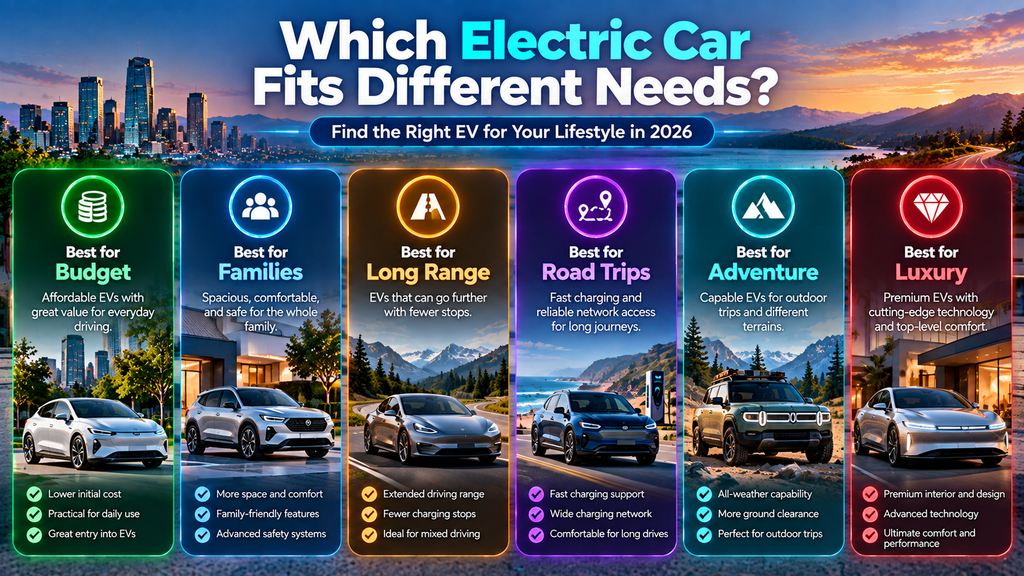
                    Electric cars for different needs in 2026 including budget family long range road trips adventure and luxury

                    How Much EV Range Do You Actually Need?

                    More range is useful, but paying for the largest possible battery is not always necessary.

                    A driver traveling 30 to 50 miles per day who can charge at home may rarely use the full capacity of a 300-mile battery.

                    Long-range capability becomes more valuable when:

                    • You regularly travel between cities
                    • Fast chargers are limited along your routes
                    • You drive in very cold or very hot weather
                    • You tow
                    • You frequently travel at highway speeds
                    • You cannot charge reliably at home

                    EPA ratings are standardized estimates, not guaranteed real-world distances.

                    Weather, wheel size, driving speed, terrain, HVAC use, vehicle load, battery temperature, and towing can all affect actual range.

                    Charging Speed Matters as Much as Range

                    Consider two hypothetical vehicles.

                    Vehicle A can travel 350 miles but requires a relatively long charging stop.

                    Vehicle B travels 310 miles but can recover a large portion of its battery very quickly.

                    On a long road trip, Vehicle B may sometimes complete the journey just as conveniently—or more conveniently—despite having the lower headline range.

                    For drivers who regularly take highway trips, our guide to the best EVs for long-distance driving in 2026 compares range, charging speed, comfort, and road-trip practicality in more detail.

                    Before choosing an EV, it is also worth understanding EV charging at home in 2026, including Level 1 vs. Level 2 charging, installation requirements, connector compatibility, and smart charging options.
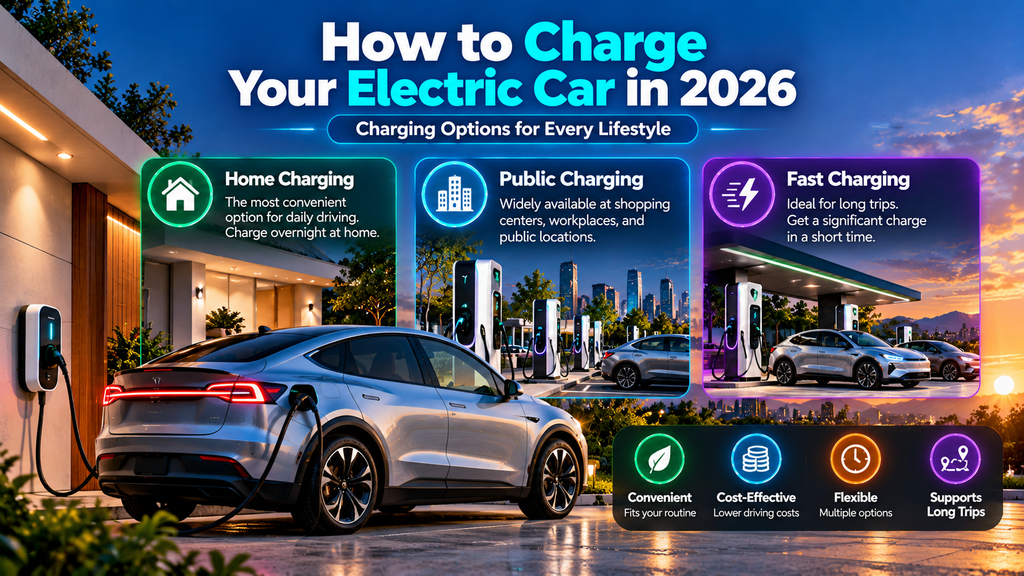
                    Electric car charging options in 2026 including home public and fast charging

                    That is why buyers should examine:

                    • Maximum DC charging capability
                    • Typical 10–80% charging time
                    • Charging curve, not just peak speed
                    • NACS or CCS compatibility
                    • Availability of chargers on regular routes
                    • Battery preconditioning
                    • Home Level 2 charging capability

                    The charging network around where you actually drive may matter more than a small difference in EPA range.

                    EV Buying Checklist for 2026

                    Before choosing an electric vehicle, answer these questions:

                    Can you charge at home?
                    Home charging dramatically changes the ownership experience.

                    How far do you usually drive each day?
                    Do not automatically pay for range you rarely need.

                    How often do you travel long distances?
                    Frequent highway travel makes DC charging speed more important.

                    How many passengers do you regularly carry?
                    A five-seat crossover and a three-row SUV serve very different households.

                    Do you need AWD or towing?
                    Both can affect price, efficiency, and range.

                    Which version provides the advertised range?
                    Maximum-range figures often apply only to specific trims, wheels, or drivetrains.

                    What does the vehicle cost after options?
                    A low base MSRP can rise substantially after selecting a larger battery, AWD, premium wheels, or technology packages.

                    Which charging networks are available where you live and travel?
                    A charging connector alone does not guarantee convenient charging coverage.

                    Battery condition and long-term durability also matter when choosing an EV, so our EV battery lifespan in 2026 guide explains degradation, battery health, warranties, charging habits, and what affects long-term battery life.

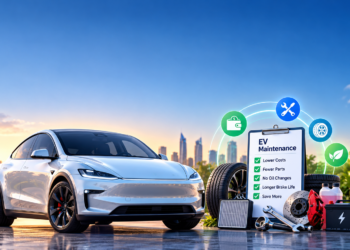
                    Long-term ownership costs also depend on routine service, tires, brakes, filters, and other wear items, so our EV maintenance costs in 2026 guide explains what electric-car owners should realistically budget for.
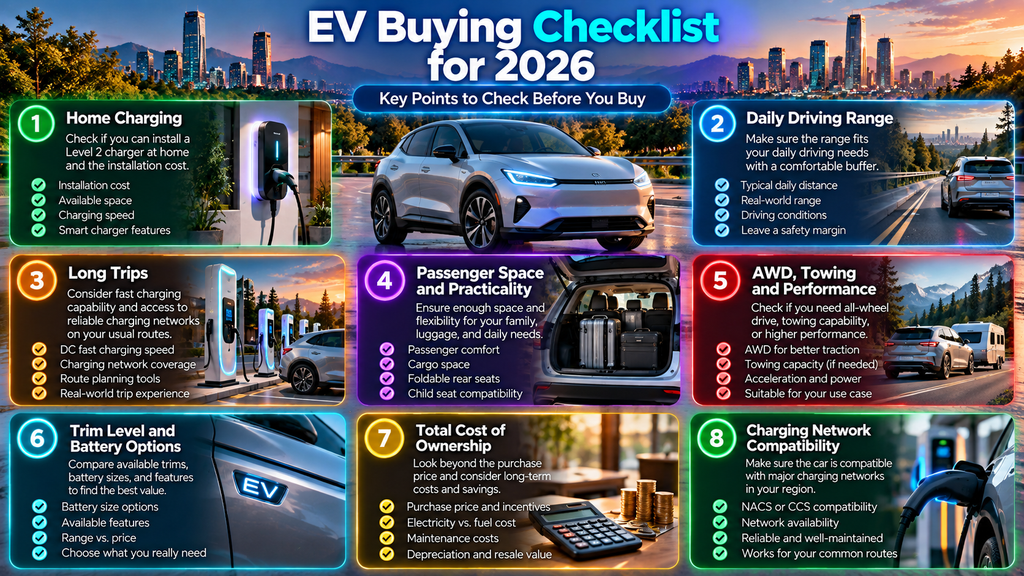
                    EV buying checklist for 2026 including home charging daily range long trips passenger space AWD towing trims cost and charging network

                    Frequently Asked Questions About Electric Cars in 2026

                    Is 300 miles of EV range enough?

                    For many drivers, yes. A vehicle with approximately 300 miles of rated range can handle normal commuting and many road trips comfortably, particularly when reliable fast charging is available.

                    Which 2026 electric cars offer more than 300 miles of range?

                    Several models in this comparison exceed 300 miles in at least one configuration, including the Nissan LEAF, Chevrolet Equinox EV, Hyundai IONIQ 5, Kia EV6, Tesla Model Y, Kia EV9, Lucid Air, and Rivian R1S.

                    Does the cheapest EV have the shortest range?

                    Not necessarily. The 2026 Nissan LEAF S+ starts below several vehicles in this comparison yet carries an EPA-estimated range of 303 miles.

                    Is fast charging more important than maximum range?

                    It depends on how you use the vehicle. Drivers who frequently travel long distances may benefit greatly from a vehicle that combines reasonable range with a strong charging curve and widespread charger access.

                    Should I buy an EV if I cannot charge at home?

                    It is possible, but public charging availability becomes much more important. Before buying, check reliable chargers near your home, workplace, and regular travel routes.

                    Do electric cars lose range in extreme weather?

                    Yes. Very hot or cold temperatures can affect battery efficiency and energy used for cabin conditioning. Real-world range can therefore differ from EPA estimates.

                    Final Thoughts

                    The electric-car market in 2026 offers far more variety than it did only a few years ago.

                    Buyers can now choose relatively affordable EVs with around 300 miles of range, exceptionally fast-charging crossovers, three-row family SUVs, software-focused vehicles, premium adventure SUVs, and luxury sedans capable of traveling more than 500 miles under EPA testing.

                    That makes the question less about finding a single “best” electric car and more about matching the vehicle to the way it will actually be used.

                    Start with your realistic daily range, home-charging situation, passenger and cargo requirements, long-distance driving habits, and budget. Then compare the specific trim you intend to buy—not simply the highest range or lowest price advertised for the model family.

                    For many buyers in 2026, the strongest EV choice will be the one that provides the right balance of range, charging convenience, space, features, and total purchase cost.

                    Sources

                    1. Nissan — 2026 Nissan LEAF Specs & Trims. Official pricing, battery capacity, EPA-estimated range, charging information, and trim specifications.
                    2. Chevrolet — 2026 Equinox EV. Official starting MSRP, EPA-estimated driving range, interior features, and vehicle specifications.
                    3. Hyundai — 2026 IONIQ 5. Official pricing, EPA-estimated range, battery options, and DC fast-charging performance.
                    4. Kia — 2026 EV6. Official starting MSRP, EPA-estimated range, charging times, features, and available configurations.
                    5. Tesla — Model Y. Official U.S. pricing, EPA-estimated range, charging specifications, Supercharger access, and vehicle configurations.
                    6. Kia — 2026 EV9. Official pricing, EPA-estimated range, three-row seating, charging information, and available features.
                    7. Lucid Motors — 2026 Lucid Air Lineup. Official 2026 pricing, EPA-estimated range, charging capability, and specifications for Pure, Touring, and Grand Touring models.
                    8. Rivian — 2026 R1S. Official pricing, EPA-estimated range, battery options, dual-motor AWD configurations, and available equipment.
                    9. U.S. Department of Energy — Alternative Fuels Data Center: Electric Vehicles for Consumers. Guidance on home charging, Level 1 and Level 2 charging, DC fast charging, charging connectors, and public charging.
                    10. U.S. Department of Energy — Alternative Fuels Data Center: Charging Electric Vehicles at Home. Guidance on residential EV charging, Level 2 equipment, electrical requirements, and home-charging considerations.
                    Previous Post

                    Best Antivirus Software in 2026: 10 Security Tools Compared

                    Next Post

                    Best EVs for Long-Distance Driving in 2026: Range, Charging & Road-Trip Comfort

                    Related Posts

                    EV maintenance costs in 2026 showing electric vehicle service tires brakes fluids filters and charging equipment
                    Cars & EVs

                    EV Maintenance Costs in 2026: What Does an Electric Car Really Cost to Maintain?

                    October 2, 2026
                    EV battery lifespan in 2026 showing electric car battery health degradation warranty and long-term battery life
                    Cars & EVs

                    EV Battery Lifespan in 2026: How Long Do Electric Car Batteries Really Last?

                    October 2, 2026
                    EV charging at home in 2026 beginner guide covering Level 1 Level 2 installation connectors and smart charging
                    Cars & EVs

                    EV Charging at Home in 2026: Complete Beginner’s Guide

                    October 2, 2026

                    Comments 1

                    1. Pingback: EV Charging at Home in 2026: Complete & Easy Guide

                    Leave a Reply Cancel reply

                    Your email address will not be published. Required fields are marked *

                    Popular News

                    AI reasoning models in 2026 using longer thinking time to analyze complex problems

                    AI Reasoning Models in 2026: Why Longer Thinking Time Is Changing What AI Can Do

                    October 1, 2026
                    Best password managers in 2026 for secure passwords, passkeys, encrypted vaults, and safer logins

                    Best Password Managers in 2026: 10 Secure Options Compared

                    October 1, 2026
                    Best power banks in 2026 from Anker, UGREEN, Baseus and INIU compared

                    Best Power Banks in 2026: Anker, UGREEN, Baseus & More Compared

                    October 13, 2026
                    Best VPN services in 2026

                    Best VPN Services in 2026: 5 Secure Options for Privacy & Everyday Use

                    October 5, 2026
                    Next Post
                    # Best EVs for Long-Distance Driving in 2026: Range, Charging & Road-Trip Comfort Long-distance travel is one of the toughest tests for an electric vehicle. An EV that works perfectly for a 30-mile daily commute may feel very different on a 600-mile road trip, where driving range, charging speed, charger availability, cabin comfort, and route planning all become much more important. The **best EVs for long-distance driving in 2026** therefore are not necessarily the vehicles with the biggest batteries or the highest advertised range. A strong road-trip EV needs to combine useful highway range with fast and predictable charging, comfortable seating, good navigation, and access to reliable charging networks. This guide compares several important long-distance electric vehicles available in 2026. Rather than declaring one universal winner, it highlights the strengths of different vehicles for different types of road-trip drivers. Range figures primarily reflect U.S. EPA or manufacturer estimates. Actual highway range can vary with speed, temperature, terrain, wheels, passenger load, HVAC use, towing, and battery condition. ## Best EVs for Long-Distance Driving in 2026: Quick Comparison | EV | Maximum/Notable Range | Fast-Charging Capability | Long-Distance Strength | |---|---:|---|---| | Lucid Air Grand Touring | Up to 512 miles EPA | Up to 300 kW; about 200 miles added in 12 min | Extremely long range | | Chevrolet Silverado EV | Up to 478 miles GM-est. | Up to 350 kW; about 120 miles in 10 min | Long range with truck capability | | Mercedes-Benz EQS 450 4MATIC | 367 miles EPA | Up to 200 kW; 10–80% in about 31 min | Luxury and highway comfort | | Tesla Model 3 Long Range RWD | 363 miles EPA | Up to 250 kW; up to 195 miles in 15 min | Efficient travel and charging integration | | BMW iX xDrive60 | Up to roughly 364 miles | Up to 195 kW; 10–80% in about 35 min | Premium SUV comfort | | Rivian R1S | Up to 410 miles depending on configuration | Up to 300 kW; up to 150 miles in 20 min | Long-range family and adventure travel | | Kia EV6 | Up to 319 miles EPA | 10–80% in about 20 min | Rapid charging and strong road-trip value | Official specifications show substantial differences in how these vehicles approach long-distance travel. Lucid emphasizes exceptional efficiency and range, Chevrolet combines a large battery with truck capability, while vehicles such as the EV6 compensate for shorter total range with particularly fast charging. ## What Makes an EV Good for Long-Distance Driving? The biggest range number does not tell the whole story. For road trips, six factors matter particularly strongly. ### Highway Range EPA range is useful for comparing vehicles, but high-speed highway driving often consumes more energy than mixed city and highway testing. A vehicle rated for 350 miles should therefore not automatically be expected to travel exactly 350 highway miles between charging stops. ### Fast-Charging Speed Long-distance drivers rarely charge from 0% to 100% at public fast chargers. A more realistic road-trip pattern is arriving with a low state of charge, charging to around 70% or 80%, and continuing the journey. That makes a vehicle's **10–80% charging performance** especially useful. ### Charging Curve Peak charging power can be misleading. A vehicle may briefly reach a very high charging rate but then reduce power quickly as the battery fills. A strong charging curve—where the vehicle maintains high power for longer—can matter more than the maximum kW figure printed in a brochure. ### Charging-Network Access A 500-mile EV is much less convenient if the few chargers along your route are unreliable or badly located. Drivers should consider: - NACS compatibility - Tesla Supercharger access - CCS availability - Charging-station density - Route-planning integration - Real-time charger availability ### Cabin Comfort Long-distance driving means spending hours in the vehicle. Seat comfort, road noise, suspension quality, climate control, rear-passenger space, and driver-assistance features become far more important than they might during short local trips. ### Efficiency A larger battery does not automatically make an EV better. An efficient vehicle can travel farther using less energy and may recover useful range quickly when charging. ## Lucid Air Grand Touring For drivers who want to minimize charging stops, the Lucid Air Grand Touring is one of the most remarkable long-distance EVs currently available. The 2026 Air Grand Touring offers an EPA-estimated range of up to **512 miles** when properly configured. Lucid also states that the vehicle can recover approximately **200 miles of range in about 12 minutes** under suitable fast-charging conditions. Its maximum DC fast-charging capability reaches approximately **300 kW**. That combination is particularly valuable on highway trips because it attacks both sides of the EV road-trip equation: - Drive farther between stops - Spend less time recovering useful range The Air is also designed as a luxury sedan, with a quiet cabin, substantial passenger space, and available comfort features suited to long journeys. ### Long-Distance Strengths - Up to 512 miles of EPA-estimated range - Very high energy efficiency - Approximately 200 miles added in 12 minutes under suitable conditions - Comfortable luxury-oriented cabin - Strong highway performance ### Important Consideration The Grand Touring is expensive compared with mainstream EVs. Therefore, its exceptional range should be viewed primarily as a premium long-distance capability rather than a value proposition. ## Chevrolet Silverado EV A pickup might not be the first vehicle people imagine for efficient electric road trips, but the 2026 Chevrolet Silverado EV offers one of the largest available driving ranges in the EV market. Chevrolet lists up to **478 miles of GM-estimated electric range** in appropriate configurations. With available **350-kW DC fast charging**, Chevrolet says the Silverado EV can recover up to approximately **120 miles of range in 10 minutes**. It also offers access to a large North American public charging ecosystem, including compatible Tesla Supercharger locations through GM's charging system and adapter support. ### Long-Distance Strengths - Up to 478 miles of estimated range - Very large battery capacity - Strong DC fast-charging capability - Pickup-bed utility - Available towing capacity up to 12,500 pounds - Standard four-wheel drive ### Important Consideration Towing can dramatically reduce EV driving range. A Silverado EV capable of traveling hundreds of miles unloaded should not be expected to achieve the same range when towing a large trailer. For drivers who need both electric transportation and truck capability, however, its large battery provides a valuable buffer. ## Mercedes-Benz EQS 450 4MATIC Sedan Long-distance driving is not only about covering the most miles. For drivers who regularly spend several hours on highways, comfort can matter just as much. The 2026 Mercedes-Benz EQS 450 4MATIC Sedan offers an EPA-estimated **367 miles of electric range**, according to Mercedes-Benz USA. It supports DC fast charging at up to **200 kW**, with Mercedes listing approximately **31 minutes for a 10–80% charge** under suitable conditions. The EQS also provides adaptive air suspension, a spacious cabin, substantial passenger room, and the quiet driving experience expected from a flagship luxury sedan. ### Long-Distance Strengths - 367-mile EPA-estimated range - Comfortable and quiet cabin - Adaptive air suspension - Large interior and cargo capacity - Strong highway refinement - 200-kW DC fast charging ### Important Consideration Its charging speed is competitive but not as aggressive as some newer 800-volt EV platforms. The EQS makes its strongest case through comfort, range, and luxury rather than minimum charging-stop duration. ## Tesla Model 3 Long Range The Tesla Model 3 remains particularly relevant for long-distance travel because it combines efficiency, useful range, and deep integration between the vehicle's navigation system and Tesla's charging network. The Long Range rear-wheel-drive Model 3 is rated at approximately **363 miles of EPA-estimated range**. Tesla lists maximum Supercharging capability of **250 kW** and says up to approximately **195 miles of range can be added in 15 minutes** under appropriate conditions. For road-trip drivers, one of the biggest advantages is not simply the charging rate. The vehicle can integrate charging stops into navigation, estimate arrival battery percentages, and direct the driver through the Supercharger network. ### Long-Distance Strengths - 363-mile EPA-estimated range - High efficiency - Up to 250-kW Supercharging - Integrated route and charging planning - Extensive charging-network availability - Compact and aerodynamic design ### Important Consideration The Model 3 is a sedan rather than a large crossover or SUV. Families carrying substantial luggage or outdoor equipment may prefer something larger even if that means accepting somewhat lower efficiency. ## BMW iX xDrive60 The BMW iX approaches long-distance driving as a premium SUV. BMW lists the 2026 iX xDrive60 at approximately **318 to 364 miles of estimated range**, depending on configuration and wheel selection. The iX supports DC charging up to approximately **195 kW**, with BMW specifications listing roughly **35 minutes for 10–80% charging**. BMW also states that around **90–103 miles of additional range** can be recovered in approximately 10 minutes under suitable high-power charging conditions. ### Long-Distance Strengths - Up to approximately 364 miles of estimated range - Spacious SUV cabin - Premium seating and interior quality - Quiet highway cruising - AWD capability - Strong driver-assistance technology ### Important Consideration Wheel size can noticeably affect EV range. Buyers planning frequent road trips should examine the range of the exact wheel and tire configuration rather than assuming every iX xDrive60 will deliver the highest quoted figure. ## Rivian R1S The Rivian R1S is designed for drivers who want long-distance capability without giving up three-row SUV practicality or outdoor capability. Rivian lists available R1S configurations with up to approximately **410 miles of EPA-estimated range**. Its charging system can add approximately **150 miles in 20 minutes**, and Rivian lists fast-charging capability up to **300 kW** in its current charging information. Another benefit is that the R1S combines road-trip range with substantial passenger and cargo flexibility. ### Long-Distance Strengths - Up to 410 miles of EPA-estimated range - Three-row capability - Up to 300-kW charging capability - AWD and outdoor capability - Large cargo capacity - Access to multiple fast-charging networks ### Important Consideration The R1S is larger and heavier than efficiency-focused electric sedans. Drivers who do not need its passenger capacity, ground clearance, or adventure capability may find a smaller EV more energy-efficient. ## Kia EV6 The Kia EV6 demonstrates why range alone should not determine whether an EV is suitable for road trips. The 2026 EV6 offers up to **319 miles of EPA-estimated range** in several rear-wheel-drive configurations. That number is lower than the Lucid Air, Silverado EV, or Rivian R1S. But the EV6's strength is charging speed. Kia states that its 800-volt charging architecture can charge the battery from approximately **10% to 80% in around 20 minutes** with a compatible DC fast charger. Kia also says its Charge Pass ecosystem provides access to more than **47,000 DC fast chargers**, including more than 30,000 compatible Tesla Superchargers, although an adapter may be required depending on the charger and vehicle configuration. ### Long-Distance Strengths - Up to 319 miles EPA-estimated range - 800-volt charging architecture - Approximately 10–80% in 20 minutes - Broad fast-charging access - Comfortable crossover layout - Lower entry price than many premium long-range EVs ### Important Consideration The EV6 may require more charging stops than a 400- or 500-mile EV on extremely long journeys. However, short and fast charging sessions can help compensate for that difference. ## Which Long-Distance EV Fits Different Drivers? Instead of asking which EV is universally best, it is more useful to match the vehicle to the trip. ### For Maximum Range The **Lucid Air Grand Touring** is particularly notable when minimizing charging stops is the priority. Its combination of more than 500 miles of EPA-estimated range and rapid charging gives it unusual long-distance capability. ### For Electric Truck Road Trips The **Chevrolet Silverado EV** combines very long range with pickup practicality. It is especially relevant for drivers who need cargo space or towing capability in addition to highway range. ### For Charging-Network Convenience The **Tesla Model 3 Long Range** combines efficient highway travel with deeply integrated Supercharger route planning. ### For Family Adventure Trips The **Rivian R1S** provides long range, three-row utility, AWD capability, and substantial cargo flexibility. ### For Luxury Highway Travel The **Mercedes-Benz EQS** and **BMW iX** emphasize cabin comfort, quietness, suspension quality, and premium features. ### For Fast Charging at a More Accessible Price The **Kia EV6** combines more than 300 miles of available range with particularly strong fast-charging performance. ## Range vs. Charging Speed: Which Matters More? Imagine two EVs. One can travel 400 miles on a charge but requires a longer charging stop. Another can travel 320 miles but restores most of its battery very quickly. On a 700-mile journey, the total travel time may be closer than the headline range numbers suggest. That is why road-trip buyers should look beyond EPA range and compare: - Highway efficiency - Battery capacity - 10–80% charging time - Charging curve - Network coverage - Charger reliability - Battery preconditioning - Route-planning software The best road-trip experience comes from the entire charging ecosystem—not one specification. ## How Weather Affects Long-Distance EV Range Temperature can significantly influence EV range. Cold conditions can increase energy consumption because the vehicle must heat both the cabin and battery. Extremely hot temperatures can also increase energy use because of air conditioning and battery thermal management. Other range-reducing factors include: - Strong headwinds - Sustained high speeds - Mountain climbs - Large wheels - Heavy cargo - Roof boxes - Towing Drivers should therefore maintain a reasonable battery reserve rather than planning routes based on the maximum advertised range. ## How to Plan an EV Road Trip in 2026 Before leaving on a long journey: **Start with a high state of charge.** Home charging before departure can eliminate the first public charging stop. **Use the vehicle's navigation system.** Modern EV route planners can account for charging stations and expected battery levels. **Prefer reliable fast-charging locations.** A slightly longer route with dependable chargers may be better than relying on a single isolated station. **Plan around 10–80% charging.** Charging speeds often slow substantially as the battery approaches full capacity. **Precondition the battery.** Many EVs can prepare the battery before reaching a DC fast charger, improving charging performance. **Keep backup charging options.** Public chargers can occasionally be occupied, offline, or operating below maximum power. ## Long-Distance EV Buying Checklist Before buying an EV primarily for highway travel, check: - EPA or manufacturer-estimated range - Realistic highway range expectations - DC fast-charging speed - Typical 10–80% charging time - Battery preconditioning - NACS and CCS compatibility - Charging networks available on your normal routes - Seat comfort - Cargo capacity - Driver-assistance systems - Wheel size and its effect on range - Heat-pump availability - Home-charging capability A test drive should also include highway driving whenever possible. Cabin noise, seating position, suspension comfort, visibility, and driver-assistance behavior can become much more noticeable after several hours behind the wheel. ## Frequently Asked Questions About Long-Distance EVs ### Can an EV handle a 500-mile road trip? Yes. Modern long-range EVs can comfortably complete 500-mile journeys with one or more charging stops depending on the vehicle, conditions, route, and starting battery level. ### Is 300 miles of range enough for road trips? For many drivers, yes. A vehicle with roughly 300 miles of range and strong fast-charging capability can be very practical for long journeys, particularly when charging stations are frequent and reliable. ### Should I charge an EV to 100% on every road-trip stop? Usually not. Charging speed typically decreases as the battery approaches full capacity. On many trips, multiple shorter fast-charging sessions can be quicker than waiting for 100%. Follow the manufacturer's charging recommendations for your specific vehicle. ### Which matters more: EPA range or charging speed? Both matter. Higher range reduces the number of stops, while faster charging reduces how long each stop takes. Network availability can be just as important as either specification. ### Does highway driving reduce EV range? It can. Electric vehicles often become less efficient at sustained high speeds because aerodynamic resistance increases rapidly as speed rises. ### Does towing reduce EV range? Yes. Towing can significantly increase energy consumption, especially at highway speeds. Drivers using electric trucks or SUVs for towing should plan more conservative charging intervals. ## Sources - Lucid Motors — 2026 Lucid Air specifications and charging information - Chevrolet — 2026 Silverado EV specifications and charging information - Tesla — Model 3 range and Supercharging specifications - Mercedes-Benz USA — 2026 EQS Sedan specifications - BMW USA — 2026 BMW iX range and charging information - Rivian — R1S range and charging information - Kia America — 2026 EV6 range and charging information ## Final Thoughts Long-distance electric driving in 2026 is no longer defined simply by whether an EV can travel far enough. The experience depends on how range, charging speed, charger availability, efficiency, comfort, and route planning work together. A Lucid Air may reduce the number of charging stops through extraordinary range. A Tesla Model 3 may simplify the journey through efficiency and integrated charging infrastructure. A Kia EV6 can compensate for a smaller range figure with fast charging, while the Rivian R1S and Silverado EV provide long-distance capability for drivers who need substantially more utility. The right choice therefore depends on how you travel. Before buying, think about your typical journey length, the charging networks along your routes, passenger and cargo needs, and how much time you are willing to spend charging. For frequent road-trip drivers, those practical considerations matter far more than simply choosing the EV with the largest number printed beside its range estimate.

                    Best EVs for Long-Distance Driving in 2026: Range, Charging & Road-Trip Comfort

                    TechZory - Technology, AI, Reviews & Future Trends

                    Technology, AI, Reviews & Future Trends

                    Stay informed with the latest technology news, AI developments, cybersecurity insights, product reviews, comparisons, EVs, and future tech.

                    Categories

                    Artificial Intelligence
                    Cybersecurity
                    Technology
                    Reviews & Comparisons
                    Cars & EVs
                    Future Tech
                    Deals

                    Quick Links

                    About Us
                    Contact Us
                    Affiliate Disclosure
                    Privacy Policy
                    Terms & Conditions

                    Connect

                    Contact TechZory
                    Facebook
                    X (Twitter)
                    YouTube

                    © 2026 TechZory. All Rights Reserved.

                    Welcome Back!

                    Login to your account below

                    Forgotten Password?

                    Retrieve your password

                    Please enter your username or email address to reset your password.

                    Log In
                    No Result
                    View All Result
                    • Home
                    • Artificial Intelligence
                    • Cybersecurity
                    • Technology
                      • Gadgets & Devices
                      • Software
                      • Apps
                      • Smart Home
                      • Startup
                    • Reviews & Comparisons
                    • Cars & EVs
                    • Future Tech
                    • Deals

                    © 2026 TechZory. All Rights Reserved.