• Login
TechZory
  • Home
  • Artificial Intelligence
  • Cybersecurity
  • Technology
    • Gadgets & Devices
    • Software
    • Apps
    • Smart Home
    • Startup
  • Reviews & Comparisons
  • Cars & EVs
  • Future Tech
  • Deals
No Result
View All Result
TechZory
  • Home
  • Artificial Intelligence
  • Cybersecurity
  • Technology
    • Gadgets & Devices
    • Software
    • Apps
    • Smart Home
    • Startup
  • Reviews & Comparisons
  • Cars & EVs
  • Future Tech
  • Deals
No Result
View All Result
TechZory
No Result
View All Result
Home
Cars & EVs

EV Battery Lifespan in 2026: How Long Do Electric Car Batteries Really Last?

TechZory TeambyTechZory Team
October 2, 2026
in Cars & EVs
Reading Time: 32 mins read
EV battery lifespan in 2026 showing electric car battery health degradation warranty and long-term battery life
Share on Facebook
Share on Twitter

Electric vehicle batteries are expensive, complex, and central to almost every part of EV ownership.

That naturally raises one of the biggest questions for anyone buying an electric car:

How long does an EV battery actually last?

The good news is that modern electric-car batteries are generally designed for long-term use. They do not suddenly become unusable after a few years, and gradual capacity loss is very different from complete battery failure.

In 2026, battery longevity depends on more than mileage alone. Climate, charging habits, battery temperature, chemistry, software, driving style, and thermal management can all influence how quickly usable capacity declines.

This guide explains EV battery lifespan in 2026, what battery degradation really means, how long batteries may last, what affects battery health, when replacement might become necessary, and what used-EV buyers should check before purchasing.

Table of Contents

  • EV Battery Lifespan in 2026: Quick Overview
  • What Does EV Battery Degradation Mean?
  • How Long Do EV Batteries Really Last?
  • Battery Degradation vs. Battery Failure
  • Do EV Batteries Need to Be Replaced Every Few Years?
  • What Affects EV Battery Lifespan?
  • Hot Climates and EV Battery Aging
  • Does Fast Charging Damage an EV Battery?
  • Is Level 2 Charging Better for Battery Health?
  • Should You Charge an EV to 100% Every Day?
  • Does Letting an EV Battery Reach 0% Damage It?
  • Does Mileage Determine Battery Life?
  • Battery Chemistry Matters
  • Why Thermal Management Is So Important
  • What Is Battery State of Health?
  • How Much Battery Degradation Is Normal?
  • What Happens When an EV Battery Loses Capacity?
  • EV Battery Warranties in 2026
  • When Would an EV Battery Need Replacement?
  • How Expensive Is EV Battery Replacement?
  • Can an EV Battery Last the Life of the Car?
  • How to Extend EV Battery Life
  • How to Check Battery Health When Buying a Used EV
  • Does Cold Weather Mean the Battery Is Degrading?
  • Can an Old EV Battery Be Reused?
  • EV Battery Recycling
  • Common EV Battery Lifespan Myths
  • EV Battery Lifespan Checklist for Buyers
  • Frequently Asked Questions About EV Battery Lifespan
  • Final Thoughts

EV Battery Lifespan in 2026: Quick Overview

QuestionGeneral Answer
How long can an EV battery last?Often many years and potentially the useful life of the vehicle
Typical manufacturer warrantyCommonly around 8 years / 100,000 miles, depending on manufacturer and market
Does battery capacity decline over time?Yes, gradual degradation is normal
Does degradation mean battery failure?No
Biggest lifespan factorsTemperature, charging patterns, battery chemistry, state of charge, and thermal management
Is frequent battery replacement normal?No, complete battery failures are relatively uncommon
Can an old EV battery still be useful?Yes, some batteries can be reused for stationary energy storage

The most important point is that battery degradation and battery failure are not the same thing.

A battery may lose some usable capacity while continuing to function normally for many years.


What Does EV Battery Degradation Mean?

Battery degradation is the gradual reduction in the amount of energy a battery can store.

When an EV is new, its battery may provide close to its original usable capacity.

As the battery ages, some capacity is gradually lost.

For example, an EV that originally provided 300 miles of usable driving range might eventually provide less range as the battery ages.

This does not necessarily mean anything is wrong with the vehicle.

It is a normal part of lithium-ion battery aging.

Battery degradation can occur through two main processes:

Calendar Aging

Calendar aging happens simply because the battery gets older.

Even if an electric vehicle is not driven very often, chemical changes continue inside the cells.

Temperature and how the battery is stored can influence calendar aging.

Cycle Aging

Cycle aging is associated with charging and discharging the battery.

Every time energy moves in and out of the battery, the cells experience small physical and chemical changes.

Modern battery-management systems are designed to reduce the impact of this process.


How Long Do EV Batteries Really Last?

There is no single lifespan that applies to every electric vehicle.

Battery longevity varies depending on:

  • Battery chemistry
  • Vehicle design
  • Thermal management
  • Climate
  • Charging behavior
  • Driving patterns
  • Average state of charge
  • Fast-charging frequency
  • Software and battery-management strategy

Many manufacturers provide battery warranties lasting around eight years or 100,000 miles, although exact terms vary by brand, vehicle, and region.

Battery-life modeling referenced by U.S. energy authorities suggests that today’s EV batteries may potentially last roughly 12 to 15 years in moderate climates and approximately 8 to 12 years in more extreme climates.

These figures should be treated as estimates rather than expiration dates.

A battery does not automatically fail when it reaches a certain age.
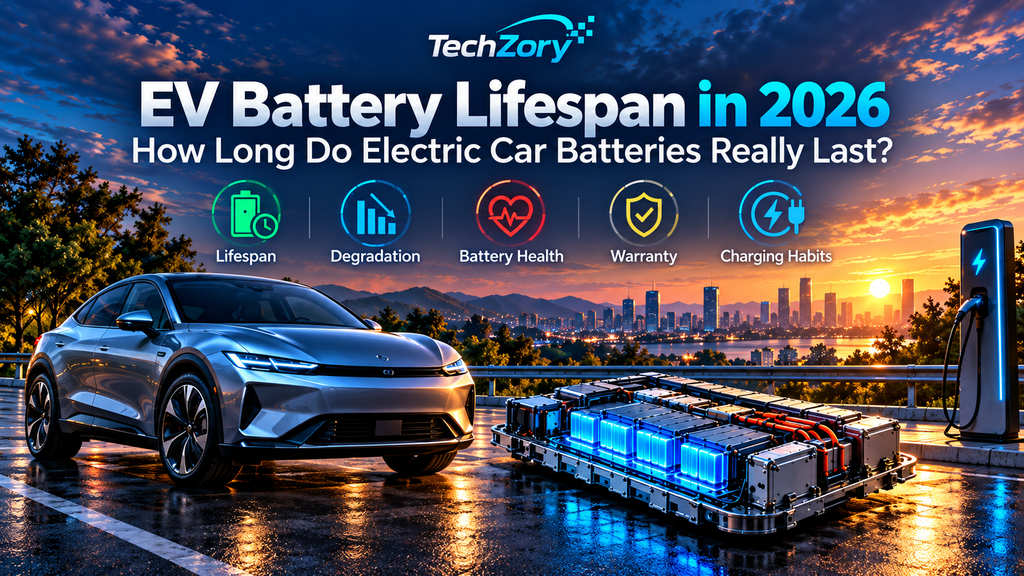
EV battery lifespan in 2026 showing degradation battery health warranty charging habits and electric vehicle battery pack

Battery Degradation vs. Battery Failure

This distinction is extremely important.

Battery degradation

The battery still works but stores less energy than when it was new.

Possible result:

  • Reduced driving range
  • More frequent charging
  • Slightly different charging behavior

Battery failure

A major component or the battery pack itself develops a fault that prevents normal operation.

This is much less common than gradual degradation.

Modern EV battery packs include sophisticated monitoring systems that track temperature, voltage, current, state of charge, and other parameters to help keep the pack within safe operating limits.

Complete battery replacement due to failure should therefore not be confused with ordinary capacity loss.


Do EV Batteries Need to Be Replaced Every Few Years?

Generally, no.

One of the biggest misconceptions about electric vehicles is that owners should expect to replace the main traction battery every few years.

Modern EV batteries are designed for long service lives.

Data cited by U.S. government agencies indicate that battery replacements resulting from failures have been uncommon, particularly among newer generations of electric vehicles.

Battery technology has also improved significantly through:

  • Better cell chemistry
  • More effective cooling
  • Improved battery-management software
  • More accurate temperature control
  • Improved charging strategies

That does not mean battery failures never occur.

However, a full battery replacement should not be considered routine maintenance in the same way that replacing tires or brake components might be.


What Affects EV Battery Lifespan?

Several factors influence how quickly an electric-car battery ages.

1. Temperature

Temperature is one of the most important factors.

Lithium-ion batteries generally perform best when they remain within an appropriate temperature range.

Extreme heat can accelerate chemical aging.

Very cold conditions can temporarily reduce performance and charging speed, although cold weather does not necessarily mean permanent battery damage.

Modern EVs often use sophisticated thermal-management systems to regulate battery temperature.
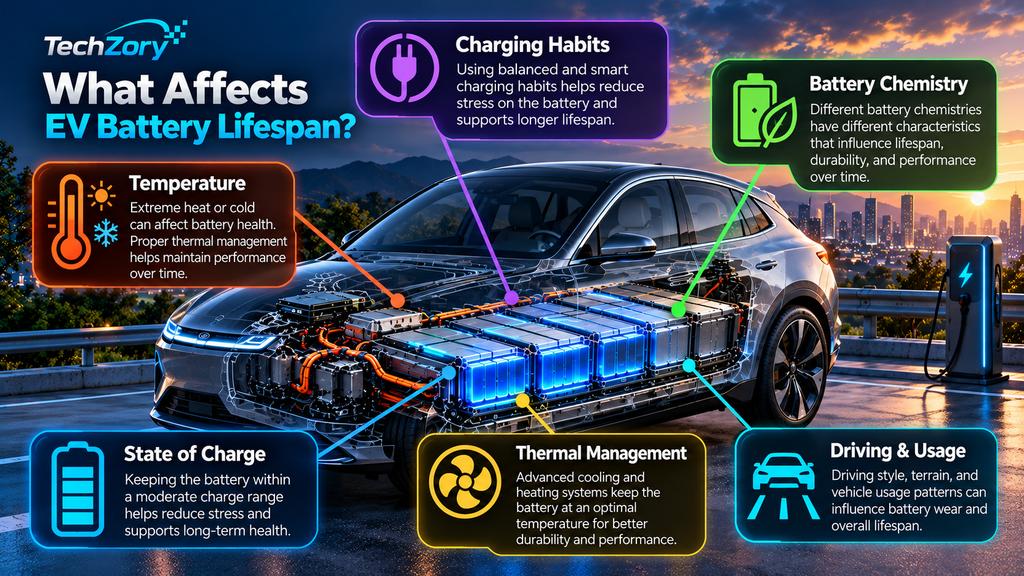
Factors that affect EV battery lifespan including temperature charging habits battery chemistry state of charge thermal management and driving usage

Hot Climates and EV Battery Aging

Drivers in very hot regions should pay particular attention to battery cooling and charging behavior.

Extended exposure to high temperatures can accelerate battery degradation.

A vehicle with effective liquid cooling and intelligent thermal management may therefore have an advantage in challenging climates.

When possible:

  • Park in shaded or covered areas
  • Avoid leaving the battery at an extremely high state of charge for unnecessary periods
  • Follow the manufacturer’s charging recommendations
  • Allow the vehicle’s thermal-management system to operate normally

The specific recommendations vary by manufacturer.


Does Fast Charging Damage an EV Battery?

DC fast charging allows an EV to recover substantial driving range quickly.

It is extremely useful during road trips and long-distance travel.

However, fast charging can place greater thermal and electrical demands on the battery than slower AC charging.

The actual effect on long-term battery health depends on several factors, including:

  • Battery temperature
  • Charging power
  • Battery chemistry
  • State of charge
  • Vehicle cooling system
  • Charging software

Modern EVs actively regulate charging speed to protect the battery.

For everyday use, many drivers rely primarily on home Level 1 or Level 2 charging and use DC fast charging when faster charging is necessary.

If you regularly take road trips, our guide to the best EVs for long-distance driving in 2026 compares range, charging speed, and road-trip comfort.


Is Level 2 Charging Better for Battery Health?

Level 2 home charging is widely used because it provides a practical balance between charging speed and convenience.

It normally places much lower peak power demands on the battery than high-power DC fast charging.

For many EV owners, Level 2 charging provides enough energy overnight without requiring frequent public fast-charging sessions.

However, battery health depends on the complete charging pattern rather than simply whether Level 1 or Level 2 equipment is used.

For a complete explanation of Level 1, Level 2, installation, connectors, and smart charging, see our EV charging at home in 2026 guide.


Should You Charge an EV to 100% Every Day?

Not every EV needs to be charged to 100% every day.

Battery manufacturers and automakers may recommend different daily charging limits depending on:

  • Battery chemistry
  • Vehicle model
  • Driving needs
  • Software
  • Upcoming travel

Some EVs allow owners to set a daily charging limit through the vehicle or mobile app.

For a long trip, charging to a higher level may be useful.

For routine commuting, a lower daily charging target may be sufficient.

The safest general rule is simple:

Follow the charging recommendations provided by the vehicle manufacturer for your specific model and battery chemistry.


Does Letting an EV Battery Reach 0% Damage It?

Frequently operating at extremely low battery levels may place additional stress on some battery systems.

Modern EVs typically include protective buffers and software designed to prevent the cells from reaching truly damaging voltage levels.

Even so, regularly arriving with nearly no indicated charge can be inconvenient and may reduce charging flexibility.

Keeping a practical reserve is usually a better approach for everyday driving.


Does Mileage Determine Battery Life?

Mileage matters, but it is not the only factor.

Two EVs with identical mileage can have different battery health.

For example, one vehicle may have:

  • Spent most of its life in a mild climate
  • Used moderate home charging
  • Maintained stable battery temperatures

Another vehicle with the same mileage may have:

  • Operated in extreme heat
  • Frequently used high-power charging
  • Spent long periods at very high or very low states of charge

This is why battery condition should be evaluated separately from odometer mileage when buying a used EV.


Battery Chemistry Matters

Not every EV uses exactly the same battery chemistry.

Different lithium-ion chemistries may prioritize different characteristics such as:

  • Energy density
  • Cost
  • Charging performance
  • Safety
  • Durability

Automakers also use different battery-management strategies.

Because of this, charging advice for one vehicle should not automatically be applied to another.

Always check the manufacturer’s recommendations for the exact model.


Why Thermal Management Is So Important

Battery temperature strongly affects both performance and lifespan.

Modern EVs may use:

  • Liquid cooling
  • Liquid heating
  • Refrigerant-based systems
  • Heat pumps
  • Software-controlled preconditioning

These systems can help maintain battery temperatures within a more suitable operating range.

Battery preconditioning can also prepare the pack for high-speed charging by moving it toward an appropriate temperature before the vehicle reaches a fast charger.

This is particularly useful in very hot or very cold conditions.


What Is Battery State of Health?

Battery State of Health, often abbreviated SOH, is a general measure of how the battery’s current condition compares with its original condition.

A new battery begins close to its designed usable capacity.

Over time, its State of Health may gradually decline.

However, SOH is not always displayed directly to the driver.

Vehicles may instead show information such as:

  • Estimated range
  • Usable energy
  • Charging performance
  • Diagnostic battery data

Professional diagnostic tools may provide more detailed information.


How Much Battery Degradation Is Normal?

There is no universal degradation percentage that applies to every EV.

Battery aging is not perfectly linear.

Some batteries may experience relatively noticeable changes early in life and then stabilize.

Others may degrade gradually over a longer period.

Important variables include:

  • Battery design
  • Chemistry
  • Climate
  • Charging habits
  • Mileage
  • Calendar age
  • Thermal management

For this reason, a single annual degradation percentage should not be treated as a guaranteed prediction for every electric vehicle.


What Happens When an EV Battery Loses Capacity?

A battery does not become useless simply because its maximum capacity declines.

The most noticeable effect is usually reduced driving range.

For example:

  • A commuter who drives short distances may barely notice moderate degradation.
  • A long-distance driver may notice reduced range more significantly.
  • Drivers in cold climates may notice seasonal range changes in addition to long-term degradation.

Whether a battery remains practical therefore depends partly on how the vehicle is used.


EV Battery Warranties in 2026

Battery warranties are important when comparing electric vehicles.

Many manufacturers offer coverage around:

8 years / 100,000 miles

but warranty terms vary considerably.

Some may cover:

  • Manufacturing defects
  • Complete battery failure
  • Capacity loss below a specified threshold

Others may define coverage differently.

Before buying an EV, especially a used one, check:

  • Warranty duration
  • Mileage limit
  • Capacity-retention terms
  • Whether the warranty transfers to the next owner
  • Regional differences
  • Exclusions and conditions

Never assume two EV battery warranties are identical.


When Would an EV Battery Need Replacement?

Battery replacement may become necessary if:

  • The battery develops a major fault
  • Capacity becomes too low for the owner’s needs
  • A damaged battery cannot be economically repaired
  • A warranty repair requires replacement of a pack or module

However, some EV battery systems may be repairable at the module or component level.

A complete pack replacement is not always the only possible solution.

The repair strategy depends on the vehicle design and manufacturer.


How Expensive Is EV Battery Replacement?

Replacing a complete EV battery outside warranty can be expensive.

The actual cost depends heavily on:

  • Vehicle model
  • Battery size
  • Battery chemistry
  • Labor
  • Parts availability
  • Whether individual modules can be repaired
  • Whether a new, remanufactured, or used pack is available

Because costs vary significantly, generic replacement-price estimates can be misleading.

Owners should obtain model-specific quotes before making a decision.


Can an EV Battery Last the Life of the Car?

It is possible.

EV batteries are designed for extended service lives, and many may remain usable for the practical life of the vehicle.

However, there is no universal guarantee.

Some batteries may eventually require repair or replacement, while others may continue operating with reduced capacity long after the original warranty expires.

The key distinction is that a battery does not have to retain 100% of its original capacity to remain useful.


How to Extend EV Battery Life

There is no single trick that guarantees maximum battery lifespan.

However, several sensible habits may help reduce unnecessary stress.

Follow the Manufacturer’s Charging Recommendations

Different battery chemistries may require different charging strategies.

Use the guidance provided for your exact vehicle.

Use Scheduled Charging When Appropriate

Scheduled charging can help reduce electricity costs and prevent the vehicle from remaining at a high state of charge longer than necessary.

Protect the Vehicle From Extreme Heat

Shade, covered parking, and functioning thermal-management systems can be particularly valuable in hot climates.

Keep Software Updated

Automakers can improve battery management, charging curves, thermal control, and diagnostics through software updates.

Use Fast Charging When It Is Useful

DC fast charging is an important feature of EV ownership.

The goal is not to avoid it completely, but to use the appropriate charging method for the situation.

Avoid Ignoring Battery Warnings

Charging faults, temperature warnings, or battery-system alerts should be investigated promptly.
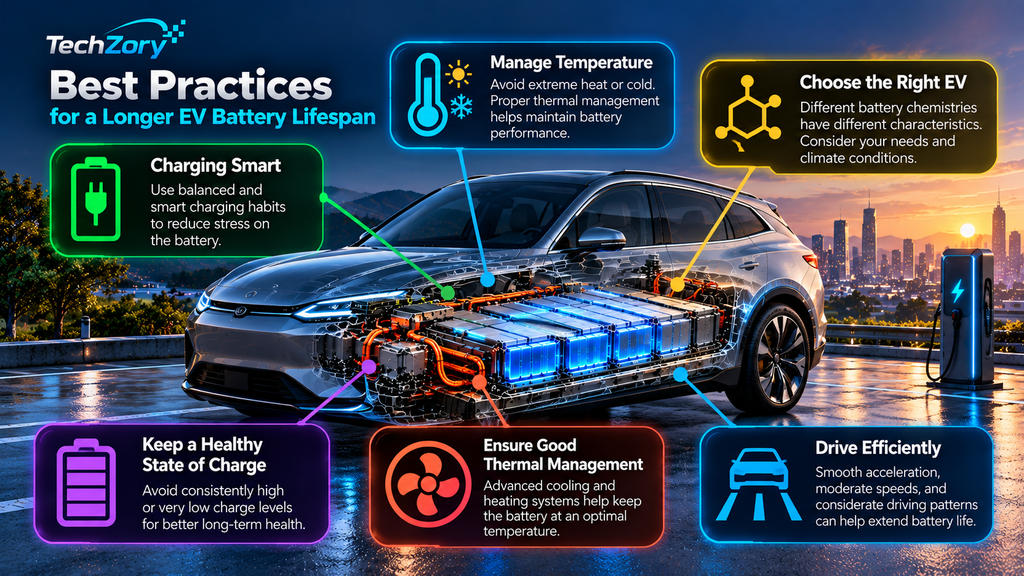
Best practices for extending EV battery lifespan including smart charging temperature management state of charge thermal management and efficient driving

How to Check Battery Health When Buying a Used EV

Battery condition is one of the most important factors in a used-electric-car purchase.

Before buying, consider checking:

Remaining Battery Warranty

Determine whether the original battery warranty is still active and transferable.

Real-World Range

Compare the vehicle’s current practical range with what would reasonably be expected for its model, configuration, weather, and driving conditions.

Charging Performance

Check that both AC and DC charging function normally where applicable.

Service History

Review records for battery repairs, recalls, software updates, and charging-system work.

Diagnostic Battery Report

If possible, obtain a professional battery-health assessment.

Vehicle History

Accident damage, flooding, or improper high-voltage repairs can be more important than ordinary battery degradation.
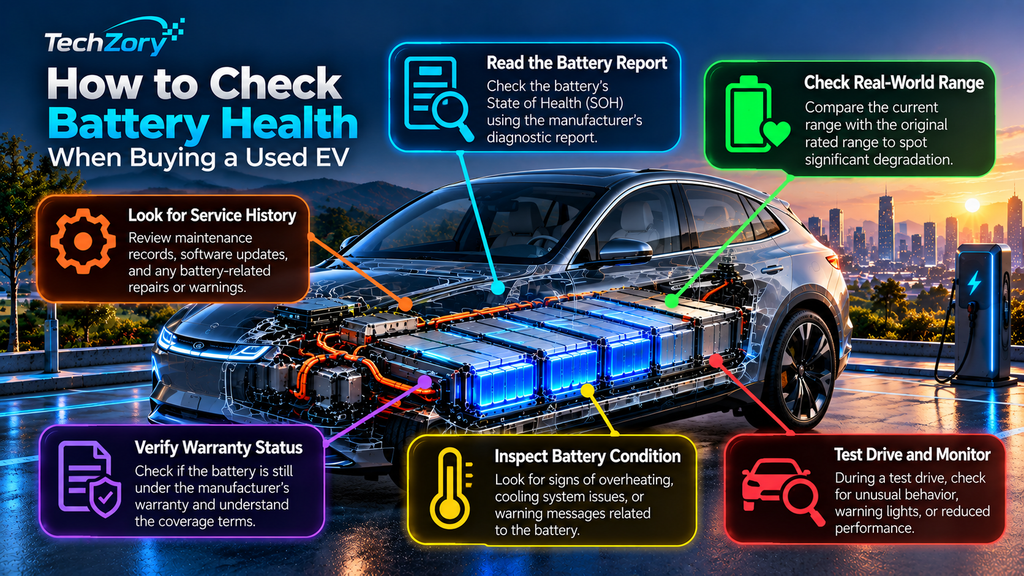
How to check EV battery health when buying a used electric vehicle including battery report range service history warranty and test drive

Does Cold Weather Mean the Battery Is Degrading?

Not necessarily.

Cold temperatures can temporarily reduce available range and charging performance.

This does not automatically mean the battery has permanently lost capacity.

When temperatures rise again, much of the lost cold-weather performance may return.

Permanent degradation and temporary temperature-related range reduction are different issues.


Can an Old EV Battery Be Reused?

Yes.

A battery that no longer provides enough capacity for an electric vehicle may still have significant remaining energy-storage capability.

Possible second-life applications include:

  • Stationary energy storage
  • Backup power
  • Renewable-energy storage
  • Grid-support applications

Battery packs can also be recycled to recover valuable materials.

The economic practicality of second-life applications depends on testing, transportation, refurbishment, certification, and installation costs.


EV Battery Recycling

Eventually, EV batteries reach the end of their useful life.

Recycling can recover valuable battery materials and reduce the need for new raw-material extraction.

Battery recycling systems continue to develop as the number of electric vehicles grows.

Manufacturers, recyclers, governments, and battery companies are investing in systems designed to collect and process end-of-life packs.


Common EV Battery Lifespan Myths

Myth: EV batteries must be replaced every few years

Modern EV batteries are designed for extended use, and complete battery failures are relatively uncommon.

Myth: Any loss of range means the battery is failing

Range can change because of temperature, driving speed, climate control, tire pressure, terrain, and other factors.

Myth: Fast charging immediately destroys a battery

Modern EVs regulate battery temperature and charging power. The long-term effect depends on the vehicle, conditions, and charging pattern.

Myth: A battery becomes useless when it drops below its original capacity

A battery can continue operating successfully even after some capacity loss.


EV Battery Lifespan Checklist for Buyers

Before purchasing an EV in 2026, check:

  • Battery warranty duration
  • Mileage limit
  • Capacity-retention coverage
  • Battery chemistry
  • Thermal-management system
  • AC charging capability
  • DC fast-charging capability
  • Manufacturer charging recommendations
  • Used-vehicle battery health if applicable
  • Service and recall history
  • Climate where the vehicle has been used
  • Expected daily range requirements

Battery lifespan should be considered together with range, charging speed, warranty, and long-term ownership plans.

Battery longevity is only one part of choosing an electric vehicle, so you can also compare the best electric cars in 2026 by range, features, charging, and overall practicality.

Battery health is only one part of long-term ownership, so our EV maintenance costs in 2026 guide explains routine service, tires, brakes, filters, cooling systems, and other ongoing EV expenses.


Frequently Asked Questions About EV Battery Lifespan

How many years does an EV battery last?

There is no universal lifespan, but modern batteries are designed for extended use. Government-referenced modeling suggests many batteries may potentially last well beyond the typical warranty period.

Do EV batteries suddenly stop working?

Usually not. Gradual capacity degradation is much more common than sudden total failure.

Is an eight-year-old EV battery useless?

No. Age alone does not determine battery condition. Battery health depends on capacity, usage, temperature history, charging patterns, and vehicle design.

Should I avoid buying a used EV because of battery degradation?

Not necessarily. A used EV can be a good purchase if battery health, warranty status, service history, and practical range meet your requirements.

Does fast charging ruin an EV battery?

Occasional or practical use of DC fast charging does not mean the battery will suddenly fail. Long-term effects depend on temperature, charging power, battery chemistry, and battery-management strategy.

Should I always charge my EV to 100%?

Not necessarily. Follow the manufacturer’s recommendations for your specific battery and vehicle.

Can an EV battery be repaired instead of replaced?

In some vehicles, individual battery modules or components may be repairable. The options depend on battery design and manufacturer procedures.

What happens to old EV batteries?

They may be reused in secondary energy-storage applications or recycled to recover valuable materials.


Final Thoughts

EV battery lifespan in 2026 should not be viewed as a simple countdown to battery replacement.

Modern EV batteries are designed to operate for many years, and gradual capacity loss is a normal aging process rather than evidence that the battery is failing.

Climate, thermal management, charging behavior, battery chemistry, state of charge, and vehicle software all influence long-term health.

For most buyers, the most useful questions are not simply “How old is the battery?” or “How many miles are on the car?”

Instead, consider:

  • How much usable capacity remains?
  • Is the battery still under warranty?
  • Does the vehicle meet your daily range needs?
  • Has the battery been properly managed and maintained?
  • Does the manufacturer provide strong thermal management and battery-health protections?

Understanding those factors provides a much clearer picture of real-world EV battery longevity than focusing on a single mileage or age figure.

Sources

  1. U.S. Department of Energy — Alternative Fuels Data Center: Electric Vehicle Benefits and Considerations.
    Information on EV battery longevity, common battery warranties, climate effects, charging patterns, battery chemistry, and thermal management.
  2. U.S. Department of Energy — Alternative Fuels Data Center: Maintenance and Safety of Electric Vehicles.
    Guidance on EV battery warranties, maintenance, battery replacement considerations, and high-voltage vehicle systems.
  3. U.S. Department of Energy — Alternative Fuels Data Center: Batteries for Electric Vehicles.
    Information on EV battery technology, remaining battery capacity, second-life applications, reuse, and energy storage.
  4. National Renewable Energy Laboratory — Battery Lifespan.
    Research on battery degradation, State of Health, temperature, charging and discharging rates, cycling, storage conditions, diagnostics, and battery-life prediction.
  5. U.S. Environmental Protection Agency — Electric Vehicle Myths.
    Updated information addressing EV battery reliability, degradation, replacement frequency, and battery failure rates.
  6. U.S. Department of Energy — Plug-In Electric Vehicle Battery Replacements Due to Failure Have Been Very Rare Since Model Year 2015.
    DOE data highlighting the relatively low incidence of traction-battery replacements caused by failure, especially among newer plug-in vehicles.
Previous Post

EV Charging at Home in 2026: Complete Beginner’s Guide

Next Post

EV Maintenance Costs in 2026: What Does an Electric Car Really Cost to Maintain?

Related Posts

EV maintenance costs in 2026 showing electric vehicle service tires brakes fluids filters and charging equipment
Cars & EVs

EV Maintenance Costs in 2026: What Does an Electric Car Really Cost to Maintain?

October 2, 2026
EV charging at home in 2026 beginner guide covering Level 1 Level 2 installation connectors and smart charging
Cars & EVs

EV Charging at Home in 2026: Complete Beginner’s Guide

October 2, 2026
# Best EVs for Long-Distance Driving in 2026: Range, Charging & Road-Trip Comfort Long-distance travel is one of the toughest tests for an electric vehicle. An EV that works perfectly for a 30-mile daily commute may feel very different on a 600-mile road trip, where driving range, charging speed, charger availability, cabin comfort, and route planning all become much more important. The **best EVs for long-distance driving in 2026** therefore are not necessarily the vehicles with the biggest batteries or the highest advertised range. A strong road-trip EV needs to combine useful highway range with fast and predictable charging, comfortable seating, good navigation, and access to reliable charging networks. This guide compares several important long-distance electric vehicles available in 2026. Rather than declaring one universal winner, it highlights the strengths of different vehicles for different types of road-trip drivers. Range figures primarily reflect U.S. EPA or manufacturer estimates. Actual highway range can vary with speed, temperature, terrain, wheels, passenger load, HVAC use, towing, and battery condition. ## Best EVs for Long-Distance Driving in 2026: Quick Comparison | EV | Maximum/Notable Range | Fast-Charging Capability | Long-Distance Strength | |---|---:|---|---| | Lucid Air Grand Touring | Up to 512 miles EPA | Up to 300 kW; about 200 miles added in 12 min | Extremely long range | | Chevrolet Silverado EV | Up to 478 miles GM-est. | Up to 350 kW; about 120 miles in 10 min | Long range with truck capability | | Mercedes-Benz EQS 450 4MATIC | 367 miles EPA | Up to 200 kW; 10–80% in about 31 min | Luxury and highway comfort | | Tesla Model 3 Long Range RWD | 363 miles EPA | Up to 250 kW; up to 195 miles in 15 min | Efficient travel and charging integration | | BMW iX xDrive60 | Up to roughly 364 miles | Up to 195 kW; 10–80% in about 35 min | Premium SUV comfort | | Rivian R1S | Up to 410 miles depending on configuration | Up to 300 kW; up to 150 miles in 20 min | Long-range family and adventure travel | | Kia EV6 | Up to 319 miles EPA | 10–80% in about 20 min | Rapid charging and strong road-trip value | Official specifications show substantial differences in how these vehicles approach long-distance travel. Lucid emphasizes exceptional efficiency and range, Chevrolet combines a large battery with truck capability, while vehicles such as the EV6 compensate for shorter total range with particularly fast charging. ## What Makes an EV Good for Long-Distance Driving? The biggest range number does not tell the whole story. For road trips, six factors matter particularly strongly. ### Highway Range EPA range is useful for comparing vehicles, but high-speed highway driving often consumes more energy than mixed city and highway testing. A vehicle rated for 350 miles should therefore not automatically be expected to travel exactly 350 highway miles between charging stops. ### Fast-Charging Speed Long-distance drivers rarely charge from 0% to 100% at public fast chargers. A more realistic road-trip pattern is arriving with a low state of charge, charging to around 70% or 80%, and continuing the journey. That makes a vehicle's **10–80% charging performance** especially useful. ### Charging Curve Peak charging power can be misleading. A vehicle may briefly reach a very high charging rate but then reduce power quickly as the battery fills. A strong charging curve—where the vehicle maintains high power for longer—can matter more than the maximum kW figure printed in a brochure. ### Charging-Network Access A 500-mile EV is much less convenient if the few chargers along your route are unreliable or badly located. Drivers should consider: - NACS compatibility - Tesla Supercharger access - CCS availability - Charging-station density - Route-planning integration - Real-time charger availability ### Cabin Comfort Long-distance driving means spending hours in the vehicle. Seat comfort, road noise, suspension quality, climate control, rear-passenger space, and driver-assistance features become far more important than they might during short local trips. ### Efficiency A larger battery does not automatically make an EV better. An efficient vehicle can travel farther using less energy and may recover useful range quickly when charging. ## Lucid Air Grand Touring For drivers who want to minimize charging stops, the Lucid Air Grand Touring is one of the most remarkable long-distance EVs currently available. The 2026 Air Grand Touring offers an EPA-estimated range of up to **512 miles** when properly configured. Lucid also states that the vehicle can recover approximately **200 miles of range in about 12 minutes** under suitable fast-charging conditions. Its maximum DC fast-charging capability reaches approximately **300 kW**. That combination is particularly valuable on highway trips because it attacks both sides of the EV road-trip equation: - Drive farther between stops - Spend less time recovering useful range The Air is also designed as a luxury sedan, with a quiet cabin, substantial passenger space, and available comfort features suited to long journeys. ### Long-Distance Strengths - Up to 512 miles of EPA-estimated range - Very high energy efficiency - Approximately 200 miles added in 12 minutes under suitable conditions - Comfortable luxury-oriented cabin - Strong highway performance ### Important Consideration The Grand Touring is expensive compared with mainstream EVs. Therefore, its exceptional range should be viewed primarily as a premium long-distance capability rather than a value proposition. ## Chevrolet Silverado EV A pickup might not be the first vehicle people imagine for efficient electric road trips, but the 2026 Chevrolet Silverado EV offers one of the largest available driving ranges in the EV market. Chevrolet lists up to **478 miles of GM-estimated electric range** in appropriate configurations. With available **350-kW DC fast charging**, Chevrolet says the Silverado EV can recover up to approximately **120 miles of range in 10 minutes**. It also offers access to a large North American public charging ecosystem, including compatible Tesla Supercharger locations through GM's charging system and adapter support. ### Long-Distance Strengths - Up to 478 miles of estimated range - Very large battery capacity - Strong DC fast-charging capability - Pickup-bed utility - Available towing capacity up to 12,500 pounds - Standard four-wheel drive ### Important Consideration Towing can dramatically reduce EV driving range. A Silverado EV capable of traveling hundreds of miles unloaded should not be expected to achieve the same range when towing a large trailer. For drivers who need both electric transportation and truck capability, however, its large battery provides a valuable buffer. ## Mercedes-Benz EQS 450 4MATIC Sedan Long-distance driving is not only about covering the most miles. For drivers who regularly spend several hours on highways, comfort can matter just as much. The 2026 Mercedes-Benz EQS 450 4MATIC Sedan offers an EPA-estimated **367 miles of electric range**, according to Mercedes-Benz USA. It supports DC fast charging at up to **200 kW**, with Mercedes listing approximately **31 minutes for a 10–80% charge** under suitable conditions. The EQS also provides adaptive air suspension, a spacious cabin, substantial passenger room, and the quiet driving experience expected from a flagship luxury sedan. ### Long-Distance Strengths - 367-mile EPA-estimated range - Comfortable and quiet cabin - Adaptive air suspension - Large interior and cargo capacity - Strong highway refinement - 200-kW DC fast charging ### Important Consideration Its charging speed is competitive but not as aggressive as some newer 800-volt EV platforms. The EQS makes its strongest case through comfort, range, and luxury rather than minimum charging-stop duration. ## Tesla Model 3 Long Range The Tesla Model 3 remains particularly relevant for long-distance travel because it combines efficiency, useful range, and deep integration between the vehicle's navigation system and Tesla's charging network. The Long Range rear-wheel-drive Model 3 is rated at approximately **363 miles of EPA-estimated range**. Tesla lists maximum Supercharging capability of **250 kW** and says up to approximately **195 miles of range can be added in 15 minutes** under appropriate conditions. For road-trip drivers, one of the biggest advantages is not simply the charging rate. The vehicle can integrate charging stops into navigation, estimate arrival battery percentages, and direct the driver through the Supercharger network. ### Long-Distance Strengths - 363-mile EPA-estimated range - High efficiency - Up to 250-kW Supercharging - Integrated route and charging planning - Extensive charging-network availability - Compact and aerodynamic design ### Important Consideration The Model 3 is a sedan rather than a large crossover or SUV. Families carrying substantial luggage or outdoor equipment may prefer something larger even if that means accepting somewhat lower efficiency. ## BMW iX xDrive60 The BMW iX approaches long-distance driving as a premium SUV. BMW lists the 2026 iX xDrive60 at approximately **318 to 364 miles of estimated range**, depending on configuration and wheel selection. The iX supports DC charging up to approximately **195 kW**, with BMW specifications listing roughly **35 minutes for 10–80% charging**. BMW also states that around **90–103 miles of additional range** can be recovered in approximately 10 minutes under suitable high-power charging conditions. ### Long-Distance Strengths - Up to approximately 364 miles of estimated range - Spacious SUV cabin - Premium seating and interior quality - Quiet highway cruising - AWD capability - Strong driver-assistance technology ### Important Consideration Wheel size can noticeably affect EV range. Buyers planning frequent road trips should examine the range of the exact wheel and tire configuration rather than assuming every iX xDrive60 will deliver the highest quoted figure. ## Rivian R1S The Rivian R1S is designed for drivers who want long-distance capability without giving up three-row SUV practicality or outdoor capability. Rivian lists available R1S configurations with up to approximately **410 miles of EPA-estimated range**. Its charging system can add approximately **150 miles in 20 minutes**, and Rivian lists fast-charging capability up to **300 kW** in its current charging information. Another benefit is that the R1S combines road-trip range with substantial passenger and cargo flexibility. ### Long-Distance Strengths - Up to 410 miles of EPA-estimated range - Three-row capability - Up to 300-kW charging capability - AWD and outdoor capability - Large cargo capacity - Access to multiple fast-charging networks ### Important Consideration The R1S is larger and heavier than efficiency-focused electric sedans. Drivers who do not need its passenger capacity, ground clearance, or adventure capability may find a smaller EV more energy-efficient. ## Kia EV6 The Kia EV6 demonstrates why range alone should not determine whether an EV is suitable for road trips. The 2026 EV6 offers up to **319 miles of EPA-estimated range** in several rear-wheel-drive configurations. That number is lower than the Lucid Air, Silverado EV, or Rivian R1S. But the EV6's strength is charging speed. Kia states that its 800-volt charging architecture can charge the battery from approximately **10% to 80% in around 20 minutes** with a compatible DC fast charger. Kia also says its Charge Pass ecosystem provides access to more than **47,000 DC fast chargers**, including more than 30,000 compatible Tesla Superchargers, although an adapter may be required depending on the charger and vehicle configuration. ### Long-Distance Strengths - Up to 319 miles EPA-estimated range - 800-volt charging architecture - Approximately 10–80% in 20 minutes - Broad fast-charging access - Comfortable crossover layout - Lower entry price than many premium long-range EVs ### Important Consideration The EV6 may require more charging stops than a 400- or 500-mile EV on extremely long journeys. However, short and fast charging sessions can help compensate for that difference. ## Which Long-Distance EV Fits Different Drivers? Instead of asking which EV is universally best, it is more useful to match the vehicle to the trip. ### For Maximum Range The **Lucid Air Grand Touring** is particularly notable when minimizing charging stops is the priority. Its combination of more than 500 miles of EPA-estimated range and rapid charging gives it unusual long-distance capability. ### For Electric Truck Road Trips The **Chevrolet Silverado EV** combines very long range with pickup practicality. It is especially relevant for drivers who need cargo space or towing capability in addition to highway range. ### For Charging-Network Convenience The **Tesla Model 3 Long Range** combines efficient highway travel with deeply integrated Supercharger route planning. ### For Family Adventure Trips The **Rivian R1S** provides long range, three-row utility, AWD capability, and substantial cargo flexibility. ### For Luxury Highway Travel The **Mercedes-Benz EQS** and **BMW iX** emphasize cabin comfort, quietness, suspension quality, and premium features. ### For Fast Charging at a More Accessible Price The **Kia EV6** combines more than 300 miles of available range with particularly strong fast-charging performance. ## Range vs. Charging Speed: Which Matters More? Imagine two EVs. One can travel 400 miles on a charge but requires a longer charging stop. Another can travel 320 miles but restores most of its battery very quickly. On a 700-mile journey, the total travel time may be closer than the headline range numbers suggest. That is why road-trip buyers should look beyond EPA range and compare: - Highway efficiency - Battery capacity - 10–80% charging time - Charging curve - Network coverage - Charger reliability - Battery preconditioning - Route-planning software The best road-trip experience comes from the entire charging ecosystem—not one specification. ## How Weather Affects Long-Distance EV Range Temperature can significantly influence EV range. Cold conditions can increase energy consumption because the vehicle must heat both the cabin and battery. Extremely hot temperatures can also increase energy use because of air conditioning and battery thermal management. Other range-reducing factors include: - Strong headwinds - Sustained high speeds - Mountain climbs - Large wheels - Heavy cargo - Roof boxes - Towing Drivers should therefore maintain a reasonable battery reserve rather than planning routes based on the maximum advertised range. ## How to Plan an EV Road Trip in 2026 Before leaving on a long journey: **Start with a high state of charge.** Home charging before departure can eliminate the first public charging stop. **Use the vehicle's navigation system.** Modern EV route planners can account for charging stations and expected battery levels. **Prefer reliable fast-charging locations.** A slightly longer route with dependable chargers may be better than relying on a single isolated station. **Plan around 10–80% charging.** Charging speeds often slow substantially as the battery approaches full capacity. **Precondition the battery.** Many EVs can prepare the battery before reaching a DC fast charger, improving charging performance. **Keep backup charging options.** Public chargers can occasionally be occupied, offline, or operating below maximum power. ## Long-Distance EV Buying Checklist Before buying an EV primarily for highway travel, check: - EPA or manufacturer-estimated range - Realistic highway range expectations - DC fast-charging speed - Typical 10–80% charging time - Battery preconditioning - NACS and CCS compatibility - Charging networks available on your normal routes - Seat comfort - Cargo capacity - Driver-assistance systems - Wheel size and its effect on range - Heat-pump availability - Home-charging capability A test drive should also include highway driving whenever possible. Cabin noise, seating position, suspension comfort, visibility, and driver-assistance behavior can become much more noticeable after several hours behind the wheel. ## Frequently Asked Questions About Long-Distance EVs ### Can an EV handle a 500-mile road trip? Yes. Modern long-range EVs can comfortably complete 500-mile journeys with one or more charging stops depending on the vehicle, conditions, route, and starting battery level. ### Is 300 miles of range enough for road trips? For many drivers, yes. A vehicle with roughly 300 miles of range and strong fast-charging capability can be very practical for long journeys, particularly when charging stations are frequent and reliable. ### Should I charge an EV to 100% on every road-trip stop? Usually not. Charging speed typically decreases as the battery approaches full capacity. On many trips, multiple shorter fast-charging sessions can be quicker than waiting for 100%. Follow the manufacturer's charging recommendations for your specific vehicle. ### Which matters more: EPA range or charging speed? Both matter. Higher range reduces the number of stops, while faster charging reduces how long each stop takes. Network availability can be just as important as either specification. ### Does highway driving reduce EV range? It can. Electric vehicles often become less efficient at sustained high speeds because aerodynamic resistance increases rapidly as speed rises. ### Does towing reduce EV range? Yes. Towing can significantly increase energy consumption, especially at highway speeds. Drivers using electric trucks or SUVs for towing should plan more conservative charging intervals. ## Sources - Lucid Motors — 2026 Lucid Air specifications and charging information - Chevrolet — 2026 Silverado EV specifications and charging information - Tesla — Model 3 range and Supercharging specifications - Mercedes-Benz USA — 2026 EQS Sedan specifications - BMW USA — 2026 BMW iX range and charging information - Rivian — R1S range and charging information - Kia America — 2026 EV6 range and charging information ## Final Thoughts Long-distance electric driving in 2026 is no longer defined simply by whether an EV can travel far enough. The experience depends on how range, charging speed, charger availability, efficiency, comfort, and route planning work together. A Lucid Air may reduce the number of charging stops through extraordinary range. A Tesla Model 3 may simplify the journey through efficiency and integrated charging infrastructure. A Kia EV6 can compensate for a smaller range figure with fast charging, while the Rivian R1S and Silverado EV provide long-distance capability for drivers who need substantially more utility. The right choice therefore depends on how you travel. Before buying, think about your typical journey length, the charging networks along your routes, passenger and cargo needs, and how much time you are willing to spend charging. For frequent road-trip drivers, those practical considerations matter far more than simply choosing the EV with the largest number printed beside its range estimate.
Cars & EVs

Best EVs for Long-Distance Driving in 2026: Range, Charging & Road-Trip Comfort

October 2, 2026

Comments 3

  1. Pingback: Best Electric Cars in 2026: Range, Features & Value
  2. Pingback: EV Charging at Home in 2026: Complete & Easy Guide
  3. Pingback: EV Maintenance Costs in 2026: Complete & Easy Guide

Leave a Reply Cancel reply

Your email address will not be published. Required fields are marked *

Popular News

AI reasoning models in 2026 using longer thinking time to analyze complex problems

AI Reasoning Models in 2026: Why Longer Thinking Time Is Changing What AI Can Do

October 1, 2026
Best password managers in 2026 for secure passwords, passkeys, encrypted vaults, and safer logins

Best Password Managers in 2026: 10 Secure Options Compared

October 1, 2026
Best power banks in 2026 from Anker, UGREEN, Baseus and INIU compared

Best Power Banks in 2026: Anker, UGREEN, Baseus & More Compared

October 13, 2026
Best VPN services in 2026

Best VPN Services in 2026: 5 Secure Options for Privacy & Everyday Use

October 5, 2026
Next Post
EV maintenance costs in 2026 showing electric vehicle service tires brakes fluids filters and charging equipment

EV Maintenance Costs in 2026: What Does an Electric Car Really Cost to Maintain?

TechZory - Technology, AI, Reviews & Future Trends

Technology, AI, Reviews & Future Trends

Stay informed with the latest technology news, AI developments, cybersecurity insights, product reviews, comparisons, EVs, and future tech.

Categories

Artificial Intelligence
Cybersecurity
Technology
Reviews & Comparisons
Cars & EVs
Future Tech
Deals

Quick Links

About Us
Contact Us
Affiliate Disclosure
Privacy Policy
Terms & Conditions

Connect

Contact TechZory
Facebook
X (Twitter)
YouTube

© 2026 TechZory. All Rights Reserved.

Welcome Back!

Login to your account below

Forgotten Password?

Retrieve your password

Please enter your username or email address to reset your password.

Log In
No Result
View All Result
  • Home
  • Artificial Intelligence
  • Cybersecurity
  • Technology
    • Gadgets & Devices
    • Software
    • Apps
    • Smart Home
    • Startup
  • Reviews & Comparisons
  • Cars & EVs
  • Future Tech
  • Deals

© 2026 TechZory. All Rights Reserved.