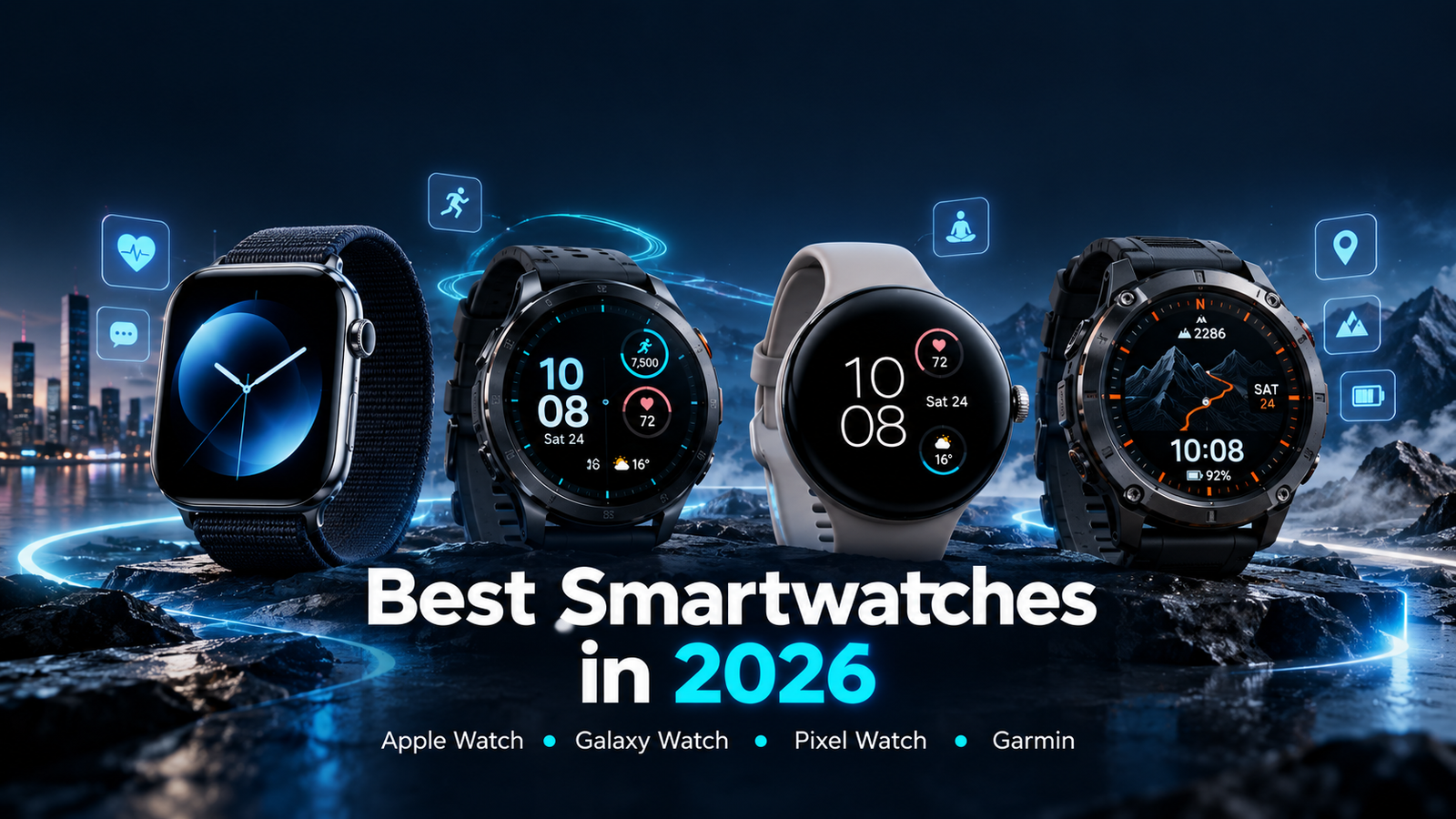
Smartwatches have become far more than notification screens strapped to the wrist.
In 2026, the leading models can monitor health trends, track sleep, guide workouts, navigate with GPS, make calls, handle payments, interact with AI assistants, and in some cases continue working for days or even weeks between charges.
But choosing the right smartwatch has also become more complicated.
Apple, Samsung, Google, and Garmin now approach the category very differently.
Apple focuses heavily on integration with the iPhone and advanced health tracking.
Samsung combines Wear OS, Samsung Health, AI-driven wellness features, and deep Galaxy ecosystem integration.
Google pushes the Pixel Watch toward proactive AI assistance and Google Health.
Garmin continues to prioritize battery life, training, GPS performance, outdoor navigation, and long-term fitness data.
That means there is no single smartwatch that is ideal for every person.
A watch that makes sense for an iPhone user may be a poor choice for someone using Android.
A runner training for a marathon may value battery life and GPS accuracy more than messaging apps.
Someone interested primarily in sleep and wellness may prioritize comfort and health insights instead.
This guide compares the major smartwatch options in 2026 and explains which type of user each platform is designed to serve.
Table of Contents
Best Smartwatches in 2026: Quick Overview
| Smartwatch | Strongest Area | Phone Compatibility | Typical Battery Focus | Best Suited For |
|---|---|---|---|---|
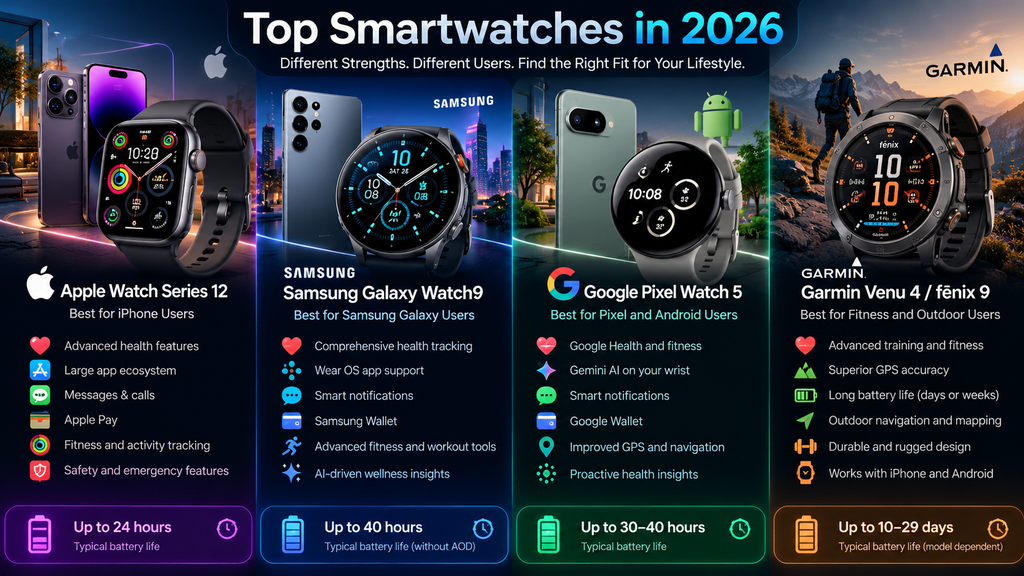
| Apple Watch Series 12 | iPhone integration and health features | iPhone | About a day | iPhone users |
| Samsung Galaxy Watch9 | Android smartwatch features and Samsung Health | Android, strongest with Galaxy | Around 1–2 days | Samsung Galaxy users |
| Google Pixel Watch 5 | Google services, AI, and health tracking | Android | Around 1–2 days | Pixel and Google ecosystem users |
| Garmin Venu 4 | Wellness, fitness, and long battery life | iPhone and Android | Multiple days | Fitness-focused everyday users |
| Garmin fēnix 9 | Advanced training, navigation, durability, and battery life | iPhone and Android | Many days | Athletes and outdoor users |
1. What Makes a Good Smartwatch in 2026?
The answer depends on what you expect the watch to do.
For some people, a smartwatch is primarily an extension of the phone.
They want:
Notifications, calls, messages, apps, navigation, payments, music, and voice assistance.
For others, the watch is mainly a fitness and health device.
They care more about:
Heart-rate tracking, GPS, training load, recovery, sleep, readiness, workout metrics, and battery life.
The best buying decision usually begins by deciding which of these two roles matters more.
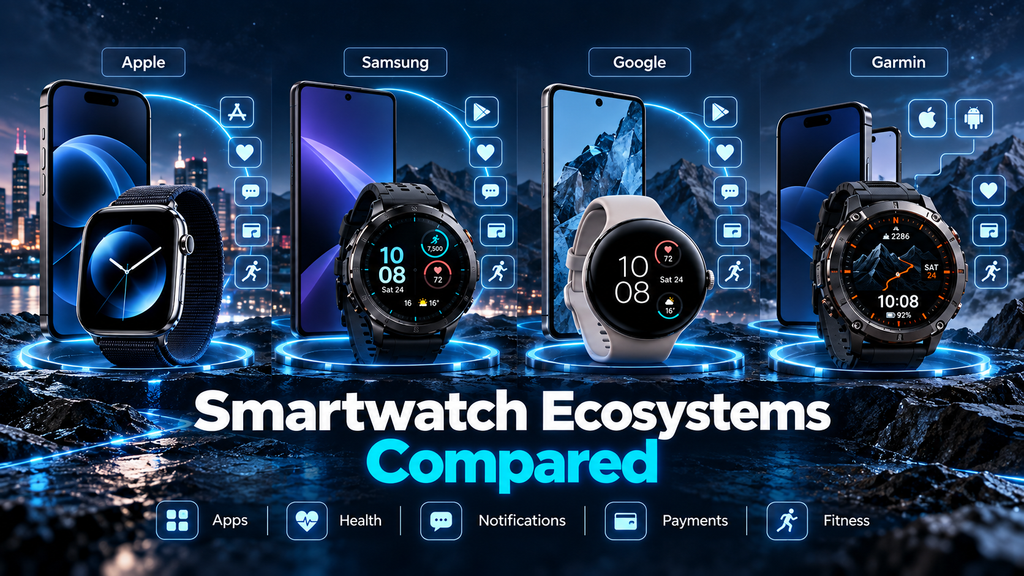
2. The Smartphone Ecosystem Matters First
Before comparing screens, sensors, or battery life, check compatibility.
Apple Watch is designed around the iPhone.
Galaxy Watch and Pixel Watch are built around Android.
Garmin supports both iPhone and Android, although some smart features can behave differently depending on the phone platform.
This means the phone you already own can narrow the decision dramatically.
An excellent smartwatch becomes less useful if it cannot integrate properly with your smartphone.
3. Apple Watch Series 12
Apple Watch Series 12 is Apple’s mainstream flagship smartwatch for 2026.
Its biggest strength is not one individual sensor or feature.
It is the way the hardware, watchOS, iPhone, Apple Health, fitness features, safety tools, payments, apps, and accessories work together.
For an iPhone user who wants a general-purpose smartwatch, this integration remains a major advantage.
The Series 12 also introduces Apple’s new Health Sensing System, higher-frequency heart-rate and HRV tracking, and a readiness score designed to help users understand whether the body may be ready for harder activity or additional recovery.
4. Apple Watch Series 12 Design and Display
Apple continues to use the familiar rectangular design with rounded corners.
Series 12 is available in multiple case materials and finishes, with 42 mm and 46 mm size options.
The always-on Retina display is designed to remain visible throughout the day while still supporting touch interaction and complications.
Apple also offers a large ecosystem of bands.
That matters more than it may initially seem.
A smartwatch is worn for many hours every day, including workouts and sleep tracking.
Comfort and band availability can be almost as important as processor speed.
5. Apple Watch Series 12 Health Features
Health remains one of the central reasons to buy an Apple Watch.
Depending on region and feature availability, Series 12 can support capabilities such as:
Heart-rate tracking, ECG, Blood Oxygen, sleep tracking, sleep score, sleep apnea notifications, wrist temperature sensing, cycle tracking, cardio fitness estimates, and readiness-related insights.
It is important to remember that smartwatch health features are not substitutes for professional diagnosis.
They are better viewed as tools that can help users observe trends and identify information worth discussing with a clinician.
6. Apple Watch Series 12 Battery Life
Battery life remains one of the clearest differences between Apple Watch and many Garmin devices.
Apple rates Series 12 for up to 24 hours of normal use, with longer operation possible in Low Power Mode.
Fast charging helps reduce the inconvenience.
For many users, the practical routine will still involve frequent charging.
That can be acceptable if smartwatch features and iPhone integration matter more than multi-day battery life.
7. Who Should Consider Apple Watch Series 12?
Series 12 makes the most sense for someone who:
Uses an iPhone, wants strong smartphone integration, values health and safety features, uses Apple Pay and Apple services, and wants a large smartwatch app ecosystem.
It is less attractive for users who prioritize week-long battery life or advanced outdoor expedition features.
8. Samsung Galaxy Watch9
Galaxy Watch9 is Samsung’s mainstream smartwatch for 2026.
Samsung has increasingly positioned Galaxy Watch as a health companion rather than simply an accessory for notifications.
The watch combines Wear OS with Samsung Health and a growing set of health, sleep, activity, recovery, and AI-driven insights.
It is available in 40 mm and 44 mm sizes.
The larger model also provides more battery capacity.
9. Galaxy Watch9 and the Galaxy Ecosystem
Galaxy Watch9 works within Android, but the experience is especially cohesive with Samsung Galaxy phones.
This is important for users already using:
Galaxy smartphones, Galaxy Buds, Samsung Health, Galaxy Ring, and Samsung Wallet.
The benefit is similar to Apple’s ecosystem strategy.
Devices can share information and services more naturally when they come from the same platform.
10. Galaxy Watch9 Performance
Galaxy Watch9 uses Qualcomm’s Snapdragon Wear Elite platform.
The goal is faster performance while continuing to support all-day health monitoring.
Samsung has also increased battery capacity compared with the previous generation.
The 40 mm version uses a 390 mAh battery, while the 44 mm version uses 445 mAh.
Samsung states that users can expect around 40 hours without the always-on display enabled, although actual battery life depends heavily on settings and usage.
11. Galaxy Watch9 Health and Wellness
Samsung Health increasingly tries to convert raw sensor information into understandable guidance.
Instead of showing only numbers, the platform combines areas such as:
Activity, sleep, cardiovascular information, recovery, nutrition, and mindfulness.
This broader interpretation is important because collecting more data is not automatically useful.
A good wearable should help users understand what the data means and what patterns may be changing.
12. Galaxy Watch9 vs. Galaxy Watch Ultra2
Samsung also offers the Galaxy Watch Ultra2.
It targets a different audience.
Ultra2 is built more heavily around demanding workouts and outdoor activity.
It offers a larger 47 mm body, a substantially larger battery, a very bright display, and stronger emphasis on durability and outdoor training.
For an everyday user, Watch9 is likely the more practical form factor.
For someone regularly running trails or spending extended periods outdoors, Ultra2 deserves consideration.
13. Who Should Consider Galaxy Watch9?
Galaxy Watch9 is especially suitable for someone who:
Uses a Samsung Galaxy phone, wants Wear OS apps, values Samsung Health, wants strong sleep and wellness tools, and prefers a traditional round smartwatch design.
Battery life remains much shorter than most Garmin watches, so users who strongly dislike charging should keep that tradeoff in mind.
14. Google Pixel Watch 5
Pixel Watch 5 represents Google’s most ambitious smartwatch generation so far.
Google is combining three areas:
Wear OS, Google Health, and Gemini Intelligence.
Rather than treating AI as a separate app, Google is increasingly integrating assistance directly into the watch experience.
That includes contextual information, hands-free interaction, and proactive suggestions.
15. Pixel Watch 5 and Gemini Intelligence
Pixel Watch 5 is designed to surface useful information at the right time.
For example, the watch can use At a Glance to show contextual information such as travel or schedule-related updates.
Raise to Talk allows users to interact with Gemini without navigating through multiple menus.
The broader idea is that the smartwatch becomes less dependent on tapping through apps.
That direction could become increasingly important as wearables gain more capable on-device AI.
16. Pixel Watch 5 Performance
Pixel Watch 5 uses the Snapdragon W5 Gen 2 Accelerated platform alongside a power-efficient co-processor.
Google also increased memory and overall responsiveness compared with the previous generation.
The display reaches up to 3,000 nits peak brightness, which can improve readability outdoors.
It is available in 41 mm and 45 mm versions.
17. Pixel Watch 5 Battery Life
Battery performance depends significantly on size.
The 41 mm version is rated for up to around 30 hours with the always-on display.
The 45 mm model can reach up to around 40 hours.
Battery Saver modes can extend operation further.
Fast charging also plays an important role because watches designed for sleep tracking need convenient opportunities to recharge during the day.
18. Pixel Watch 5 Health Features
Google has expanded its wearable health strategy considerably.
Pixel Watch 5 combines traditional fitness and sleep tracking with Google Health and newer Health Guardian capabilities.
These tools are designed to monitor long-term patterns rather than simply display isolated readings.
The watch also emphasizes improved GPS and heart-rate tracking for workouts.
19. Who Should Consider Pixel Watch 5?
Pixel Watch 5 makes the most sense for:
Pixel phone users, people heavily invested in Google services, users who want Gemini features on the wrist, and Android users who prefer Google’s software approach over Samsung’s.
Its battery remains closer to Apple and Samsung than Garmin.
That means it is a technology-first smartwatch rather than a multi-week endurance watch.
20. Garmin Takes a Different Approach
Garmin is difficult to compare directly with Apple, Samsung, and Google because Garmin produces many different smartwatch families.
Its lineup includes:
Venu, vívoactive, Forerunner, fēnix, Instinct, and other specialist models.
Instead of choosing one Garmin watch for everyone, it is more useful to divide the lineup by purpose.
For everyday wellness and general fitness, Venu 4 is a strong reference point.
For serious training, navigation, and outdoor use, fēnix 9 is more representative.
21. Garmin Venu 4
Venu 4 is designed for users who want a polished smartwatch without abandoning Garmin’s fitness strengths.
It uses an AMOLED display and includes health, fitness, GPS, training, and smart features.
It is available in 41 mm and 45 mm sizes.
Compared with many Wear OS or Apple watches, its biggest advantage is battery life.
22. Garmin Venu 4 Battery Life
Garmin rates Venu 4 for up to 10 days in smartwatch mode on the 41 mm model and up to 12 days on the 45 mm version.
GPS use reduces battery life, especially with multi-band satellite tracking and music.
Even so, Venu 4 operates on a completely different charging schedule from many full-featured smartphone-style smartwatches.
For users who want reliable sleep tracking without planning a charging session every day, this is a major advantage.
23. Garmin Venu 4 Fitness Features
Venu 4 focuses heavily on health and fitness.
It includes features such as:
Sleep insights, multi-band GPS, training readiness, workout guidance, heart-rate tracking, Pulse Ox support, Garmin Pay, music storage, and an LED flashlight.
Garmin also continues improving features through software updates.
That long-term software behavior matters for a wearable that may remain on someone’s wrist for several years.
24. Garmin fēnix 9
fēnix 9 sits much farther toward the performance and outdoor side of the market.
It is designed for:
Running, hiking, cycling, multisport training, navigation, long outdoor activities, and endurance use.
It is available in multiple sizes and configurations.
The Pro models also expand connectivity options, including variants with satellite and LTE capabilities.
25. Garmin fēnix 9 Battery Life
Battery life is one of the defining strengths of the fēnix line.
Depending on size and configuration, standard fēnix 9 models can last roughly 10 to 29 days in smartwatch mode.
Some Pro Solar configurations can extend considerably longer under appropriate solar conditions.
GPS-heavy activity tracking naturally reduces those numbers.
Even so, Garmin remains in a different category from watches that require charging roughly every day.
26. Who Should Consider Garmin?
Garmin is particularly attractive for:
Runners, cyclists, hikers, triathletes, outdoor users, users who value long battery life, and people who care more about training data than having the largest app ecosystem.
For someone who wants to respond to many messages, use numerous third-party apps, or rely heavily on a voice assistant, Apple or Wear OS may feel more capable.
27. Apple Watch vs. Galaxy Watch vs. Pixel Watch vs. Garmin
The easiest way to understand the differences is to look at priorities.
Smartphone Integration
Apple Watch is deeply optimized for iPhone.
Galaxy Watch is strongest within Samsung’s ecosystem.
Pixel Watch emphasizes Google’s Android services.
Garmin works across both platforms but is less centered around replicating the smartphone experience.
Battery Life
Garmin generally has the strongest advantage.
Apple, Samsung, and Google provide richer phone-like smartwatch experiences but typically require much more frequent charging.
Apps
Apple Watch and Wear OS watches generally provide broader app ecosystems.
Garmin supports apps and watch faces, but its identity is centered more heavily around fitness and navigation.
Fitness
All major platforms now offer substantial fitness features.
Garmin goes deepest for many serious athletes.
AI
Google and Samsung are pushing AI-assisted wearable experiences aggressively.
Apple is also adding intelligence throughout its ecosystem.
Garmin uses algorithms extensively for training and health interpretation, although it presents the experience differently.
28. Which Smartwatch Is Better for iPhone Users?
For most iPhone users who want the deepest smartwatch integration, Apple Watch remains the logical platform.
Messages, calls, Apple Pay, apps, health data, Find My features, and watchOS are designed around the iPhone.
Garmin is the major alternative when fitness depth or battery life is more important.
That creates a useful distinction:
Choose Apple Watch when smartwatch functionality comes first.
Consider Garmin when training and battery life come first.
29. Which Smartwatch Is Better for Samsung Galaxy Users?
Galaxy Watch9 is designed specifically to fit Samsung’s mobile ecosystem.
For users already relying on Samsung Health, Galaxy phones, Galaxy Buds, or Galaxy Ring, that integration is valuable.
Pixel Watch is still an alternative for Android users who prefer Google’s software design.
But some Samsung-specific health or ecosystem experiences may make Galaxy Watch the more natural fit for a Samsung phone.
30. Which Smartwatch Is Better for Pixel Users?
Pixel Watch 5 offers the most direct extension of Google’s Pixel philosophy.
It integrates Google services, Gemini, Wear OS, and Google Health within one device.
People who use Gmail, Calendar, Maps, Google Wallet, and Gemini extensively may find this approach particularly attractive.
The choice between Pixel Watch and Galaxy Watch is therefore not only about specifications.
It is increasingly about which software ecosystem you prefer.
31. Which Smartwatch Is Better for Runners?
Casual runners can use any of the major watches.
For serious runners, the decision becomes more specialized.
Important factors include:
GPS quality, training load, recovery information, race tools, battery life, heart-rate accuracy, and structured workouts.
Garmin is especially strong in this area because its platform has been designed around long-term training data.
Apple, Samsung, and Google continue closing the gap for many mainstream runners.
32. Which Smartwatch Is Better for Sleep Tracking?
Sleep tracking requires something simple but often overlooked:
You must actually wear the watch overnight.
That makes comfort and battery life important.
A watch with excellent sleep analytics is less useful if it spends every night charging.
Garmin’s multi-day battery provides an obvious advantage here.
Apple, Samsung, and Google address the issue increasingly through faster charging and improved batteries.
The correct choice depends partly on whether frequent charging bothers you.
33. Which Smartwatch Is Better for Health Monitoring?
All four platforms now place significant emphasis on health.
Apple focuses heavily on sensor-driven health features and integration with Apple Health.
Samsung integrates many measurements into Samsung Health.
Google is expanding Google Health with proactive trend analysis.
Garmin combines wellness metrics with fitness and recovery information.
Consumers should focus less on which platform produces the largest number of measurements and more on which metrics are actually useful to them.
34. Smartwatch Health Features Are Not Medical Diagnoses
This point is important.
A smartwatch can collect useful information.
It may identify unusual patterns.
It may encourage someone to seek professional advice.
But consumer wearables have limitations.
Sensor readings may be affected by:
Skin contact, motion, temperature, device fit, tattoos, environmental conditions, and other variables.
Availability of regulated health features can also vary by country.
Do not treat a smartwatch as a replacement for professional medical evaluation.
Wearables are also becoming part of the broader connected-health ecosystem.
35. GPS Accuracy Matters More Than Many Buyers Realize
GPS affects more than maps.
It influences:
Running distance, cycling distance, pace, route history, outdoor navigation, and workout analysis.
Modern watches increasingly use multi-band satellite systems and improved signal processing.
Users who train in:
Dense cities, mountains, forests, or areas with tall buildings
should pay particular attention to GPS performance.
36. LTE: Do You Need Cellular Connectivity?
Some watches are available with cellular connectivity.
LTE can allow supported models to:
Receive messages, use data, stream music, make or receive calls, and access certain online features without the phone nearby.
This is convenient for running or short trips.
But LTE models usually cost more and may require carrier support or an additional plan.
If your phone is almost always with you, LTE may provide limited value.
37. Smartwatch Storage and Offline Music
Offline music can be useful for workouts.
It allows users to leave the phone behind while still listening through Bluetooth headphones.
Apple, Wear OS devices, and many Garmin watches provide ways to store or download music.
Support varies by service and platform.
This is worth checking before buying if phone-free workouts are important.
38. Payments From the Wrist
Contactless payments are now common.
Apple uses Apple Pay.
Samsung and Google support their respective wallet ecosystems.
Garmin offers Garmin Pay.
Availability depends on region, bank, card, and watch model.
Users who want to leave the phone or wallet behind during exercise should verify local banking compatibility before buying.
39. Smartwatch Durability
A smartwatch may be exposed to:
Sweat, rain, swimming, impacts, dust, heat, and outdoor use.
Water resistance therefore matters.
So does screen material.
A premium outdoor watch may justify tougher materials for someone who frequently hikes or trains outside.
An office user may care more about weight and comfort.
Durability should match actual use rather than marketing.
40. Screen Size vs. Comfort
Larger watches provide:
More readable text, larger controls, larger batteries, and sometimes brighter or more capable displays.
But they also take up more wrist space.
Smaller wrists may find large watches uncomfortable during sleep.
This is particularly important because many brands now offer two or three case sizes.
Try to evaluate wrist fit, not just specifications.
41. How Much Battery Life Do You Really Need?
Battery life affects how the watch fits into daily routines.
Around one day can work well if you charge during a shower or while getting ready.
Two days provides more flexibility.
A week or more makes charging much less noticeable.
Very long battery life becomes especially useful for:
Travel, hiking, endurance sports, sleep tracking, and users who simply dislike frequent charging.
The value of battery life is therefore highly personal.
42. Should You Upgrade Your Existing Smartwatch?
Not necessarily.
Smartwatches have matured.
Annual changes can be meaningful without making last year’s model obsolete.
Consider upgrading when the new watch solves a real problem.
Examples include:
Poor battery health, missing health features, inaccurate GPS for your needs, lack of software support, damaged hardware, or a major ecosystem change.
If your current watch already performs reliably, keeping it longer may provide better value.
43. Previous-Generation Watches Can Offer Better Value
A new model often causes older models to become cheaper.
That can create strong value opportunities.
An Apple Watch Series 11, Galaxy Watch8, Pixel Watch 4, or previous Garmin model may remain capable enough for many people.
The important questions are:
How much cheaper is it?
How many years of software support remain?
Which new features would you lose?
A lower price is only a bargain if the watch still meets your needs.
44. What to Check Before Buying a Smartwatch
Before purchasing, verify the following:
Your phone compatibility, wrist size, expected battery life, health-feature availability in your country, LTE carrier compatibility if needed, payment support, preferred fitness metrics, GPS requirements, app support, band availability, and software-support expectations.
These factors will usually matter more than one isolated benchmark.
45. A Practical Buying Guide
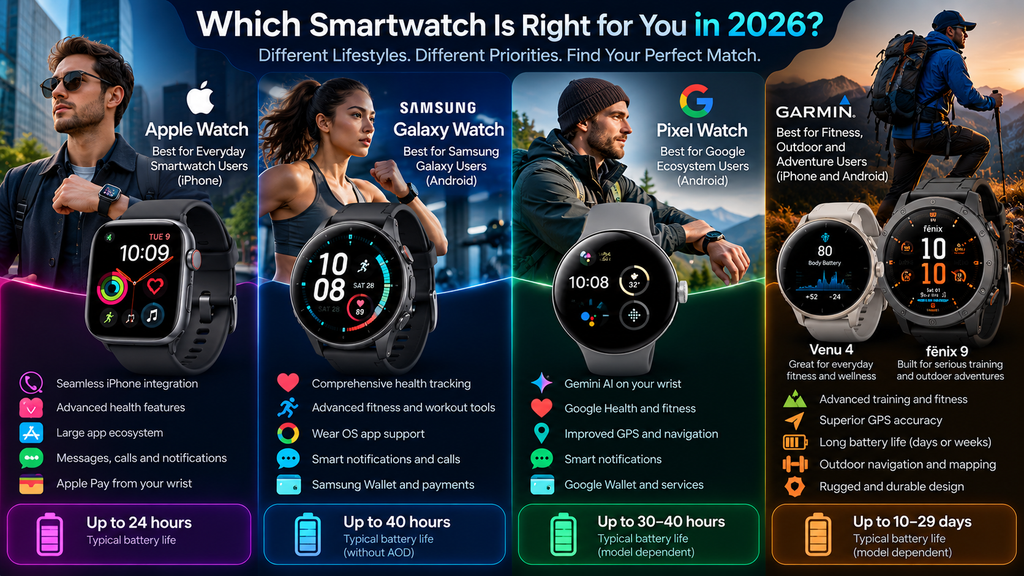
Choose Apple Watch Series 12 if you use an iPhone and want the strongest general smartwatch integration.
Choose Galaxy Watch9 if you use a Samsung Galaxy phone and want Samsung Health combined with Wear OS functionality.
Choose Pixel Watch 5 if you prefer Google’s Android ecosystem, Gemini, and Google Health.
Choose Garmin Venu 4 if you want strong health and fitness features with substantially longer battery life.
Choose Garmin fēnix 9 if advanced training, outdoor navigation, ruggedness, and endurance matter more than having the largest smartwatch app ecosystem.
Frequently Asked Questions
What is the best smartwatch in 2026?
There is no universal answer. The most suitable watch depends heavily on your smartphone, fitness requirements, battery expectations, and preferred ecosystem.
What is the latest Apple Watch in 2026?
Apple Watch Series 12 is Apple’s mainstream 2026 model, while Apple also offers Ultra models for users wanting a larger and more rugged design.
What is the latest Samsung Galaxy Watch in 2026?
Samsung’s 2026 mainstream model is Galaxy Watch9, alongside Galaxy Watch Ultra2.
What is the latest Google Pixel Watch in 2026?
Google Pixel Watch 5 is the current generation.
What is the latest Garmin fēnix watch?
Garmin introduced the fēnix 9 family in 2026, including fēnix 9 and fēnix 9 Pro variants.
Which smartwatch has the longest battery life?
Garmin watches generally operate much longer between charges than Apple Watch, Galaxy Watch, or Pixel Watch, although exact battery life depends on model and settings.
Can Apple Watch work with Android?
Apple Watch is designed for the iPhone ecosystem and is not the appropriate choice for Android users.
Does Pixel Watch work with iPhone?
Pixel Watch is built for Android rather than iPhone.
Is Galaxy Watch only for Samsung phones?
Galaxy Watch operates within Android, but some features and ecosystem integrations are strongest with Samsung Galaxy phones.
Does Garmin work with iPhone and Android?
Garmin supports both major smartphone platforms, although the available smart functions can differ.
Are smartwatch health readings accurate?
Modern wearables can provide useful health and fitness information, but readings have limitations and should not be treated as professional medical diagnoses.
Do I need LTE on a smartwatch?
Only if you want supported connected features while away from your phone. Users who almost always carry their phone may not need LTE.
Is a smartwatch worth upgrading every year?
Usually not. Upgrade when a newer model adds features you genuinely need or when the current device no longer performs well.
Final Thoughts
The smartwatch market in 2026 is no longer about finding one device that beats every competitor in every category.
The platforms have become increasingly specialized.
Apple Watch Series 12 is tightly connected to the iPhone experience.
Galaxy Watch9 combines Samsung Health with the broader Wear OS ecosystem.
Pixel Watch 5 pushes Google Health and Gemini closer to the center of the smartwatch experience.
Garmin Venu 4 provides a strong balance of everyday wellness, fitness, and multi-day battery life.
Garmin fēnix 9 targets users who need deeper training metrics, navigation, durability, and substantially longer endurance.
The most important question is therefore not:
“Which smartwatch has the longest feature list?”
It is:
“Which smartwatch fits the way I already use technology, exercise, and manage my day?”
Start with your phone.
Then decide how much battery life you need.
After that, evaluate health features, fitness depth, GPS, apps, and design.
That approach is far more reliable than choosing a smartwatch based only on the latest headline feature.
Sources
- Apple — Introducing Apple Watch Series 12
- Apple — Apple Watch Series 12 Battery Information
- Samsung — Galaxy Watch9 Official Product Page
- Samsung — Galaxy Watch9 Battery Information
- Google — Pixel Watch 5: Proactive Assistance and Advanced Health Tracking
- Google Store — Pixel Watch 5
- Garmin — Venu 4 Official Announcement
- Garmin — Venu 4 Battery Information
- Garmin — fēnix 9 and fēnix 9 Pro Official Announcement
- U.S. Food and Drug Administration — General Wellness: Policy for Low Risk Devices