Cybersecurity threats in 2026 are no longer limited to traditional malware, suspicious email attachments, or poorly protected passwords. Businesses now operate across cloud platforms, SaaS applications, remote devices, third-party services, APIs, and increasingly AI-powered tools, creating a much broader attack surface.
At the same time, attackers are becoming faster and more efficient. Artificial intelligence can help threat actors create convincing phishing campaigns, automate reconnaissance, discover vulnerable systems, and scale social engineering. Meanwhile, ransomware groups are increasingly targeting not only business data but also identity systems, virtualization platforms, and backup infrastructure to make recovery more difficult.
The ENISA Threat Landscape 2026 identifies ransomware as the most impactful cyber incident type in the short term and highlights continued risks from social engineering, vulnerability exploitation, DDoS activity, supply-chain dependencies, and malicious use of artificial intelligence.
For businesses, the goal in 2026 is therefore not simply to prevent every attack. A more realistic cybersecurity strategy combines prevention, detection, identity protection, backup resilience, employee awareness, and the ability to recover quickly when an incident occurs.
Table of Contents
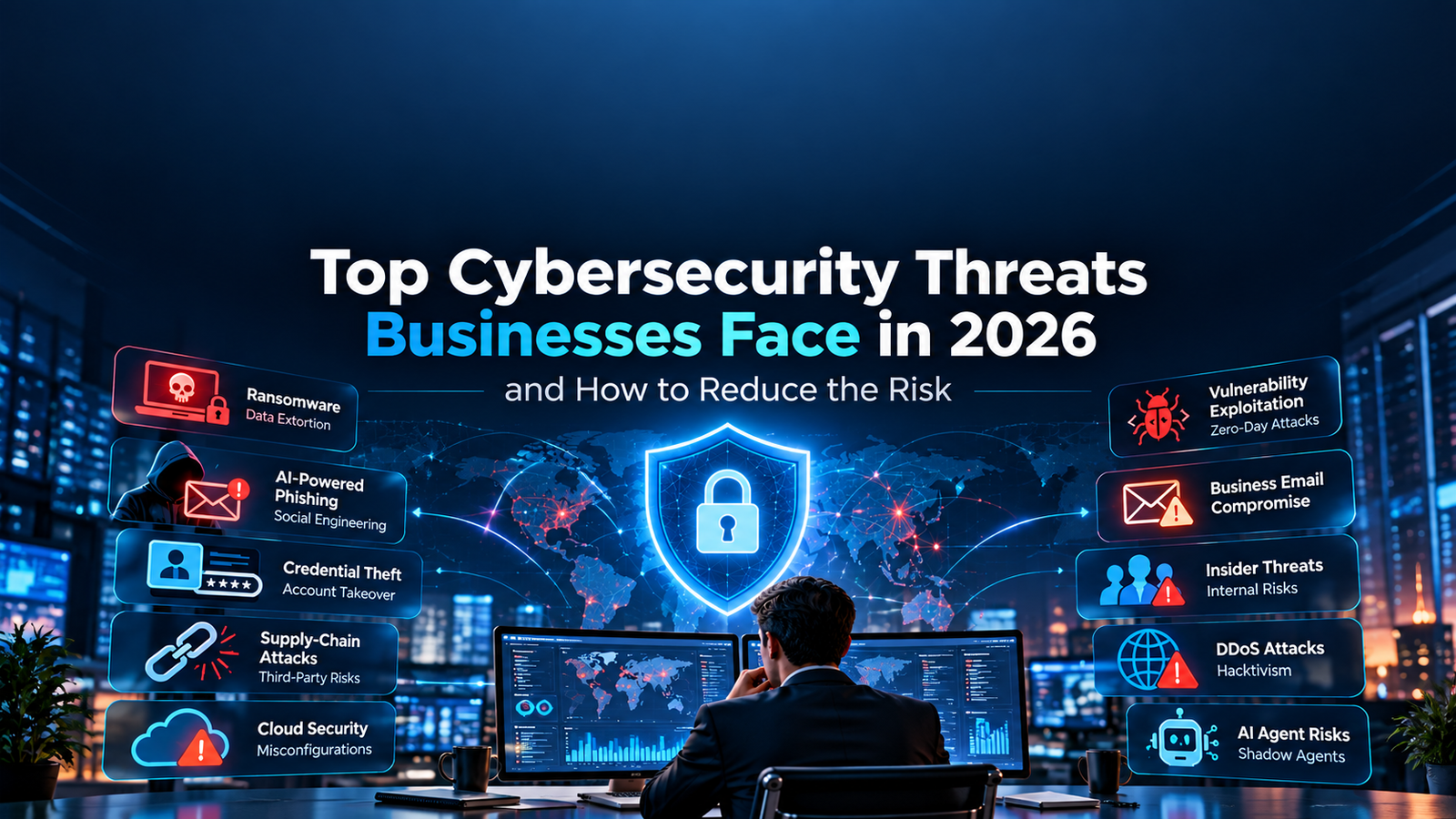
Cybersecurity Threats Businesses Face in 2026: Quick Overview
| Cybersecurity Threat | Primary Risk | Potential Business Impact | Important Defense |
|---|---|---|---|
| Ransomware and data extortion | Encryption, data theft, recovery denial | Downtime, financial loss, data exposure | Offline backups, EDR, segmentation |
| AI-powered phishing | Highly convincing social engineering | Credential theft, fraud, malware infection | Training, email security, phishing-resistant MFA |
| Credential theft | Stolen passwords, tokens, sessions | Account takeover, unauthorized access | Passkeys, MFA, identity monitoring |
| Supply-chain attacks | Compromised vendors or software | Large-scale indirect compromise | Vendor risk management, access controls |
| Cloud security threats | Identity abuse and misconfiguration | Data theft, account takeover | Least privilege, cloud monitoring |
| Vulnerability exploitation | Rapid exploitation of known or zero-day flaws | Initial access, ransomware, data theft | Fast patching and exposure management |
| Business email compromise | Impersonation and payment fraud | Direct financial loss | Payment verification procedures |
| Insider threats | Malicious or accidental internal actions | Data loss, sabotage, leakage | Least privilege, monitoring, separation of duties |
| DDoS attacks | Service disruption | Website and service outages | DDoS protection and redundancy |
| AI agent risks | Excessive permissions and autonomous actions | Data leakage, unauthorized actions | Agent identity, permission controls, monitoring |
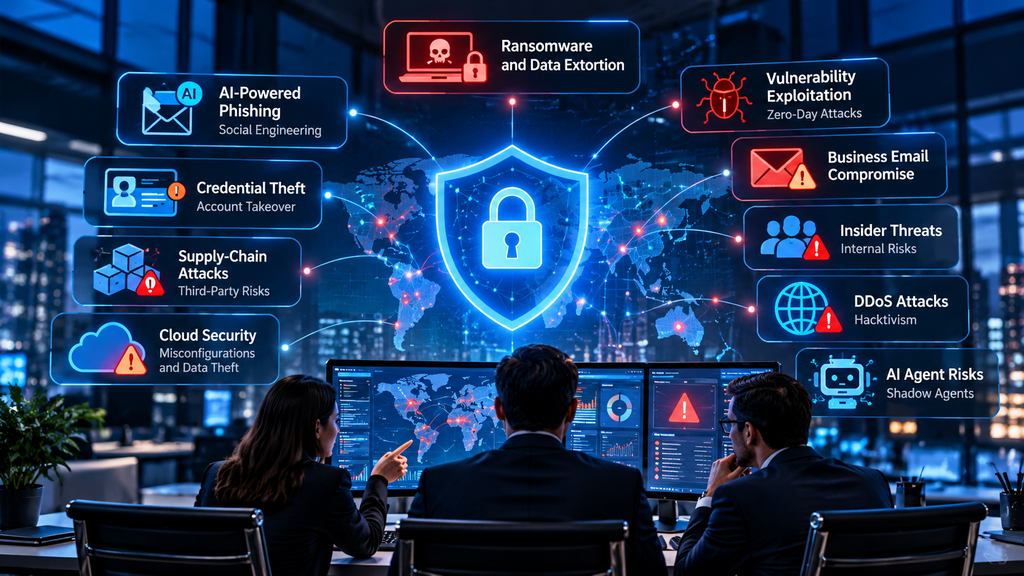
1. Ransomware and Data Extortion
Ransomware remains one of the most serious cybersecurity threats businesses face in 2026.
Modern ransomware attacks are increasingly about more than encrypting files. Attackers may steal sensitive information before encryption, threaten to publish it, target backup systems, disable security tools, compromise identity infrastructure, or attack virtualization environments.
This creates a form of multi-layered extortion in which an organization may face operational disruption even if it has copies of its data.
Mandiant’s 2026 threat research describes an increasing focus on what can be called recovery denial. Instead of simply encrypting endpoints, sophisticated attackers may target administrative systems, identity services, virtualization platforms, and backup infrastructure to make recovery significantly harder.
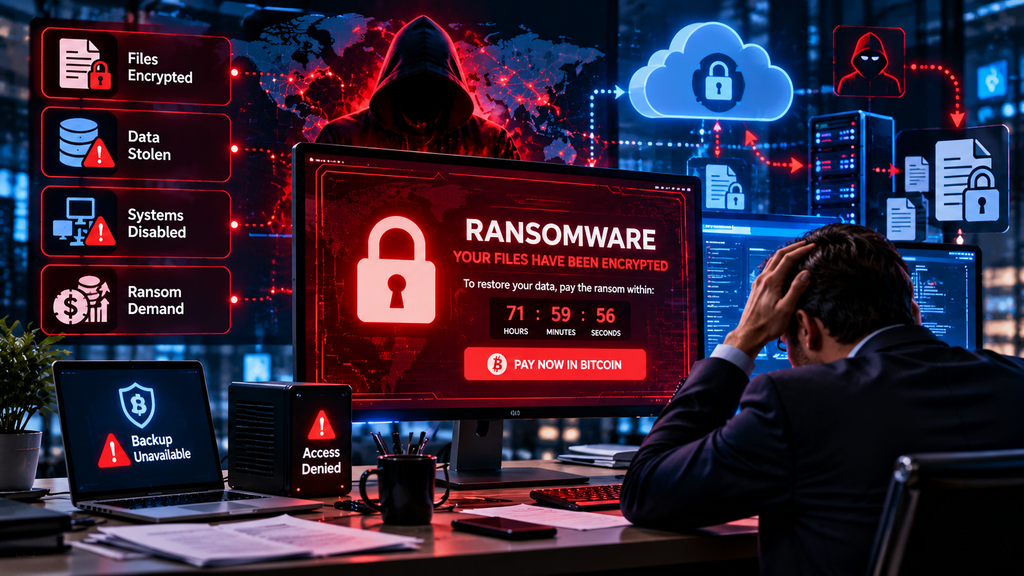
Why ransomware remains dangerous
Businesses may face:
- Extended operational downtime
- Loss of access to critical systems
- Theft of confidential information
- Regulatory and legal consequences
- Recovery and incident-response costs
- Damage to customer trust
- Pressure from double- or multi-extortion tactics
Small and medium-sized businesses are not immune. Attackers often target organizations with weaker security controls precisely because they may be easier to compromise.
How businesses can reduce ransomware risk
Use multiple layers of protection rather than relying on a single antivirus product.
Important controls include:
- Maintain tested offline or immutable backups.
- Use antivirus or endpoint protection tools alongside EDR where appropriate.
- Apply security updates quickly.
- Segment critical systems from ordinary user networks.
- Require strong authentication for administrative accounts.
- Restrict unnecessary remote access.
- Monitor unusual account and file activity.
- Test recovery procedures before an actual incident occurs.
Backups should also be protected as critical infrastructure. If attackers can delete or encrypt the backup environment, the organization may lose its most important recovery option.
2. AI-Powered Phishing and Social Engineering
Phishing is becoming harder to recognize as artificial intelligence improves the quality and scale of fraudulent communications.
Attackers can use generative AI to produce polished emails in multiple languages, imitate professional writing styles, research potential victims, create realistic fake support conversations, and generate convincing messages with fewer obvious spelling or grammar mistakes.
AI can also contribute to voice impersonation, synthetic media, and highly personalized social engineering.
The result is an important shift: employees can no longer assume that a professionally written message is legitimate.
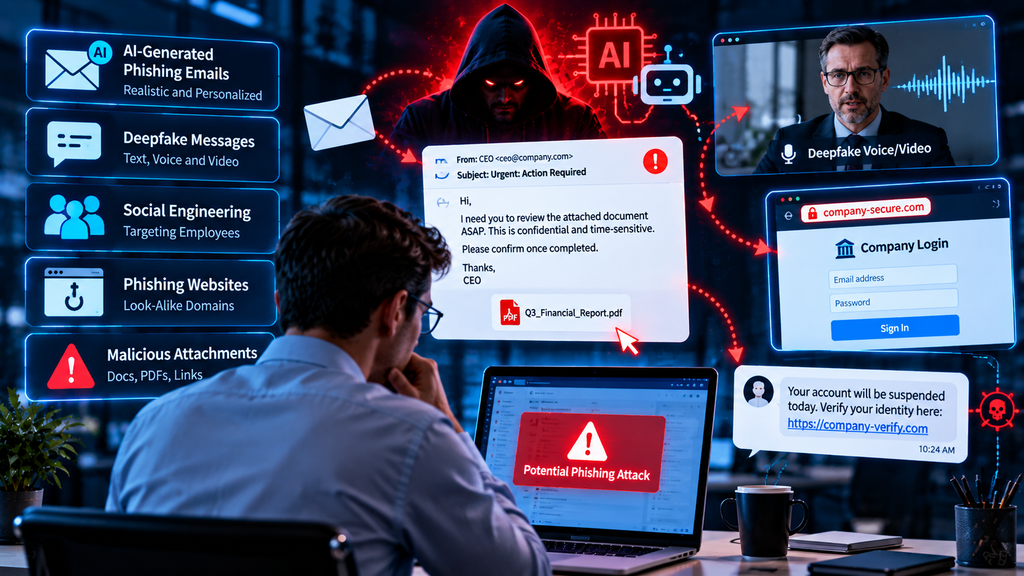
Common AI-assisted social engineering scenarios
Businesses should watch for:
- Fake executive requests
- Fraudulent supplier invoices
- Password-reset messages
- Cloud account warnings
- Fake Microsoft 365 or Google Workspace login pages
- IT help-desk impersonation
- Voice-based social engineering
- Deepfake audio or video
- Malicious QR codes
- Fake document-sharing notifications
How to reduce phishing risk
Employee training remains useful, but training alone is not enough.
Businesses should combine awareness with technical controls such as:
- Advanced email filtering
- Domain protection
- Phishing-resistant authentication
- Passkeys or hardware security keys
- Attachment and URL scanning
- Browser protection
- Verification procedures for financial requests
Employees should also be encouraged to verify unusual requests through a separate communication channel rather than replying directly to the suspicious message.
3. Credential Theft and Account Takeover
Passwords, authentication tokens, browser sessions, API keys, and administrative credentials are extremely valuable to attackers.
Once valid credentials are stolen, an attacker may be able to enter a system without triggering the same alerts generated by obvious malware.
This is particularly important as businesses depend on cloud applications such as email, collaboration platforms, CRM systems, storage services, accounting tools, and administrative dashboards.
Google Cloud’s 2026 Cloud Threat Horizons research found that identity-related weaknesses were involved in a large majority of investigated incidents affecting major cloud and SaaS environments.
How credentials are stolen
Common methods include:
- Phishing
- Infostealer malware
- Password reuse
- Credential stuffing
- MFA fatigue
- Session-cookie theft
- Help-desk social engineering
- Exposed API keys
- Compromised developer credentials
How to improve identity security
Businesses should:
- Use unique passwords.
- Deploy a trusted password manager.
- Require MFA for important accounts.
- Move toward passkeys or hardware security keys where supported.
- Disable unused accounts quickly.
- Separate administrator accounts from daily-use accounts.
- Monitor unusual sign-ins.
- Restrict access according to job role.
- Protect recovery methods and help-desk processes.
Authentication should be treated as a security layer of its own, rather than simply a login screen.
4. Supply-Chain and Third-Party Attacks
Modern businesses depend on a large ecosystem of external software vendors, cloud providers, contractors, payment processors, managed service providers, APIs, and open-source packages.
This creates dependencies that attackers can exploit.
Instead of attacking a well-protected company directly, an attacker may compromise a smaller supplier that already has trusted access to the target organization.
Verizon’s 2026 Data Breach Investigations Report highlights the growing importance of third-party and supply-chain exposure.
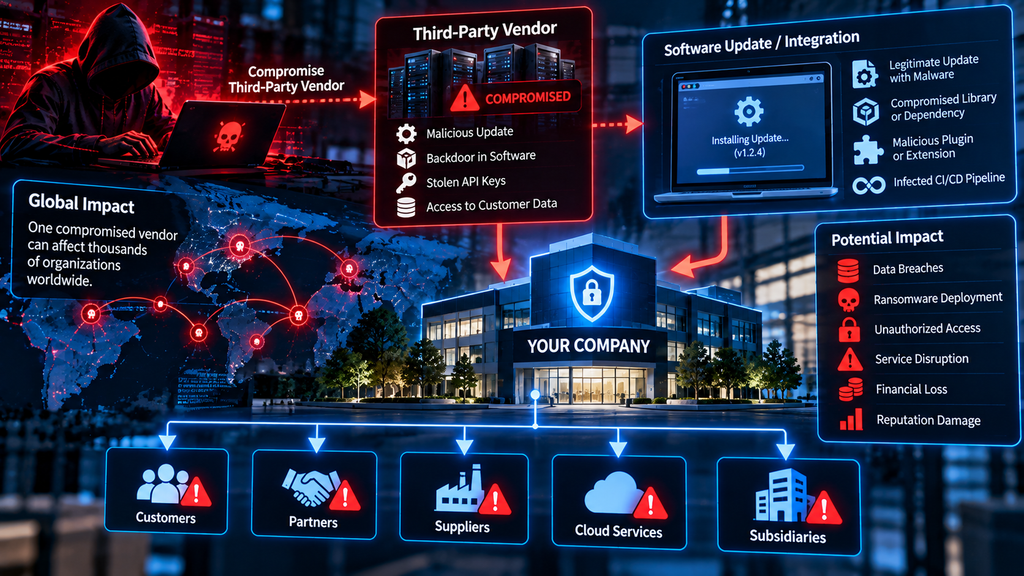
Why third-party risk is difficult
A business may carefully secure its own employees while still depending on:
- Vendor administrator accounts
- SaaS integrations
- Software updates
- API connections
- Managed service providers
- Contractors
- Open-source dependencies
- Cloud marketplaces
Compromise of one trusted service can potentially affect multiple customers.
How businesses can reduce supply-chain risk
Organizations should:
- Maintain an inventory of critical vendors.
- Review vendor access regularly.
- Limit third-party permissions.
- Require MFA for external administrators.
- Remove inactive integrations.
- Review security requirements during procurement.
- Monitor third-party access.
- Prepare procedures for quickly disabling a compromised service.
Third-party access should never remain broader than necessary simply because a vendor is trusted.
5. Cloud Security Misconfigurations and Data Theft
Cloud services have become central to business operations, but cloud security failures often involve identity, access control, configuration, or monitoring rather than a flaw in the cloud platform itself.
Attackers increasingly use legitimate credentials to access cloud environments and steal information through normal-looking channels.
Google Cloud’s H1 2026 Cloud Threat Horizons report found that data theft was a primary goal in many investigated cloud-related incidents.
Common cloud security problems
Examples include:
- Excessive administrator privileges
- Public storage buckets
- Weak API security
- Unmanaged service accounts
- Long-lived access keys
- Poorly protected SaaS accounts
- Lack of log monitoring
- Unused accounts that remain active
- Misconfigured sharing permissions
How businesses can reduce cloud risk
Use the principle of least privilege.
Employees, applications, contractors, and AI systems should receive only the access needed for their tasks.
Organizations should also:
- Enable centralized logging.
- Review cloud permissions regularly.
- Protect administrative accounts.
- Rotate or eliminate unnecessary access keys.
- Monitor large data transfers.
- Detect suspicious logins.
- Configure alerts for privilege changes.
- Separate production systems from development environments.
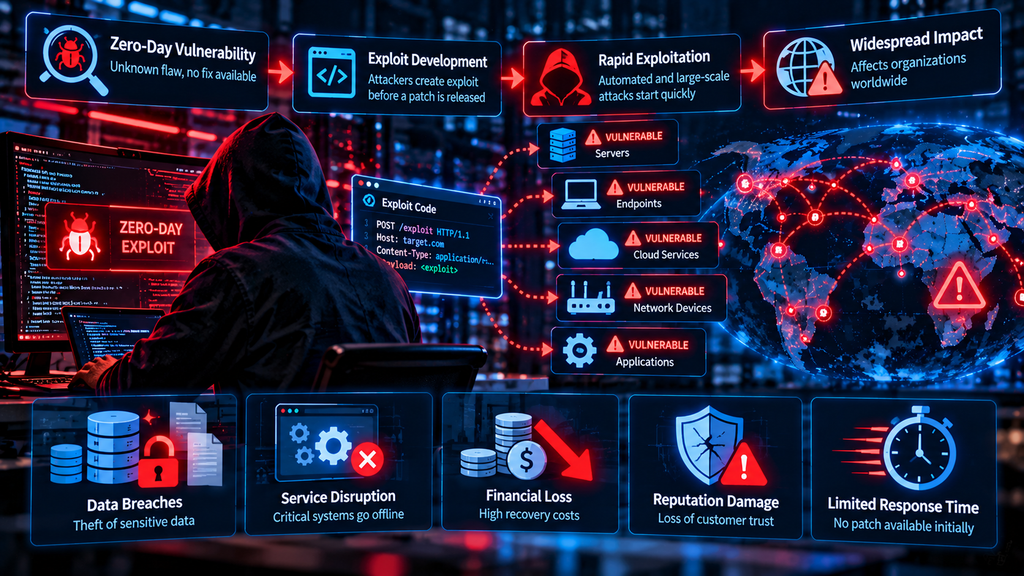
6. Zero-Day and Rapid Vulnerability Exploitation
Software vulnerabilities remain a major route into business networks.
What has changed is the speed.
The time between public disclosure of a vulnerability and active exploitation can be extremely short. Automation and AI-assisted reconnaissance may further reduce the window businesses have to respond.
Verizon’s 2026 DBIR reported that vulnerability exploitation became a leading initial entry method in the breaches it analyzed.
ENISA also reported a significant volume of newly published vulnerabilities during 2025 and continued exploitation of both known and previously unknown flaws.
Systems that deserve particular attention
Organizations should prioritize:
- Internet-facing servers
- VPN gateways
- Firewalls
- Remote-access systems
- Virtualization infrastructure
- Email servers
- Routers
- Network appliances
- Cloud management consoles
Attackers frequently target infrastructure that sits at the edge of the network because compromising it can provide broad access.
How businesses should respond
A good vulnerability program should include:
- Asset inventory
- Continuous vulnerability scanning
- Risk-based patch prioritization
- Removal of unsupported software
- Internet-exposure monitoring
- Emergency patching procedures
- Compensating controls when immediate patching is impossible
Businesses should not treat every vulnerability equally. Prioritize vulnerabilities that are exposed to the internet, actively exploited, or affect critical systems.
7. Business Email Compromise
Business Email Compromise, or BEC, is a form of fraud in which attackers impersonate executives, employees, suppliers, or business partners.
The objective is often not to install malware but to convince someone to send money, change bank details, disclose sensitive information, or approve an unauthorized transaction.
AI can make impersonation more convincing by improving language, personalization, and research.
Typical BEC scenarios
An attacker may:
- Impersonate a CEO requesting an urgent transfer.
- Send fake supplier bank-account changes.
- Compromise a real employee mailbox.
- Insert fraudulent payment instructions into an existing email conversation.
- Impersonate an attorney, customer, or contractor.
- Use voice impersonation to reinforce a fraudulent request.
How to reduce BEC risk
Financial controls are as important as technical controls.
Businesses should require independent verification for:
- Bank-account changes
- Large payments
- Gift-card requests
- New supplier payment details
- Unusual executive requests
Employees should never treat urgency as proof of legitimacy.
8. Insider Threats
Not every security incident begins with an external attacker.
Employees, contractors, administrators, and former staff can create cybersecurity risk either intentionally or accidentally.
An insider does not need to be malicious to cause serious damage. A legitimate employee may upload sensitive information to an unapproved AI service, send a document to the wrong recipient, misconfigure cloud storage, or fall victim to social engineering.
Insider risk can involve
- Unauthorized data copying
- Excessive access permissions
- Misconfigured systems
- Credential sharing
- Accidental disclosure
- Use of unapproved software
- Departing employees retaining access
- Malicious sabotage
Reducing insider risk
Businesses should:
- Follow least-privilege principles.
- Remove unnecessary permissions.
- Review privileged access.
- Monitor unusual data movement.
- Disable accounts promptly when staff leave.
- Separate sensitive responsibilities.
- Establish clear data-handling policies.
- Provide employees with approved alternatives to shadow IT and shadow AI tools.
The goal should not be constant surveillance of employees. It should be reducing unnecessary access and identifying unusually risky activity.
9. DDoS and Hacktivist Attacks
Distributed Denial-of-Service attacks attempt to overwhelm websites, applications, or network services with traffic so legitimate users cannot access them.
The ENISA Threat Landscape 2026 shows that DDoS activity remains extremely common, particularly in campaigns linked to geopolitical events and hacktivism.
Many attacks may be relatively short or limited in impact, but businesses that depend heavily on online availability can still suffer significant disruption.
Organizations at higher risk include
- Online retailers
- Financial services
- Media companies
- Technology platforms
- Transportation services
- Government contractors
- Organizations involved in politically sensitive sectors
How to reduce DDoS risk
Businesses should consider:
- DDoS mitigation services
- Content delivery networks
- Rate limiting
- Redundant infrastructure
- Traffic filtering
- Incident-response procedures
- Monitoring unusual traffic patterns
Availability should be part of cybersecurity planning, not just infrastructure planning.
10. AI Agent and Shadow Agent Risks
One of the newest cybersecurity challenges in 2026 comes from autonomous and semi-autonomous AI agents.
AI agents can perform tasks, access applications, retrieve data, call APIs, generate code, interact with business systems, and act on behalf of employees.
This capability is useful, but it creates a new security question:
What happens when an AI agent has too much authority?
Google Cloud’s 2026 security forecast highlights the emergence of Shadow Agent risks—the uncontrolled use of AI agents without sufficient governance, authentication, monitoring, or permission boundaries.

Potential AI-agent risks include
- Excessive permissions
- Sensitive-data exposure
- Prompt injection
- Unauthorized actions
- Unsafe API access
- Poor auditability
- Compromised plugins or integrations
- Agents acting on incorrect instructions
- Employees deploying unapproved AI automation
How businesses should secure AI agents
Organizations should treat AI agents much like other privileged identities.
Each agent should have:
- A defined identity
- Limited permissions
- Approved data access
- Logging
- Authentication controls
- Human approval for high-risk actions
- Monitoring for abnormal behavior
Businesses should avoid giving a single autonomous agent unrestricted access across email, financial systems, cloud infrastructure, and sensitive databases.
How Businesses Can Reduce Cyber Risk in 2026
Cybersecurity works best as a layered strategy.
A broader set of cybersecurity tools can help cover identity, browsing, network, and device protection
No single product can eliminate all of the threats described above.
Businesses should focus on several fundamental areas.
1. Strengthen identity security
Require MFA, passkeys, or hardware security keys for sensitive accounts.
Protect administrative identities especially carefully.
2. Maintain resilient backups
Use multiple backup copies and ensure attackers cannot easily delete all of them from the same administrative environment.
Regularly test recovery.
3. Patch exposed systems quickly
Prioritize internet-facing systems and vulnerabilities known to be actively exploited.
4. Protect endpoints
Use appropriate endpoint security, antivirus, or EDR tools and keep them updated.
5. Segment networks
A compromised employee device should not automatically provide access to every critical system.
6. Train employees
Training should cover phishing, impersonation, payment fraud, credential theft, AI-generated scams, and safe handling of sensitive data.
7. Secure cloud and SaaS accounts
Review permissions and monitor account activity.
8. Control third-party access
Remove unused vendor accounts and restrict integrations.
9. Govern AI use
Define which AI tools employees may use and what types of data they may upload.
Include AI agents in identity and access-management policies.
10. Prepare for incidents
Organizations should have a documented incident-response plan defining who is responsible for technical containment, legal decisions, communications, backups, recovery, and customer notifications.
Cybersecurity Checklist for Businesses in 2026
Use the following checklist as a starting point:
- MFA enabled for important accounts
- Passkeys or hardware security keys considered for privileged users
- Unique passwords stored in a password manager
- Offline or immutable backups maintained
- Backup recovery tested
- Antivirus or endpoint protection deployed
- Internet-facing systems inventoried
- Critical patches applied promptly
- Cloud administrator accounts protected
- Third-party access reviewed
- Departed employee accounts disabled
- Email fraud verification procedures established
- Employees trained on phishing and social engineering
- Sensitive data classified and access restricted
- DDoS protection evaluated
- AI usage policies documented
- AI agents monitored and permission-limited
- Incident-response plan tested
Frequently Asked Questions About Cybersecurity Threats in 2026
What is the biggest cybersecurity threat to businesses in 2026?
There is no single threat that affects every organization in the same way. However, ransomware remains particularly disruptive because attacks can combine data theft, encryption, extortion, and attempts to prevent recovery.
Identity compromise, vulnerability exploitation, third-party access, and phishing are also major routes into business systems.
Is ransomware still a serious threat in 2026?
Yes. Ransomware remains an important business risk, but attacks increasingly extend beyond file encryption. Some groups target backups, identity systems, virtualization platforms, and sensitive data to increase pressure on victims.
How is AI changing cyberattacks?
AI can help attackers scale reconnaissance, phishing, translation, impersonation, and parts of malware development. It can also improve the speed at which attackers analyze potential targets.
At the same time, security teams are using AI to improve detection, investigation, automation, and response.
Are small businesses targeted by cybercriminals?
Yes. Smaller businesses may have fewer security resources and can also serve as a pathway to larger customers through supply-chain relationships.
Basic security controls such as MFA, backups, patching, endpoint protection, and employee awareness can significantly reduce common risks.
Can antivirus software protect a business from all cyber threats?
No.
Antivirus and endpoint security are valuable layers, but they cannot prevent every phishing attack, stolen credential, cloud misconfiguration, insider incident, payment fraud, supply-chain compromise, or DDoS attack.
Businesses need multiple security layers.
Should businesses use passkeys instead of passwords?
Passkeys can significantly reduce traditional password-related risks and phishing when supported by the service.
Organizations should consider passkeys and hardware security keys particularly for administrators, executives, and accounts protecting sensitive information.
Do businesses need a VPN in 2026?
A VPN can help protect network traffic in appropriate situations, particularly when employees connect from untrusted networks or when organizations use controlled remote-access infrastructure.
However, a VPN should not be treated as a replacement for identity security, endpoint protection, or zero-trust access controls.
How often should a business review its cybersecurity strategy?
Cybersecurity should be reviewed continuously, with formal assessments at regular intervals and whenever the organization introduces major new technologies, cloud platforms, suppliers, AI systems, or business processes.
Final Thoughts
The cybersecurity threats businesses face in 2026 reflect a larger change in how organizations use technology.
Businesses are more connected to cloud services, vendors, remote employees, mobile devices, APIs, and AI systems than ever before. Those technologies provide significant benefits, but each connection can also create new security dependencies.
Ransomware, credential theft, phishing, vulnerability exploitation, supply-chain compromise, cloud attacks, and DDoS activity remain important threats. AI now adds another layer by helping attackers scale certain operations while also introducing new risks through autonomous agents and uncontrolled enterprise AI use.
Businesses do not need perfect security to become significantly harder to attack.
Strong authentication, reliable backups, rapid patching, endpoint protection, employee awareness, limited privileges, cloud monitoring, third-party controls, and a tested incident-response plan can dramatically improve resilience.
The most effective cybersecurity strategy in 2026 is therefore not based on one security product. It is based on layers of protection that help prevent attacks, detect suspicious activity quickly, limit the damage when something goes wrong, and restore business operations safely.
Sources
- ENISA — ENISA Threat Landscape 2026. European Union Agency for Cybersecurity, 2026.
- Google Cloud / Mandiant — M-Trends 2026. Annual analysis of cyber intrusion trends, ransomware activity, identity attacks, and incident response findings.
- Verizon — 2026 Data Breach Investigations Report (DBIR). Analysis of global security incidents, confirmed breaches, vulnerability exploitation, and third-party risk.
- Google Cloud Security — Cloud Threat Horizons Report, H1 2026. Research covering cloud identity compromise, data theft, vulnerability exploitation, and SaaS security risks.
- Google Cloud Security — Cybersecurity Forecast 2026. Analysis of emerging security trends including AI-powered attacks, AI agents, Shadow Agents, identity security, and evolving threat activity.